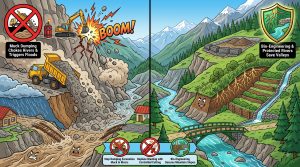
The Flying Dhaba: Why Blasting the Himalayas is a Recipe for Structural Collapse: Santa thinks dynamic slope-cutting and dumping construction muck into rivers is economic progress. Banta drops a brutal hydrological check based on 160 documented slope failures along the Char Dham route, explaining why traditional bio-engineering beats concrete when saving mountain lifelines.
Landslide
The Hungry Land of the Forgotten Terraces
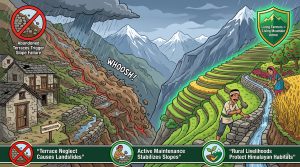
Himalayan agricultural terraces function as vital, engineered slope-stabilization structures that depend entirely on continuous maintenance by local communities. The accelerating decay of these dry-stone retaining systems due to rural outmigration transforms once-stable slopes into severe landslide hazards during heavy monsoon downpours. Revitalizing agrarian livelihoods is not merely an economic imperative, but a fundamental ecological defense required to sustain the human custodianship necessary for stabilizing vulnerable mountain landscapes.
The Crushed Dam and the Sleeping Monster
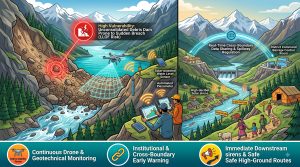
The Deadly Illusion of the Mountain Lake: Santa thinks a landslide blocking a river has gifted his village a scenic swimming pool. Banta exposes the terrifying physics of Landslide Lake Outburst Floods (LLOFs) and outlines the vital cross-boundary data networks required to save downstream infrastructure from sudden, catastrophic breaches.
The Mountain’s Broken Straw and the Empty Spring
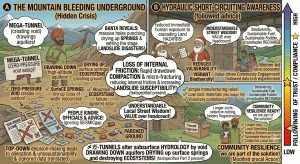
The Mountain Bleeding Underground: Santa thinks a new railway tunnel is pure engineering progress, but Banta reveals a hidden geological crisis. Discover the science of “Hydraulic Short-Circuiting” and why punching massive holes through the Himalayas is drying up surface springs while setting the stage for deep-seated landslide disasters.
The Tilted Layers of Barfi and the Limit of Greed
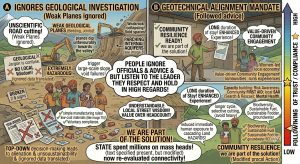
Rushing road alignments through the Himalayas without deep geological and geotechnical investigations invites structural failure, particularly when cutting slopes where weak geological planes dip unfavorably toward the valley. True mountain safety requires us to establish a scientific consensus on non-negotiable “no-go” zones and re-evaluate the assumption that every single settlement must have road connectivity, shifting instead toward a holistic approach that respects strict geographical constraints.
Santa’s Free Topsoil and Banta’s Mountain’s Unwanted Gift
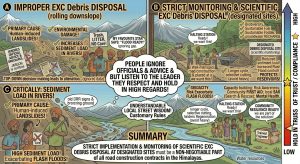
Stopping the Downslope Avalanche: The Crisis of Unscientific Muck Dumping – Dumping excavated debris directly downslope transforms infrastructure projects into environmental hazards, triggering new, human-induced landslides and choking river systems with high sediment loads. To mitigate the rising destructiveness of flash floods and safeguard reservoir lifespans, strict monitoring and execution of scientific debris disposal at designated sites must be an absolute, non-negotiable clause in every Himalayan road construction contract.
The Cannon on the Slope and the Infrastructure Overload
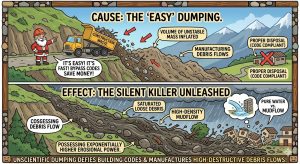
Manufacturing the Next Mudflow: Santa thinks pushing road-widening debris over the cliff is a smart, cost-effective way to clear a construction site. Banta drops a heavy truth bomb on how unscientific waste disposal interacts with climate-induced cloudbursts to create deadly, high-velocity debris flows.
The ‘Lego’ Mountain and the Invisible Blanket
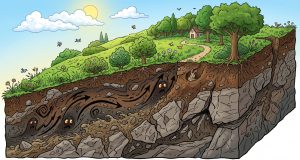
The Blind Spot of Space-Age Maps: Santa thinks his house is safe because a satellite labeled his zone as “solid bedrock.” Banta reveals why modern GIS and Remote Sensing maps miss the invisible, loose debris hiding underneath the grass—the exact material that turns a monsoon into a tragedy.
The Danger of the “Silent” Slope: The Map with the Blind Spot
Generic hazard maps often fail to account for recent human-induced changes. Site-specific risk assessment is therefore mandatory for major infrastructure projects in the Himalayas as reactivation of old, dormant landslides is a major threat to human settlements that requires detailed geological mapping.
The “Lazy” Hill and the Big Surprise

A slope that has been quiet for decades isn’t necessarily safe; it may just be dormant. The first initiation of a landslide after a long period of silence is often the most catastrophic, catching communities entirely off guard. Discover how aggressive human interventions, such as reckless hill-cutting and heavy construction, can “infuse” instability into ancestral slopes, turning a peaceful mountain into an active hazard zone.