
The Frozen Trap: Why Satellites Need Ancestral Wisdom to Read Himalayan Ice: Santa attempts to dispatch eighty commercial trekkers onto a frozen river trek based on a clear satellite radar reading. Banta and a local indigenous herder halt the expedition, proving how traditional early warning indicators detect subsurface ice fractures hours before advanced automated software can register the hazard.
Traditional knowledge
The Broken Pot and the Wisdom of the Ancestors
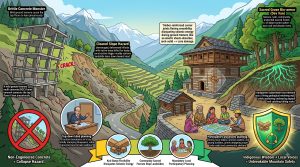
The Architecture of Resilience: Why Modern Glass Fails Where Timber Wins: Santa wants to replace an ancient mountain timber structure with a shiny glass commercial mall. Banta and the village elders intervene with the science of Koti Banal engineering, proving how traditional ecological knowledge (TEK) creates structures that survive Himalayan tremors.
The Expanding Bathtub on the Roof of the World
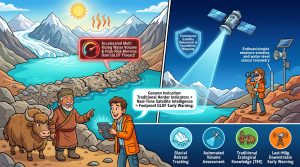
The Overflowing Bathtubs of the Himalayas: Santa sees expanding glacial lakes as a prime real estate opportunity for boating resorts. Banta shatters the illusion, diving into the terrifying mechanics of Glacial Lake Outburst Floods (GLOFs) and outlining the critical three-pronged strategy of volumetric mapping, international data sharing, and indigenous safety drills.
The Sky is Full of Micro-Climates
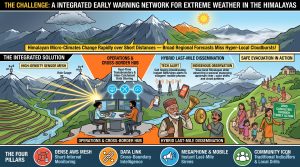
The Myth of the 50-Kilometer Weather Forecast: Santa thinks his orchard is safe because a distant weather app reads “light drizzle.” Banta drops a localized truth bomb on why Himalayan catchments require high-density, short-distance monitoring to detect flash floods before they strike. Learn the three-pronged strategy for precipitation resilience.
Santa’s “Forbidden Stone” and the Mason’s “Cement Confusion”
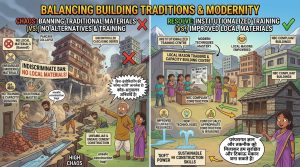
Outlawing traditional building materials without providing viable alternatives forces communities into unfamiliar construction techniques, compromising structural safety. Sustainable housing resilience requires blending time-tested local resources with modern materials, supported by institutional training for regional masons.
The “Imported Water Pump” that Gathered Dust, and the “Wise Old Spring”
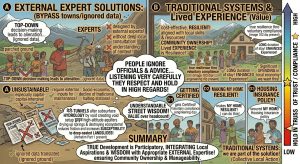
Beyond Capital-Intensive Jargon: The Power of Lived Experience
Top-down, capital-intensive solutions designed by external experts without deep local consultation often prove unsustainable, quickly falling apart when external inputs dry up. True Himalayan resilience depends on the “lived experience” embedded within the local socio-ecological fabric. Traditional systems, developed over generations, are inherently more cost-effective, resilient, and aligned with local skills and resources. Achieving lasting safety requires a deeply participatory approach—one that integrates local knowledge and community aspirations with appropriate modern technologies to ensure true local ownership and manageability.
Santa’s “Quick Fodder” Fix vs. Banta’s “Tree’s Lifespan” Logic
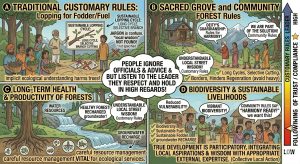
Long before modern environmental governance, traditional mountain communities practiced a highly sophisticated form of resource management. Through customary laws regulating tree lopping for fodder and fuel—especially within sacred groves—they protected their ecosystems from over-exploitation. They intuitively understood that aggressive cutting disrupts forest regeneration, stunts seed production, and degrades the land.
By enforcing selective branch-cutting and resting cycles, these ancestral rules preserved the forest’s long-term health. This wasn’t just about resource conservation; it was a foundational disaster risk reduction strategy. Healthy, un-degraded forests maintain critical ecological services—such as stabilizing slopes, anchoring soil, and facilitating groundwater recharge—creating natural safety nets against climate-induced hazards.
The “Words for Each Floor” and Banta’s Layered Wisdom

The existence of distinct local dialect terms for every floor in traditional Himalayan houses proves that multi-storied construction was a common, culturally integrated practice. This linguistic heritage underscores a widespread, ancestral mastery of sophisticated earthquake-resistant techniques, validating the depth of indigenous resilience wisdom.
The “Breathable Walls” and the “Pinning” Beams
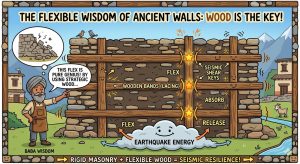
Ever wonder why those ancient wooden-framed buildings still stand after all this time? It’s not just luck; it’s a centuries-old masterclass in disaster resilience, using a simple but powerful tool: wood. Our latest deep dive into seismic performance uncovers the ingenious ways traditional builders turned wood into the backbone of earthquake resistance, a wisdom we ignore at our own peril in modern construction.
Santa’s “Nail-It-Quick” Fix vs. Banta’s “Interlocking Embrace”

Traditional wooden joinery in the Himalayan region involved intricate housed joints in addition to nailing creating stronger, more rigid connections that distributed forces effectively, enhancing the structure’s ability to resist earthquake shaking without easily loosening or pulling apart.