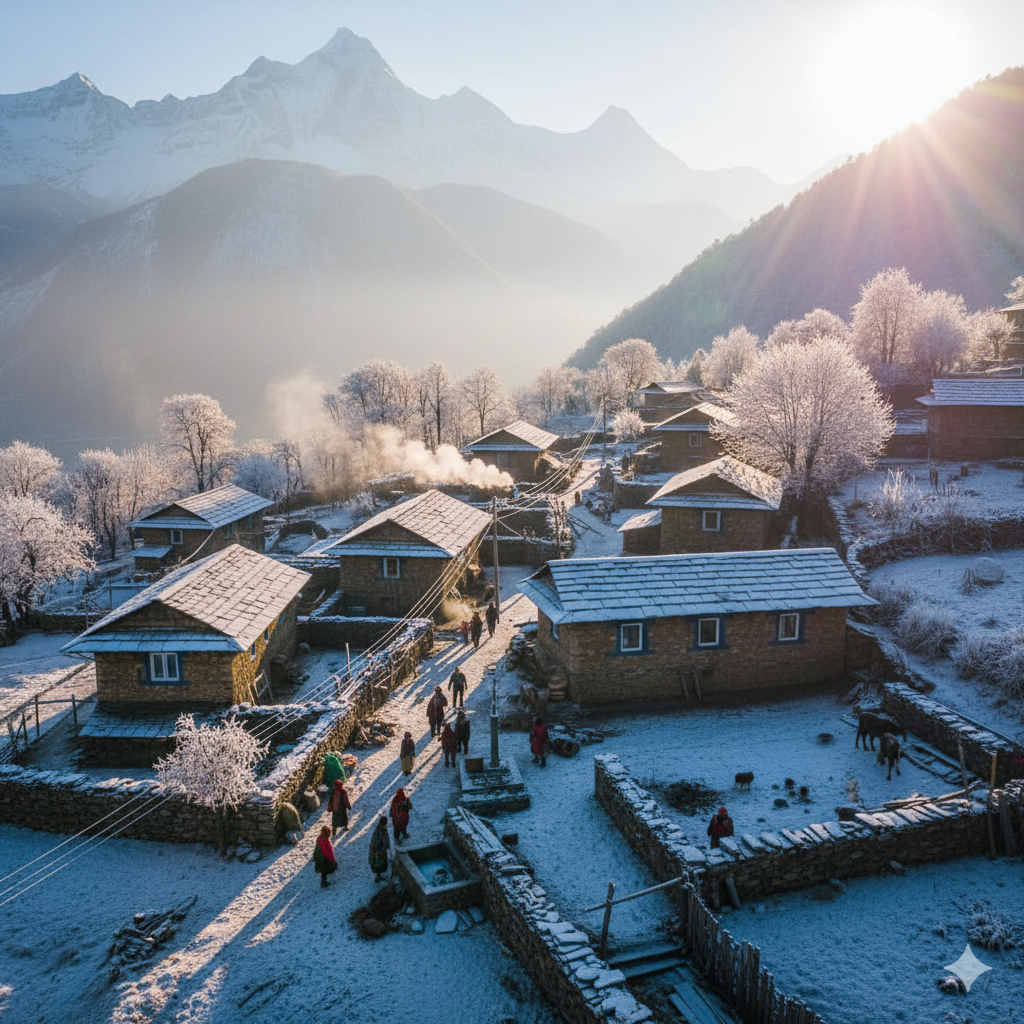
 Primary Focus: Himalayan and Indian Subcontinent Regions
The subcontinent is focused on the devastating aftermath of the Cyclone Ditwah catastrophe, with a deepening cold wave across the North and chronic vulnerabilities exposed in the Himalayan region.
Sri Lanka Catastrophe: Cyclone Ditwah Recovery (Humanitarian/Financial Disaster)
The massive recovery operation following Cyclone Ditwah remains the most critical incidence, highlighting the financial and humanitarian fragility of the island nation.
The United Nations Development Programme (UNDP) confirms that the cyclone inundated 1.1 million hectares (20% of Sri Lanka’s landmass) and directly exposed 2.3 million people to flooding. The physical impacts are compounded by deep pre-existing vulnerabilities, with over half of the people in flooded areas already facing chronic socioeconomic fragilities (unstable income, high debt) before the storm hit.
Grid power has been restored to the Eastern Province after approximately one week, and essential supplies are resuming. However, the rebuilding costs are poised to severely strain the nation’s fragile economic recovery, compelling the government to restructure its recovery agenda, potentially exceeding IMF expenditure limits. International aid and “disaster diplomacy” from the US, China, and India are playing a crucial role in clearing blocked highways and restoring critical infrastructure.
Himalayan Cold Wave & Infrastructure Fire
The Cold Wave is the primary disaster incidence in the North today.
Temperatures in Srinagar, Jammu and Kashmir, have dropped to 0.4o C and dipped to sub-zero levels earlier this month, forcing residents to seek warmth through firewood. Amidst this biting cold, a fire broke out in several shops and a furniture godown in the Munwarabad area of Srinagar on Sunday, requiring a rapid response from fire and emergency teams to prevent a larger catastrophe.
These cold wave conditions pose a major health risk to vulnerable populations and highlight the infrastructural vulnerability (e.g., electrical short circuits) common in extreme winter weather.7
Major Disasters in Other Areas Globally
Asia Floods of 2025
The entire region has faced catastrophic flooding, with over 1,600 confirmed deaths across Sri Lanka, Indonesia, Thailand, Malaysia, the Philippines, and Vietnam, caused by an erratic northeast monsoon strengthened by intense cyclones (Ditwah, Kalmaegi, Senyar).
Industrial Disaster Anniversary
Tomorrow (December 11) is the 20th anniversary of the Buncefield fire in Hemel Hempstead, UK, which was the largest peacetime fire in Europe and caused significant localized damage and disruption.
DRR & CCA Conferences, Workshops, and Reports
Vulnerability Assessment
The UNDP’s detailed assessment of Cyclone Ditwah integrating satellite-derived flood mapping, landslide data, and Multidimensional Vulnerability Index (MVI) is a critical development in DRR. It helps identify communities where disaster impacts intersect with chronic socioeconomic fragilities.
Climate Finance Debate
The economic and welfare necessity of restructuring Sri Lanka’s recovery agenda underscores the global debate on Loss and Damage (L&D) finance. Climate disasters are forcing poor nations to forgo revenue targets and spend more on welfare and capital investment.
Gender-Sensitive Disaster Response
A focus area in today’s political discussions was the demand for accessible gender-sensitive mental health facilities for trauma survivors, recognizing the often-overlooked psychological dimension of disasters.
Ongoing Climate Change Concerns and Incidences
Climate and Economic Stability
Cyclone Ditwah struck Sri Lanka when its economy was about to take off from a fragile macroeconomic stability, forcing the government to forego revenue targets and increase spending. This highlights how a single climate disaster can trigger a major economic setback and threaten stability in vulnerable nations.
Accelerating Warming Trend
The persistent intensity of cyclones like Ditwah is directly linked to the accelerating global warming trend and warmer oceans, which provide fuel for more intense storms.
Black Carbon & Air Quality
The fire incidence in Srinagar, amid the cold wave, is a reminder of the recurring risks posed by domestic heating methods and infrastructure failures, which contribute to the harmful Black Carbon emissions in the Himalayan region.
Historical Disasters, Wars, and Other Incidencees on 10 December
1948 – Universal Declaration of Human Rights
The United Nations General Assembly adopted the Universal Declaration of Human Rights, a foundational document in international law.
1901 – First Nobel Prizes Awarded
The first Nobel Prizes were awarded in Stockholm, Sweden, in chemistry, literature, medicine, peace, and physics.
1898 – Spanish-American War Ends
The Treaty of Paris was signed, officially ending the Spanish-American War. Spain ceded Cuba, Puerto Rico, and Guam to the U.S.
1996 – South African Constitution
The current Constitution of South Africa was adopted, a pivotal event in the country’s post-apartheid history.
These vignettes—from mine shafts to smog—paint a tapestry of recurring themes: exploitation, neglect, and the slow march toward resilience. They echo today, as climate-amplified events blur the lines between natural and human-made calamities.
Stay vigilant; history whispers warnings.
यह हमारा एक छोटा सा प्रयास हैं, आपको हर दिन आपदा से जुड़ी नवीनतम जानकारियाँ प्रदान करने का –
विशेष रूप से वह आपदायें जो हिमालय व अन्य पहाड़ी क्षेत्रों में घटित हों.
हमारा यह प्रयास आपको कैसा लगा और कैसे हम इसे बेहतर व उपयोगी बना सकते हैं ?
हमेशा की तरह आपके सुझावों का हमें इंतजार रहेगा.
Leave a Reply