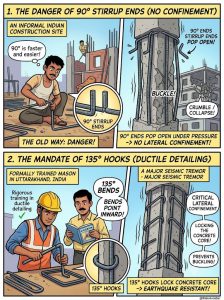
The Untied Shoelace – Why 90-Degree Stirrups are Killing Indian Buildings: Santa cuts corners on his steel column reinforcement by bending stirrup hooks at a lazy 90-degree angle. Banta uses a structural demonstration to prove how skipping the mandatory 135-degree inward hook allows columns to burst open during a seismic tug-of-war, exposing a critical training gap among local builders.
Santa Banta
The ‘Dhaba’ Batter and the Hydration Hiss
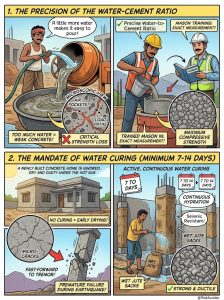
The Samosa Batter Blueprint: How Untrained Masons are Watering Down India’s Safety: Santa thinks adding extra water to his concrete mix is a smart shortcut to save labor. Banta drops a heavy material-science diagnostic, proving why incorrect mix ratios and neglecting water curing turn modern concrete buildings into brittle death traps.
The Tale of the Sagging Floor and the “Murda Mitti” Warning
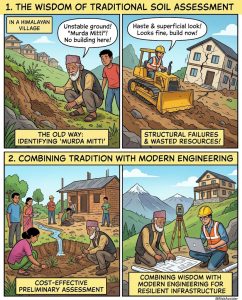
Centuries of indigenous Himalayan wisdom, such as identifying structurally compromised “murda mitti” through subtle surface indicators, offered robust, low-cost ground stability assessments long before modern soil testing existed. Disregarding these empirical site-selection traditions in the rush for rapid development invites avoidable structural collapse, reminding us that combining time-tested local knowledge with modern engineering is essential for building truly resilient mountain infrastructure.
The IoT River Guardian and the Parametric Paycheck
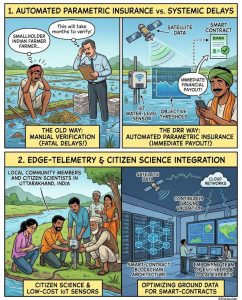
The Autonomous Payout: How IoT Sensors and Smart Contracts are Saving Indian Farmers: Santa struggles with a mountainous pile of manual crop-damage paperwork, leaving flooded farmers in deep economic distress. Banta deploys a solar-powered IoT river-level sensor to demonstrate how parametric insurance smart contracts automate immediate financial recovery, depositing payouts in 48 hours without a single form.
The Category 5 Landfall and the WeatherNext Revolution
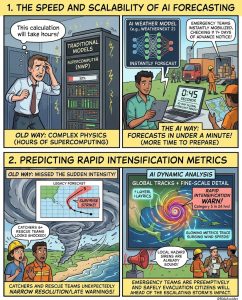
Sprinting Ahead of the Cyclone: How DeepMind’s AI Outruns Supercomputers: Santa waits for hours as roaring supercomputers solve physics equations to track a Category 5 storm. Banta deploys Google DeepMind’s WeatherNext 2 platform to prove how deep learning architecture generates a complete global ensemble weather forecast in under sixty seconds, providing unprecedented lead times for emergency evacuations.
The Project Sunny Lives Shield and the U-Net Matrix
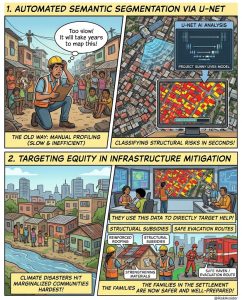
Planetary Intelligence for the Chawls: How U-Net AI Maps Slum Vulnerability: Santa spends weeks using a magnifying glass on paper maps to count vulnerable informal houses. Banta introduces the AI-driven Project Sunny Lives framework, demonstrating how U-Net deep neural networks scan satellite imagery to classify structural risks across thousands of low-income homes in under a minute.
The Disappearing Debris and Banta’s River of Rocks Prophecy
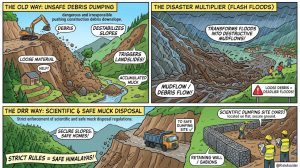
Unregulated downslope dumping of road construction debris turns our mountain highways into active disaster incubators. By overloading fragile slopes and feeding high-velocity debris flows during monsoon downpours, this short-sighted disposal practice transforms manageable rainfall into catastrophic slope failures—making scientific muck management non-negotiable for Himalayan infrastructure.
The Groundsource Sieve and the Invisible Flash Flood
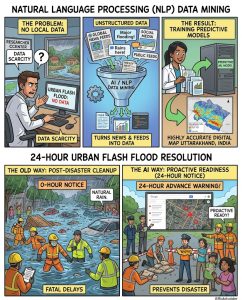
Mining the News to Stop the Flood: How Gemini-Driven Datasets Predict Flash Floods: Santa relies on manual paper logs to track urban drainage risks, believing sudden flash floods leave no historical patterns. Banta deploys the revolutionary AI-driven Groundsource methodology to show how scanning twenty years of unstructured news reports creates a predictive grid that warns of urban flash floods 24 hours in advance.
The Seven-Day Oracle and the Disbelieving Dhaba
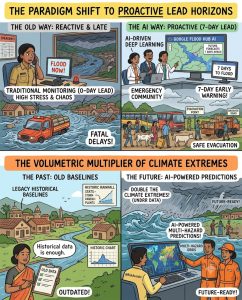
The 7-Day Digital Oracle: How Deep Learning AI Outsmarts Himalayan Floods: Santa ignores an urgent flood advisory because the river outside his highway eatery looks perfectly calm. Banta deploys real-time AI-driven hydrological forecasting models to prove how machine learning calculates volumetric peak discharges days before the cloudburst water hits, transforming emergency response timelines.
The Magic Alarm Clock and the Leaky Roof
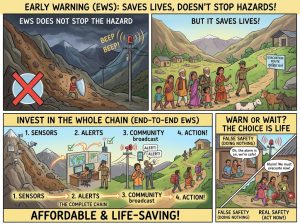
An Early Warning System cannot stop a hazard, but an informed community can stop it from turning into a tragedy. Investing in reliable, end-to-end warning networks saves lives only when people understand their limits—treating alerts as a trigger for rapid evacuation rather than a guarantee that the threat has been averted.