 Santa was standing on a newly constructed concrete tower overlooking a roaring Himalayan riverbank in Uttarakhand.
He was proudly polishing a massive, shiny metallic satellite dish connected to an array of automatic rain gauges, discharge sensors, and digital transmitters.
“Oye Banta, look at this!” Santa beamed, patting a flashing blue computer screen.
“This is our new ‘Supersonic Hydro-Meteorological Early Warning Matrix.’”
“It cost crores of rupees!”
“It tracks atmospheric circulation, measures river discharge to the milliliter, and transmits data in real-time straight to a supercomputer.”
“Climate change can bring all the cloudbursts it wants—this high-tech beauty will save us all!”
Banta walked up the tower stairs, holding a rusty hand-cranked megaphone and a bucket of water.
He looked at the flashing lights, then pointed to the crowded village bazaar down in the valley where children were playing and shops were bustling.
“Santa-ji, this dish looks very beautiful,” Banta said quietly.
“But tell me, when that supercomputer detects a flash flood upstream, how exactly does the warning reach the shopkeeper who is frying samosas down there?”
Santa blinked, tapping his chin.
“Uh… well… the computer sends an automated high-priority email to the department head in the state capital.”
“Then, the department head verifies the telemetry, coordinates with the oceanic circulation database, and issues a formal warning notification on our official web portal!”
Banta shook his head and threw a stone into the river.
“Santa, a warning is only as good as its weakest link—the dissemination.”
“By the time your department head logs in and updates the portal, the river will have already washed the samosas, the shop, and the shopkeeper down to Haridwar!”
“You are trapped in a high-tech illusion.”
“No state agency has the infrastructure or analytical manpower to translate global atmospheric equations into real-time village street actions.”
“You’ve spent crores buying a giant siren, but you haven’t given anyone in the village the key to turn it on, nor have you taught them where to run when it sounds!”
Santa looked down at the village, his smile vanishing.
“So… the satellite won’t pick the villagers up and fly them to safety?”
“No, Santa,” Banta sighed.
“Early warning isn’t an instrumentation race; it’s a people process.”
“Unless the warning maps directly into the community’s muscle memory through continuous drills, your fancy sensors are just very expensive cameras recording our own destruction.”
संता – बंता की इस जुगलबन्दी से आज हमने क्या सीखा:-
- तकनीकी मापन का भ्रम / The Telemetry Illusion:
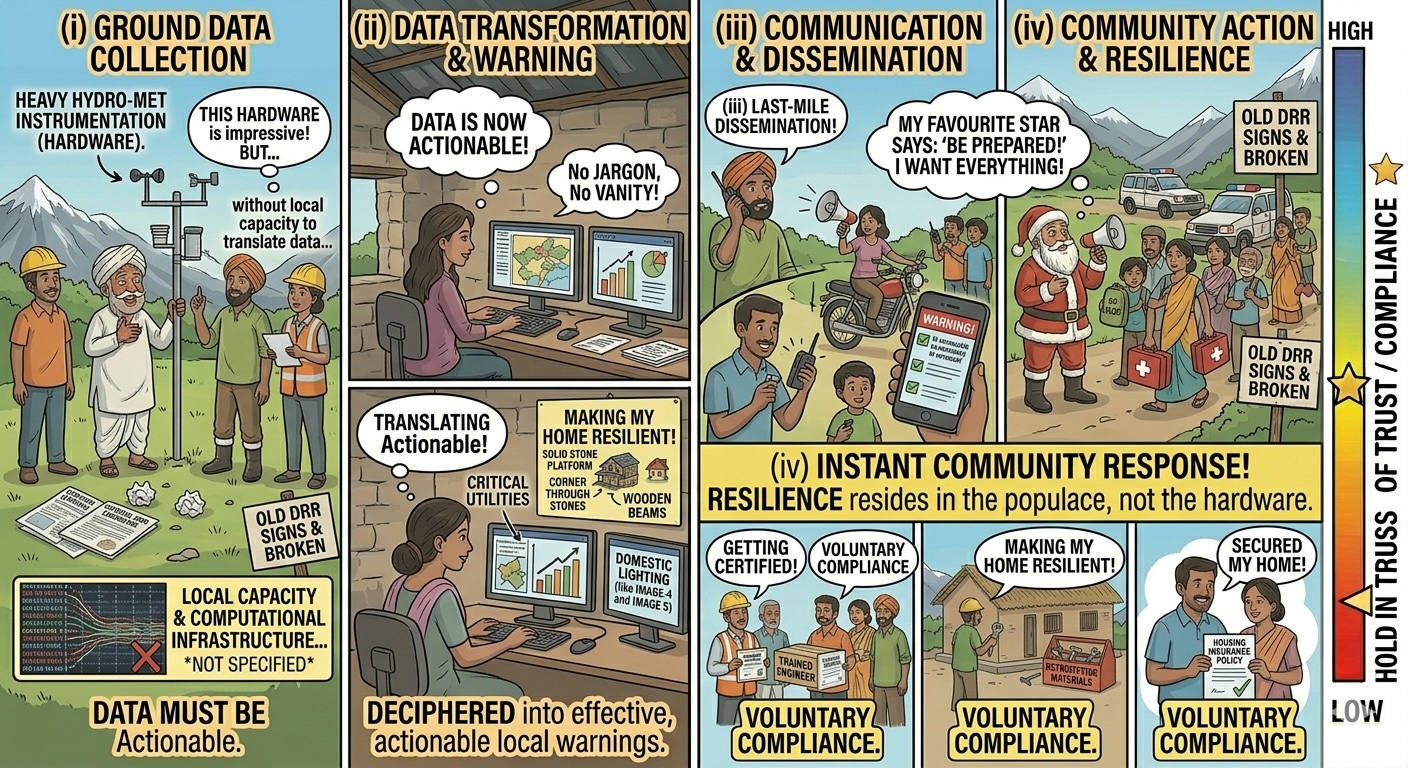
- पानी, जल प्रवाह व मौसम सम्बंधित उपकरणों (hydro-met sensors) में भारी निवेश तब तक बेकार है जब तक इन उपकरणों से प्राप्त जानकारियों या डेटा को तत्काल व्यावहारिक व स्थानीय चेतावनियों में बदलने की क्षमता और बुनियादी ढांचा न हो / Heavy investment in hydro-meteorological instrumentation is useless without the local capacity and computational infrastructure to translate data into rapid, actionable local warnings.
- सूचना प्रसार और प्रतिक्रिया क्षमता / Dissemination and Action Thresholds:
- एक चेतावनी प्रणाली विफल हो जाती है यदि उसमें अंतिम व्यक्ति तक सूचना पहुँचाने (last-mile dissemination) का माध्यम और तुरंत प्रतिक्रिया देने के लिए प्रशिक्षित समुदाय न हो / A warning system fails if it lacks effective, last-mile dissemination channels and a community trained to respond instantly. True resilience resides in the populace, not the hardware.
संता – बंता की यह जुगलबन्दी आपको कैसी लगी, कृपया हमें जरुर बताये
व
इस जुगलबन्दी को बेहतर बनाने के लिये अपने सुझाव अवश्य दें।
हमें हमेशा की तरह आपके सुझावों, प्रतिक्रियाओं व कटाक्षो का बेसब्री से इंतजार रहता हैं औरसच मानिये इसी के आधार पर हम अपने आप में, अपनी सोच व रचनात्मकता में सुधार करने कोप्रेरित होते हैं।
सो अच्छा – बुरा जैसा आपको महसूस हुवा हो, कमेंट जरुर करते रहें।
#EarlyWarningSystems #LastMileDissemination #HimalayanFloods #TechIllusion#CommunityPreparedness #SantaBanta
Leave a Reply