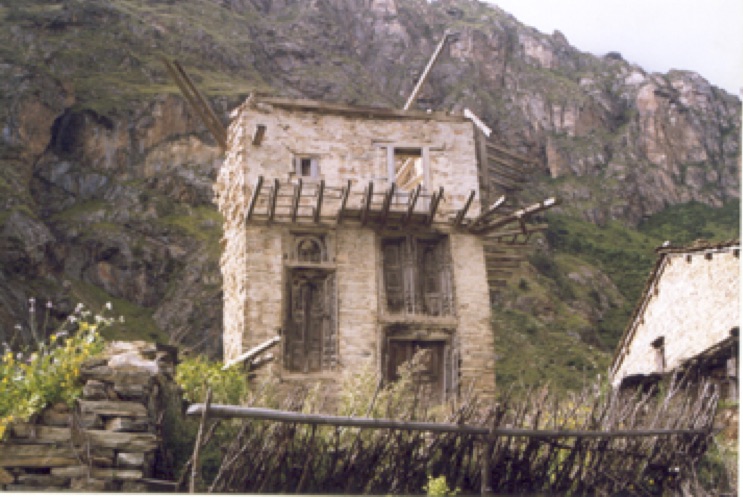
 Banta and Santa are being given a tour of a well-maintained, old four-storied house by its owner.
As they ascend the sturdy wooden stairs from one level to the next, Banta points out the features.
“This lowest level, Santa,” Banta explains, “often used for sheltering animals or storage, is what our friends in Kumaon call the ‘ghot’.”
They climb to the next level.
“This floor, usually with the kitchen and a common living area, is the ‘chak’.”
On the third level, he says, “This is the ‘pan,’ often with bedrooms.”
And finally, reaching the topmost floor, typically a bit more open or with a balcony, “And this, under the sloping roof, is the ‘chaj’.”
Santa, slightly out of breath but impressed, says, “Ghot, chak, pan, chaj!”
“It’s fascinating that there are specific names for each floor in your Kumaoni dialect.”
“In my Garhwali area, old folks also have names for each level in such houses – ‘koti’ for the base, then ‘manjua,’ ‘baund,’ and the top one is ‘baurar’!”
“Exactly, Santa!” Banta exclaims, pleased at Santa’s observation.
“This richness in our local languages, having distinct words for each floor of a four or even five-storied house, isn’t just a linguistic curiosity.”
“It’s powerful proof that building multi-storied homes was not a rare or exceptional feat for our ancestors.”
“It was a common, well-understood, and integral part of their way of life, deeply embedded in their culture and daily vocabulary.”
“So, because they had words for it, it means they did it a lot, and successfully?” Santa asks.
“Precisely,” Banta affirms.
“You don’t develop specific, widely used terminology for something that is an oddity.”
“These words tell us that the knowledge of how to construct these ‘bahumanzila imarat’ safely was widespread.”
“The techniques – the strong platforms, the composite walls, the clever joinery, the balanced designs – were part of a living tradition, passed down from master builders to apprentices, allowing generation after generation to build these resilient homes.”
He sweeps his hand around the ‘chaj’.
“To be able to live and thrive, floor upon floor, in a land that trembles, required immense skill and confidence.”
“That confidence didn’t come from recklessness, but from a system of building that worked.”
“The very existence of these words in our dialects is like an unwritten chapter in our history of resilience, echoing the success of those building practices.”
Santa looks around thoughtfully.
“So, every time we use these words – ghot, chak, pan, chaj, or koti, manjua, baund, baurar – we are actually speaking of a legacy of earthquake-safe construction?”
“It’s more than just names for floors; it’s a reminder of our ancestors‘ genius.”
Banta nods. “It is indeed, Santa,”
“A reminder that true resilience is often built layer by layer, with wisdom passed down not just in structures, but in the very words we speak.”
संता – बंता की इस जुगलबन्दी से आज हमने क्या सीखा:-
- स्थानीय भाषा में भवन के चार तलों के लिये विशिष्ट शब्दों का होना इनके ऐतिहासिक व सांस्कृतिक महत्त्व को दर्शाता हैं / The existence of specific local dialect terms for each floor in traditional multi-storied houses (e.g., Kumaoni: ghot, chak, pan, chaj; Garhwali: koti, manjua, baund, baurar) highlights the historical prevalence and cultural integration of this building style.
- स्थानीय भाषा में भवन के चार तलों के लिये विशिष्ट शब्दों के होने का तात्पर्य हैं कि क्षेत्र में बहुमंजिला भवन बहुतायत में थे / This linguistic evidence underscores that multi-storied construction was a common and successful practice, not an anomaly.
- यह एक बड़े भौगोलिक क्षेत्र के लोगो के मध्य निरन्तरता में हुवे ज्ञान व अनुभवों के आदान-प्रदान को दर्शाता हैं जिसने भूकम्प सुरक्षित भवन निर्माण की विधा को विकसित किया / It implies a widespread, shared knowledge of the sophisticated earthquake-resistant techniques that made such structures viable.
- इस भाषायी विरासत की स्वीकार्यता क्षेत्र के लोगो के परम्परागत आपदा जोखिम न्यूनीकरण सम्बन्धित समझ का परिचायक हैं / Recognizing this linguistic heritage reinforces the value and depth of indigenous DRR wisdom.
संता – बंता की यह जुगलबन्दी आपको कैसी लगी, कृपया हमें जरुर बताये
व
इस जुगलबन्दी को बेहतर बनाने के लिये अपने सुझाव अवश्य दें।
हमें हमेशा की तरह आपके सुझावों, प्रतिक्रियाओं व कटाक्षो का बेसब्री से इंतजार रहता हैं और सच मानिये इसी के आधार पर हम अपने आप में, अपनी सोच व रचनात्मकता में सुधार करने को प्रेरित होते हैं।
सो अच्छा – बुरा जैसा आपको महसूस हुवा हो, कमेंट जरुर करते रहें।
Leave a Reply