
The existence of distinct local dialect terms for every floor in traditional Himalayan houses proves that multi-storied construction was a common, culturally integrated practice. This linguistic heritage underscores a widespread, ancestral mastery of sophisticated earthquake-resistant techniques, validating the depth of indigenous resilience wisdom.
Traditional construction
The “Breathable Walls” and the “Pinning” Beams
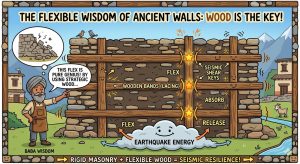
Ever wonder why those ancient wooden-framed buildings still stand after all this time? It’s not just luck; it’s a centuries-old masterclass in disaster resilience, using a simple but powerful tool: wood. Our latest deep dive into seismic performance uncovers the ingenious ways traditional builders turned wood into the backbone of earthquake resistance, a wisdom we ignore at our own peril in modern construction.
The Unyielding Shrine and the Wisdom of the “Original Stone”
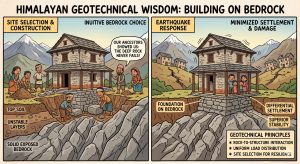
People of the Himalayan region constructed over exposed, solid bedrock which provided superior stability during earthquakes, minimised differential settlement and reduced damage. This demonstrates an intuitive understanding of geotechnical principles and site selection for seismic resilience.
Santa’s “Nail-It-Quick” Fix vs. Banta’s “Interlocking Embrace”
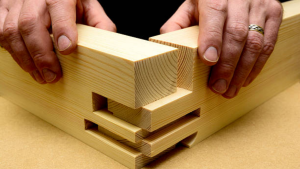
Traditional wooden joinery in the Himalayan region involved intricate housed joints in addition to nailing creating stronger, more rigid connections that distributed forces effectively, enhancing the structure’s ability to resist earthquake shaking without easily loosening or pulling apart.
Santa’s “Pakka Cement Dream” vs. Banta’s “Wall of Worry”

Blanket condemnation of traditional structures after an earthquake often masks the real culprit: structural incompatibility. Across mountain regions, the rapid, status-driven adoption of cement-concrete has created dangerous structural hybrids, such as placing heavy concrete slabs on top of old stone walls. Discover why true resilience depends on strict engineering compatibility and localized technical guidance, rather than the blind pursuit of a “modern” aesthetic.