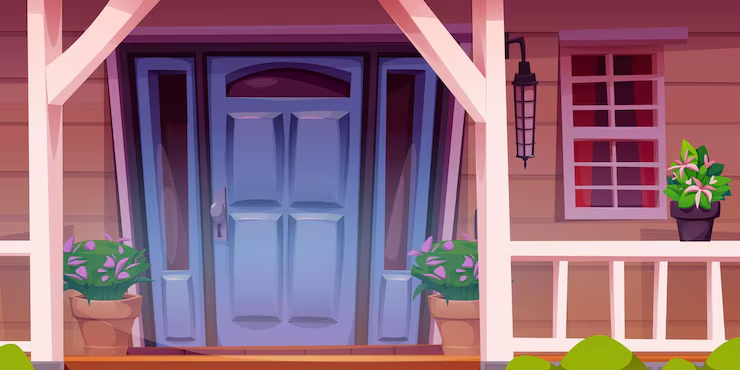
 Santa and Banta are sitting inside a beautifully preserved, but typically dark, ancestral home in their village.
The walls are thick, made of stone and wood.
There’s one small, sturdy wooden darvaja and only a couple of small, deeply set khidkiya.
“Banta,” Santa says, squinting a little, “these old houses are so strong, no doubt.”
“But don’t you think they are a bit gloomy?”
“Imagine if they had large glass khidkiya like they have in city houses, letting in so much light and air!”
“And maybe a big, wide entrance darvaja.”
“It would feel so much more open and modern.”
Banta looks around at the solid walls.
“Your desire for more light is understandable, Santa.”
“But our ancestors had very good reasons for keeping the openings in their houses – the ‘darvaje–khidki‘ – few and small.”
“Reasons beyond just not having large panes of glass back then?” Santa asks.
“Indeed,” Banta replies.
“Every opening you make in a wall, be it for a darvaja or a khidki, is essentially a point of weakness.”
“It breaks the continuous strength of that wall.”
“During an earthquake, stresses tend to concentrate around these openings, and that’s often where cracks first appear or failure begins.”
“Our forefathers knew this intuitively.”
“By having only one, often small, main darvaja and very few, small khidkiya, they maintained the maximum possible structural integrity of their walls.”
He points to the sturdy ‘lakdi ki chaukhat‘ around the small khidki.
“And look closely where they did make openings.”
“They didn’t just cut a hole.”
“They always incorporated strong ‘lakdi ki chaukhat‘ – a complete assembly of posts and lintels – around every darvaja and khidki.”
“These frames weren’t just for fitting the shutters; they were designed to support and manage the stresses around the opening, to compensate for the loss of wall strength, and to help transfer loads safely.”
“So, the small holes had strong wooden guards?” Santa says, getting the idea.
“Exactly!”
“It was a very clever system,” Banta affirms.
“And there was another benefit to these small openings, Santa, something our ancestors deeply valued – it helped keep the houses warm during our harsh winters and cooler during the hot summer days.”
“Less heat would escape in winter, meaning they needed less firewood, and less hot air would enter in summer.”
“This made their homes more energy-efficient, a perfect example of how they thought about safety and sustainability together, a truly holistic design.”
Santa looks at the small, deep-set khidki with new appreciation.
“So, small was strong, and small was also warm!”
“They weren’t just trying to save on wood for big khidkiyo; they were making their houses earthquake-safe and weather-resilient at the same time.”
“That’s quite a bit of thinking packed into one small khidki!”
Banta smiles.
“Our ancestors were masters of multi-functional design, Santa.”
“They understood that a truly good house needs to be a safe shelter in all senses – safe from the shaking earth, and safe from the biting cold, all while using resources wisely.”
#piyoosh #piyooshrautela #riskavoider #riskavoideracademy
संता – बंता की इस जुगलबन्दी से आज हमने क्या सीखा:-
- हिमालयी क्षेत्र के परम्परागत घरो की दीवारों की संरचनात्मक सुदृढ़ता सुनिश्चित करने की लिये छोटे व सीमित खुले स्थानों (दरवाजे व खिड़कियों) को रखा जाता था / Traditional Himalayan houses featured minimal openings (few, small doors and windows) to maximize the structural integrity of walls against earthquake forces.
- परम्परागत घरो में भूकम्प की स्थिति में बलों के जमाव के प्रबन्धन तथा अतिरिक्त मजबूती प्रदान करने के उद्देश्य से खुले स्थानों के चारो ओर मजबूत लकड़ी का फ्रेम डाला जाता था / Strong wooden frames were used around these openings to reinforce them and manage stress concentrations.
- इस प्रकार का ढांचागत चयन संरचना में कमजोर स्थानों को काम करके उसे भूकम्प सुरक्षित बनाता है / This design choice, reducing points of weakness, significantly contributed to the seismic resilience of the structure.
- छोटे व सीमित खुले स्थान इन परम्परागत संरचनाओं को ऊर्जा कुशल व आरामदायक बनाते है – यह संरचनाये गर्मियों में ठंडी व सर्दियों में गरम रहती है / The small openings also enhanced energy efficiency by minimizing heat loss in winter and heat gain in summer, reflecting a holistic and sustainable design approach.
संता – बंता की यह जुगलबन्दी आपको कैसी लगी, कृपया हमें जरुर बताये
व
इस जुगलबन्दी को बेहतर बनाने के लिये अपने सुझाव अवश्य दें।
हमें हमेशा की तरह आपके सुझावों, प्रतिक्रियाओं व कटाक्षो का बेसब्री से इंतजार रहता हैं और सच मानिये इसी के आधार पर हम अपने आप में, अपनी सोच व रचनात्मकता में सुधार करने को प्रेरित होते हैं।
सो अच्छा – बुरा जैसा आपको महसूस हुवा हो, कमेंट जरुर करते रहें।
Leave a Reply