
The Frozen Trap: Why Satellites Need Ancestral Wisdom to Read Himalayan Ice: Santa attempts to dispatch eighty commercial trekkers onto a frozen river trek based on a clear satellite radar reading. Banta and a local indigenous herder halt the expedition, proving how traditional early warning indicators detect subsurface ice fractures hours before advanced automated software can register the hazard.
Traditional Wisdom
The Broken Pot and the Wisdom of the Ancestors
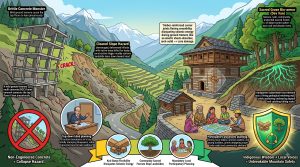
The Architecture of Resilience: Why Modern Glass Fails Where Timber Wins: Santa wants to replace an ancient mountain timber structure with a shiny glass commercial mall. Banta and the village elders intervene with the science of Koti Banal engineering, proving how traditional ecological knowledge (TEK) creates structures that survive Himalayan tremors.
The “Words for Each Floor” and Banta’s Layered Wisdom

The existence of distinct local dialect terms for every floor in traditional Himalayan houses proves that multi-storied construction was a common, culturally integrated practice. This linguistic heritage underscores a widespread, ancestral mastery of sophisticated earthquake-resistant techniques, validating the depth of indigenous resilience wisdom.
The Unyielding Shrine and the Wisdom of the “Original Stone”
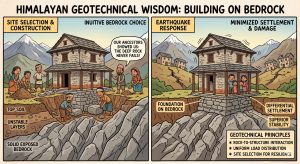
People of the Himalayan region constructed over exposed, solid bedrock which provided superior stability during earthquakes, minimised differential settlement and reduced damage. This demonstrates an intuitive understanding of geotechnical principles and site selection for seismic resilience.
The Ghost of the Green Slopes and the Gram Sabha Law
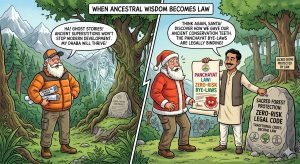
When Ancestral Wisdom Becomes Law: Santa wants to build a commercial dhaba in a sacred mountain forest, dismissing old warnings as “ghost stories.” Banta reveals how the local Panchayat turned those ancient environmental codes into legally binding Zero-Risk bye-laws. Discover how to give traditional conservation teeth.
Santa’s “Nail-It-Quick” Fix vs. Banta’s “Interlocking Embrace”
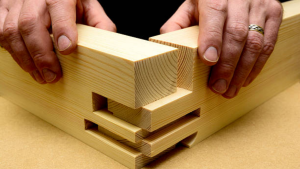
Traditional wooden joinery in the Himalayan region involved intricate housed joints in addition to nailing creating stronger, more rigid connections that distributed forces effectively, enhancing the structure’s ability to resist earthquake shaking without easily loosening or pulling apart.
Santa’s Wish for “Grand Windows” vs. Banta’s “Strengthened Openings”
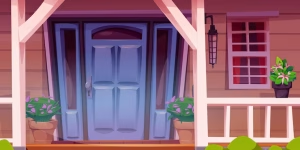
The survival of centuries-old timber-reinforced structures during major Himalayan tremors warns us that “modern” isn’t always “safer.”
The House on Stilts and the Race to the Road
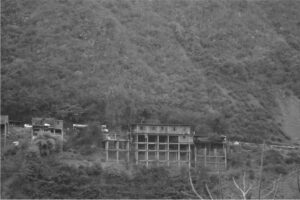
The practice of constructing multi-story, non-engineered stilts on steep slopes to reach road level, which is becoming commonplace in the Himalayan region is extremely hazardous and creates buildings with immense seismic vulnerability.
Santa’s Miracle Tap and the Orphaned Dhara

Over-dependence on distant sources increases vulnerability and can lead to the neglect of traditional water sources and their vital recharge zones and all this has severe, long-term hydrological consequences for slope stability.
Santa’s “Modern Maze” vs. Banta’s “Sensible Rectangle”

Simple rectangular plans with balanced proportions of the traditional Uttarakhandi houses align with modern seismic design codes that advocate for regular and symmetrical building configurations and are a result of sophisticated, practical engineering for resilience.