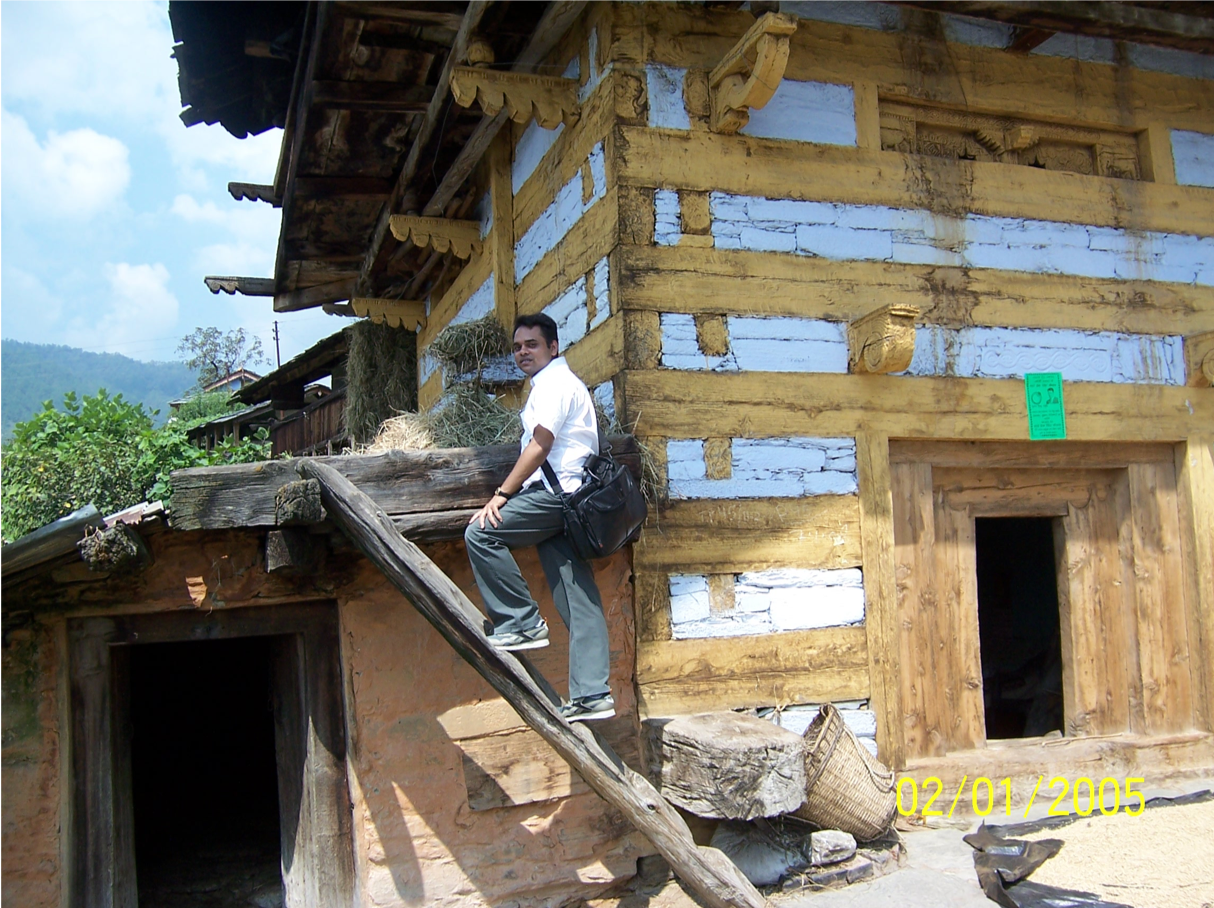
 Santa and Banta are watching masons carefully replace a few dislodged stones in the wall of a majestic, old multi-storied house.
The exposed section reveals a fascinating pattern: layers of neatly dressed flat stones alternating with double layers of thick wooden logs running horizontally.
“Banta,” Santa remarks, “I’ve always wondered about this.”
“Our ancestors were masters with stone, no doubt.”
“But why did they mix so much wood in these big, important house walls?”
“Wouldn’t a wall made entirely of solid stone, thicker and heavier, be even stronger against earthquakes?”
Banta smiles.
“That’s a natural thought, Santa, the idea that sheer mass equals strength.”
“But our forefathers understood something more subtle and incredibly effective, especially for our shaky land.”
“They created a ‘jugalbandi‘ – a beautiful duet – between wood and stone, making the wall far more resilient than if it were made of stone alone.”
“A duet?”
“How so?” Santa asks, intrigued.
“Look closely,” Banta points.
“Those alternating layers of double wooden logs and dressed stones, often reinforced with wooden beams running across the structure connecting opposite walls – this wasn’t just random layering.”
“It created a kind of flexible, internal wooden frame within the wall.”
“The stone provided the compressive strength and a solid infill, while the wooden logs and beams tied everything together, provided tensile strength (resistance to pulling apart), and allowed the structure to ‘give’ or flex a little during an earthquake.”
He continues, “In a way, it’s very similar to how modern engineers build tall earthquake-resistant buildings with a strong concrete or steel frame first, and then fill in the walls with bricks or blocks.”
“Our ancestors were, in essence, creating a robust wooden frame, sometimes completing this framework first, and then skillfully infilling it with stone.”
“This composite system could absorb and dissipate the earthquake‘s energy much better than a rigid, heavy, all-stone wall, which might crack and shatter under severe stress.”
Santa’s eyes widen. “So, the wood acted like the building’s haddiyon ka dhancha, and the stone was like its strong flesh, working together?”
“An excellent analogy, Santa!” Banta affirms.
“The wooden frame provided a continuous path for forces, preventing catastrophic collapse even if some stones got dislodged.”
“It allowed the building to sway and resettle.”
“The wooden beams running across also helped divide the large wall panels into smaller, more manageable sections, further controlling damage and providing excellent support for the floorboards above.”
“It was a system where each material played to its strengths, creating a whole that was far more earthquake-proof than the sum of its parts.”
Santa looks at the wall with new understanding.
“So, less like a rigid rock, and more like a strong, slightly flexible tree that can bend in the wind but not break.”
“Our ancestors were building ‘living’ walls!”
संता – बंता की इस जुगलबन्दी से आज हमने क्या सीखा:-
- हिमालय में परम्परागत रूप से बनाये जाने वाले बहुमंजिला भवनों में दीवारों को सुदृढ़ बनाने के लिये विशेष रूप से तराशे गये पत्थरो व लकड़ी का उपयोग किया जाता था / Traditional Himalayan multi-storied houses often used a composite wall structure with alternating layers of double wooden logs and dressed flat stones.
- इस तरह से बनने वाला लकड़ी का ढांचा मजबूत होने के साथ ही लचीला भी होता था / This system, reinforced by cross-beams, created an internal wooden frame similar in principle to modern framed structures, providing both strength and flexibility.
- यह लकड़ी का ढांचा पूरी संरचना को साथ बांधे रखने के साथ ही भूकम्पीय बलों को निस्तारित करता था, तो संरचना में लगने वाले पत्थर भार व दबाव सहने की क्षमता प्रदान करते थे / The wooden frame helped to tie the structure together, distribute seismic forces, and absorb energy, while the stone infill provided mass and compressive strength.
- दीवारों का निर्माण करने की यह पद्धति परम्परागत रूप से बनाये जाने वाले बहुमंजिला भवनों को भूकम्प सुरक्षित बनाती थी / This composite approach was a sophisticated method for enhancing earthquake resistance.
संता – बंता की यह जुगलबन्दी आपको कैसी लगी, कृपया हमें जरुर बताये
व
इस जुगलबन्दी को बेहतर बनाने के लिये अपने सुझाव अवश्य दें।
हमें हमेशा की तरह आपके सुझावों, प्रतिक्रियाओं व कटाक्षो का बेसब्री से इंतजार रहता हैं और सच मानिये इसी के आधार पर हम अपने आप में, अपनी सोच व रचनात्मकता में सुधार करने को प्रेरित होते हैं।
सो अच्छा – बुरा जैसा आपको महसूस हुवा हो, कमेंट जरुर करते रहें।
Leave a Reply