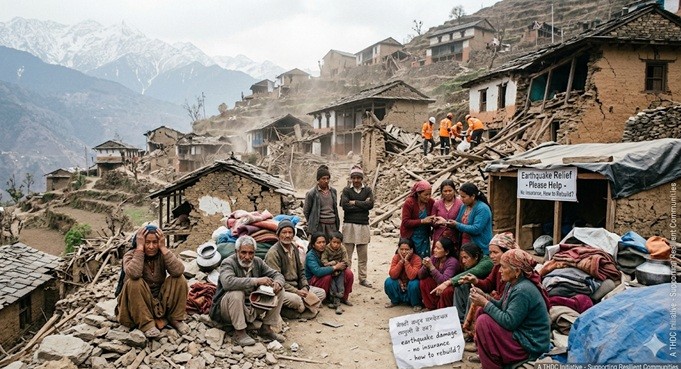
 Edition: 30 May 2026 | 2130 hrs IST
I. The Mountain Pulse: Pan-Himalayan Analysis 🏔️
The Himalayan arc is exhibiting severe sub-surface and cryospheric distress today, May 30, 2026, as newly published deep-earth imaging redefines our understanding of the range’s internal structural vulnerability.
-
The Plate Tectonic Tear: Groundbreaking 3D seismic imaging and S-wave receiver data released this week reveal that the Indian tectonic plate beneath the Himalayas is actively delaminating and tearing apart internally. This peeling effect has created a soft-rock asthenospheric wedge just 100 kilometers south of the main suture zone. Geologists warn that this deep structural tearing introduces massive, unmapped crustal stresses, keeping Zone V (the highest currently active risk category) under immense long-term strain for potential mega-thrust events.
-
The Policy Reality: While the scientific community continues to push for tighter standards based on these plate-tearing models, the built environment remains governed by the reinstated IS 1893:2016 framework. This puts an immense responsibility on local engineers to voluntarily enforce max-tier Zone V ductile detailing guidelines rather than relying on minimum compliance.
-
The Cryospheric Baseline: This structural stress coincides with the ongoing 27.8% deficit in regional snow persistence mapped by ICIMOD. The lack of insulating snow cover means that deep fractures, like the expanding Cona-Sangri Rift, are experiencing unprecedented thermal variations, further destabilizing highly fractured high-altitude rock faces.
II. Global Echoes: The Urban Exposure & Bio-Sovereignty Radar 🌏
Beyond the immediate peaks, today’s international profile tracks severe socio-ecological tipping points where unplanned development meets extreme natural thresholds.
-
Brazil / Tanzania (The Saturated Slope Inversion): Comprehensive World Weather Attribution (WWA) data finalized today reveals that recent urban landslide disasters in Minas Gerais (72 fatalities) and Tanzania’s Southern Highlands were heavily driven by a lethal mix of unplanned hillside expansion and severe soil saturation. WWA models confirm that while climate change is creating a 7% increase in intense rainfall trends, the true catalyst for disaster is “exposure vulnerability“—the rapid settling of low-income populations on steep slope bases that lack adequate drainage infrastructure.
-
Global Bio-Shield Activation: International transit hubs remain on high alert following the World Health Organization‘s active declaration of the Ebola outbreak in Central Africa as a Public Health Emergency of International Concern (PHEIC). Strict boundary-containment measures and flight quarantine protocols have been institutionalized globally to prevent cross-border pathogen transmission.
-
New Zealand (Tectonic distress): A Magnitude 4.7 earthquake shook the Marlborough region (15 km east of Seddon) today at 10:56 AM local time, striking at a shallow depth of 12 km. The moderate event caused widespread shaking but no immediate structural casualties.
III. The Laboratory: Sub-Surface Rheology & Lithospheric Strain 🔬
The Topic: “Mantle Delamination and Volumetric Strain Projections.”
-
The Science: The discovery of the Indian Plate’s internal tearing and delamination shifts our laboratory modeling away from simple horizontal compression. When the dense lower crust peels away from the upper crust, it allows hot, buoyant mantle material to surge upward into the newly formed gap.
-
The Innovation: This process alters the thermal gradient of the overlying mountain crust. The heating of deep fault zones reduces their frictional locking strength, causing stress to accumulate much faster in the mid-crustal detachment layers.
-
The Application: Geophysicists are shifting from measuring surface GPS displacement to analyzing Deep Low-Frequency (DLF) seismic tremors. These micro-acoustic whispers are the raw signatures of the plate actively tearing apart beneath us, providing a real-time health monitor for faults primed for sudden ruptures within the classic Zone V classification.
IV. The Time Machine ⏳
Historical Evidence: 30 May
-
1998 – The Takhar (Afghanistan) Earthquake: Exactly 28 years ago today, a powerful M 6.6 thrust earthquake struck northern Afghanistan, killing over 4,000 people and triggering massive landslides that buried entire mountain villages.
-
The Lesson: It warns us about “The Soft-Soil Trap.” The majority of fatalities occurred because villages were built on loose, unconsolidated river terraces that completely liquefied during the shaking. Rebuilding on old riverbeds without deep piling—even under less stringent code baselines—remains an structural gamble.
-
-
1972 – The Managua Reconstruction Debate: Historically, late May marks the period when international planners realized that rebuilding Nicaragua’s capital directly over unmapped fault lines—without seismic zonation—guaranteed its secondary destruction later that year.
-
The Lesson: It proves that updating building codes after a disaster is a failure of imagination. Voluntary enforcement of peak safety criteria is the only way to break this cycle.
-
V. The Daily Ordinance: The Zone V “Soft-Joint” Shear Assessment 📜
Your 60-second structural hack for the Reinstated 2016 Code Environment.
-
The Hack: The “Structural Gap” Clearance Check.
-
The Observation: Walk around any reinforced concrete building or boundary wall on your property. Locate the expansion or separation joints—the deliberate gaps left between distinct structural blocks or adjacent buildings.
-
The Danger: Under current Zone V conditions, ground motion contains severe horizontal displacement waves. If these expansion joints have been filled with rigid cement mortar, tiled over, or blocked by stored materials, the two blocks will smash into each other during a tremor (a phenomenon called pounding), causing immediate localized columns to snap.
-
-
The Action: Clear all debris, pipes, or rigid masonry from structural expansion joints. Ensure they are empty or filled only with highly flexible, compressible materials like bitumen-impregnated board or specialized rubber seals. The building must have room to flex independently, or it will break under structural load. #HimalayanSentinel #ZoneVReady
The devastating legacy of the 1998 Takhar earthquake and the complex policy challenges surrounding the withdrawal of the 2025 seismic code warn us that we cannot let economic trade-offs dictate our awareness of environmental limits.
These past events tell us that ‘Mantle Delamination’ and ‘Unplanned Hillside Exposure’ are the true, underlying architects of modern human tragedy. Our ongoing initiatives in ‘High-Resolution Seismic Imaging’ and ‘Voluntary Ductile Compliance’ prove we are learning to listen to the Earth’s internal fractures, but history warns us that if we do not convert this raw science into proactive safety on the ground, the inevitable tectonic adjustments of a splitting plate will claim our future tomorrow.
Today tells us the plate is tearing; it warns us that code rollbacks do not change the friction of the faults.
Leave a Reply