 Edition: 26 May 2026 | 2130 hrs IST
I. The Mountain Pulse: Pan-Himalayan Analysis 🏔️
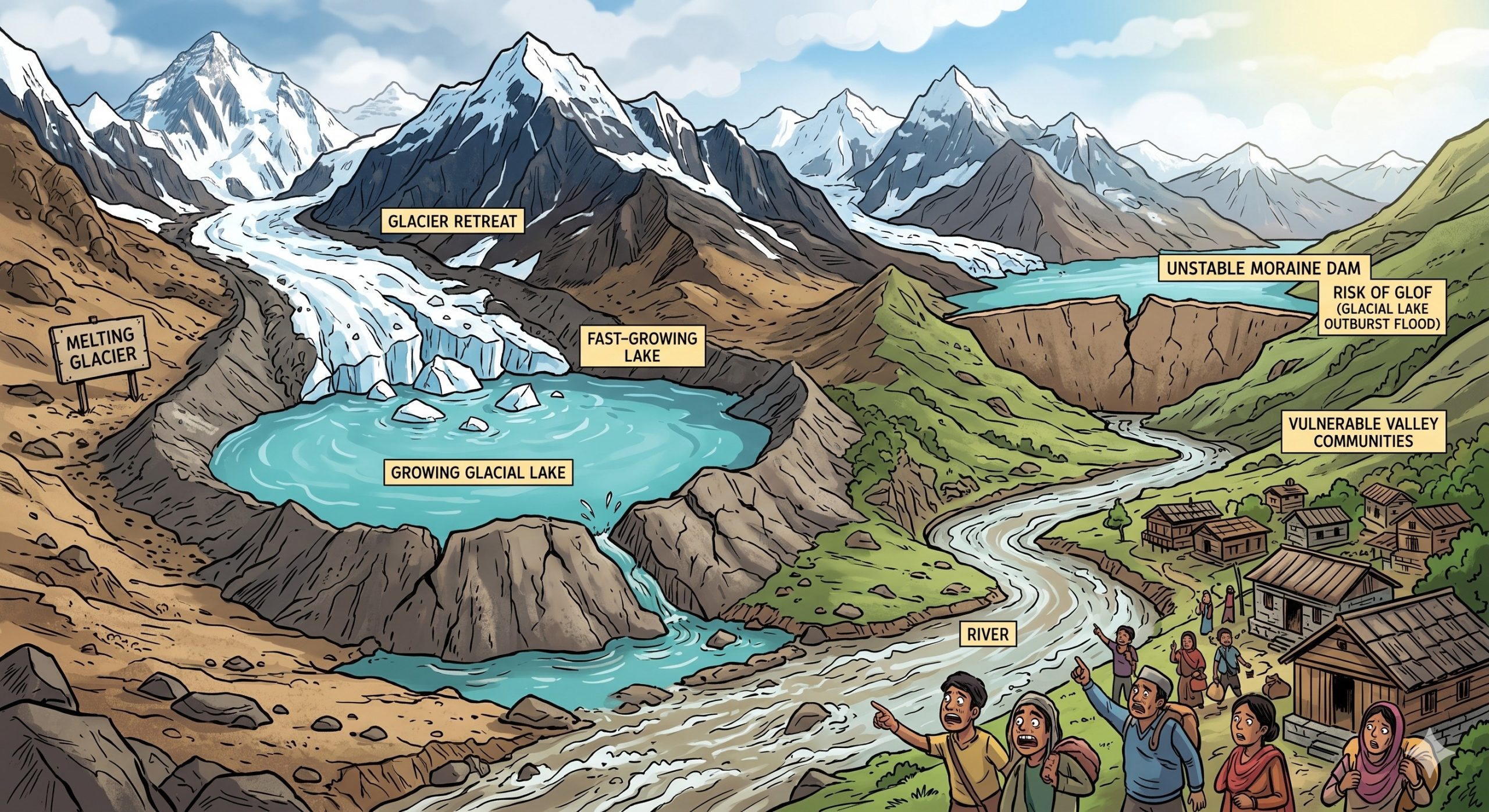
The Himalayan arc is entering late May under severe thermodynamic tension, with high-altitude melting actively triggering massive structural failures across the range.
-
The Tectonic Baseline: A mild Magnitude 3.4 earthquake jolted parts of the peripheral south-Himalayan sedimentary grid today at 11:41 IST. Centered in the Mymensingh region, the minor tremor reminds us that the strain of the Indian plate‘s northward push is continuously loading faults across the entire boundary.
-
The Status: “The Hanging Collapse.” A massive section of a glacier broke off in the high-altitude Kanchan Ganga region yesterday, triggering a powerful ice avalanche above the sacred shrine of Badrinath Dham. Huge blocks of ice, snow, and pulverized rock cascaded down steep, remote slopes, generating roaring shockwaves that echoed across the valley. While local authorities confirmed no casualties or structural infrastructure damage occurred, the sheer magnitude of the collapse triggered temporary panic among traveling pilgrims and mountain communities.
-
The Catalyst: Continuous, unseasonal heatwaves hitting the higher altitudes have accelerated snowmelt, systematically destabilizing these hanging glaciers and making them highly susceptible to sudden stress fractures. Long-term data from the University of Kashmir confirms this, revealing that temperatures above 3,000 meters are rising sharply. This “elevation-driven climate acceleration” means the highest mountain peaks are warming vastly faster than the lowlands, transforming solid ice reservoirs into highly volatile hazard zones.
II. Global Echoes: The Copper Shock & Pathogen Watch 🌏
Beyond the immediate peaks, today’s global disaster map links raw geological power with fragile resource chains and international quarantine systems.
-
Chile (The Antofagasta Fault Shock): A massive, deep-focus Magnitude 6.9 earthquake violently struck the Antofagasta region of northern Chile. Originating at a depth of 114 km, the tectonic shock triggered localized landslides, localized water supply disruptions, and power outages. Because the epicenter sits inside a core global copper mining hub, international markets instantly reacted as mining giants temporarily halted production for emergency facility assessments—demonstrating how a single subduction shift can trigger immediate volatility in global supply chains.
-
India / Democratic Republic of Congo (Aviation Bio-Shield): Following the WHO’s escalation of the rapidly spreading Ebola outbreak in eastern DRC into a health emergency, India’s Directorate General of Civil Aviation (DGCA) today issued strict Standard Operating Procedures for airlines. Mandatory in-flight health broadcasts, self-declaration forms, and a designated onboard quarantine protocol (moving suspected cases to the rear while keeping three adjacent rows vacant) have been activated. It underscores a vital lesson: in a hyper-connected world, biological containment must move as fast as commercial flight paths.
III. The Laboratory: Cryosphere Kinetics & Failure Mechanics 🔬
The Topic: “Hanging Glacier Disclinations and Thermal Shear Surcharge.”
-
The Science: Yesterday’s Kanchan Ganga avalanche brings a new mechanics focus into the laboratory. Traditional avalanche models assess uniform snow packs on open slopes; however, the ongoing warming above 3,000 meters is specifically attacking hanging glaciers—perched ice bodies anchored on vertical rock cliffs.
-
The Physics: When meltwater from elevation-driven warming trickles down into the basal layer where the ice grips the bedrock, it acts as a pressurized hydraulic lubricant. This induces a severe reduction in structural friction. Simultaneously, as the upper ice thins, it loses its cohesive mass, causing internal micro-fractures called disclinations.
-
The Mechanics: This combination shifts the ice body from a state of steady plastic flow to sudden, catastrophic shear failure. The ice does not merely melt; the entire frozen cantilever snaps off under its own weight, transforming into a high-velocity ice-rock slurry that can travel miles beyond the original fracture point.
IV. The Time Machine ⏳
Historical Evidence: 26 May
-
1974 – The Initiation of Systematic Glacier Monitoring: Exactly 52 years ago, the Geological Survey of India initiated its very first systematic annual mass balance monitoring on the Gara Glacier.
-
The Lesson: It warns us that “Baseline Delusions“ happen when data is short. Five decades of observation show that the mean mass loss of Himalayan glaciers has nearly doubled post-2000 compared to the late 20th century. The mountains we are engineering today are physically not the same mountains our ancestors mapped.
-
-
1822 – The Great Vesuvius Eruption Studies: Historically, late May marks the publication of early volcanological mapping that detailed how ancient pyroclastic currents utilized deep, dry river ravines to bypass town defensive walls.
-
The Lesson: It reminds us that “Topographical Funnels” are nature’s delivery systems. Whether it is volcanic ash or a modern glacial debris flow, gravity will always seek out and overwhelm human transport corridors built inside narrow mountain trenches.
-
V. The Daily Ordinance: The “Aerosol-Albedo” Visual Audit 📜
Your 60-second high-altitude diagnostic for the May 26 Thermal Spike.
-
The Hack: The “Peak Clarity” Monocular Check.
-
The Observation: Look at the snow line of the highest visible ridges (above 3,500m) during late afternoon clear-sky conditions. Pay attention to any distinct “Brown or Dull Grey” tinting on the snow surfaces.
-
The Danger: This tint indicates a heavy accumulation of Black Carbon (from valley fires and industrial emissions) mixed with fine dust. This aerosol deposition drastically destroys the surface Albedo (reflectivity), causing the snowpack to absorb up to 30% more solar radiation than clean ice. This hidden thermal surcharge is what destabilizes underlying hanging glaciers.
-
-
The Action: If a ridge line has turned noticeably “dull” or dark during a persistent warm spell, expect an unseasonal, sharp volume surge in downstream glacier-fed streams within 12 to 24 hours. Inform local water monitors and clear riverside equipment—the ice is melting from the inside out.
The sudden, structural shattering of the Kanchan Ganga ice canopy yesterday and the high-magnitude tectonic displacement across the Chilean copper fault today warn us that our global economic and infrastructure baselines are built upon fragile, highly dynamic foundations.
These past events tell us that ‘Elevation-Driven Warming’ and ‘Infrastructural Hubris’ are the hidden accelerators of modern risk. Our ongoing initiatives in ‘Continuous Cryosphere Surveillance’ and ‘Aviation Pathogen SOPs’ prove we are refining our defensive shields, but history warns us that if we do not integrate cascading, multi-sector hazard data into our regional development plans today, the unseasonal kinetic surges of a heating alpine ecosystem will claim our future tomorrow.
Today tells us the peaks are fracturing; it warns us that the altitude is driving the fuse.
Leave a Reply