 Edition: 27 May 2026 | 2130 hrs IST
I. The Mountain Pulse: Pan-Himalayan Analysis 🏔️
The Himalayan arc is entering late May under heightened structural and hydrological compression, as energy transfers from the western structural knot intersect with an accelerating seasonal snowmelt.
-
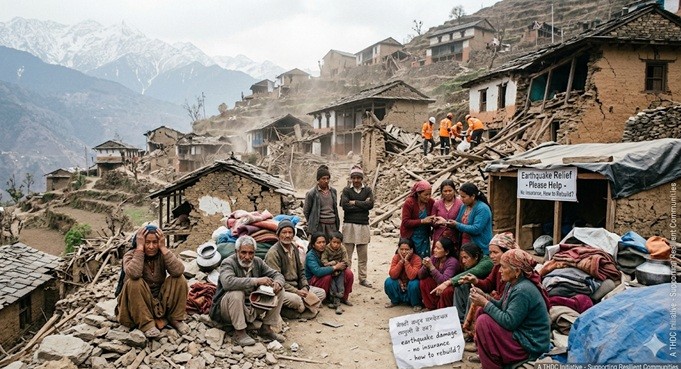
The Movement: Severe seismic energy was discharged across the western Himalayan foothills last night. A Magnitude 4.8 earthquake struck the Jhelum district of Pakistan‘s Punjab province, originating at a shallow depth of 12 kilometers. The epicenter, located 58 kilometers southwest of Jhelum near the Salt Range thrust zone, caused structural failures, collapsing or heavily damaging around 10 houses in the Jalalpur Sharif area, resulting in one fatality and 11 injuries. Tremors rippled across northern Pakistan, reminding telemetry networks that the sub-Himalayan plate boundary remains in a state of high friction.
-
The Status: “The Base-Load Depletion.” As the trans-Himalayan range navigates late spring, the regional snow persistence benchmark remains stuck at 27.8% below the long-term average—marking a 24-year low. This prolonged exposure of dark glacier bodies is accelerating thermal unloading.
-
High-Altitude Flood Vectors: In adjacent high-altitude terrains, sudden, intense weather fronts are rapidly transforming into geological hazards. A catastrophic rainstorm struck the mountainous fringes of southwest China‘s Chongqing Municipality (Yongchuan District), triggering sudden flash floods and widespread mudslides that have overwhelmed local mountain valleys and necessitated emergency multi-agency boat rescues.
II. Global Echoes: The Geopolitical-Environmental Friction 🌏
Beyond the peaks, today’s international crisis map highlights the structural vulnerability of infrastructure and global logistics to non-natural disruptions.
-
South Korea (Urban Structural Snap): An abrupt overpass collapse in Seoul yesterday claimed three lives and injured three others. The fatal failure occurred without warning, prompting a national emergency assessment of aging urban transit concrete frameworks.
-
Philippines (Transition to Retrieval): Emergency teams at the site of the collapsed nine-story building in Angeles City, Pampanga, officially terminated active rescue efforts today and transitioned to heavy-machinery retrieval. The structure collapsed on May 24, leaving at least 17 missing.
-
The Strait of Hormuz (The Three-Month Squeeze): Long-term monitoring confirms the effective closure of the strategic Strait of Hormuz has stretched into its third month, removing nearly 14 million barrels of oil per day from global markets. The prolonged crisis is cascading severely into India‘s economic sectors, directly threatening agricultural food security due to a massive freeze on importing essential petrochemical building blocks and fertilizers just ahead of the sowing season.
III. The Laboratory: Isotopic Hydro-Fingerprinting 🔬
The Topic: “Deuterium Excess (d-excess) Tracking of Glacier Core Structural Exhaustion.”
-
The Science: Rather than relying purely on remote-sensing visuals of shrinking snouts, cryosphere geochemists are now using stable isotope parameters—specifically Deuterium Excess (d = δD – 8 δ18O)—to evaluate the health of Himalayan watersheds.
-
The Innovation: This method maps the “age” and source of water flowing down mountain channels. Seasonal snowmelt yields a distinctly high, volatile d-excess signature. However, as the 24-year low in snow persistence strips the peaks clean, the chemical profile of local streams is shifting.
-
The Diagnostic: Telemetry arrays are picking up a sudden drop in d-excess values, matching the exact isotopic fingerprint of fossil glacier core ice that has been insulated for thousands of years. This biochemical shift gives us a raw, undeniable diagnostic: the watershed is no longer living off seasonal interest; it is actively spending its ancient, irreplaceable cryospheric capital to maintain baseline spring flow.
IV. The Time Machine ⏳
Historical Evidence: 27 May
-
1896 – The St. Louis Tornado Catastrophe: Exactly 130 years ago today, an F4 tornado tore through the industrial heart of St. Louis, Missouri, killing 255 people and demonstrating how narrow river corridors can amplify atmospheric wind vectors.
-
The Lesson: It warns us that “Topographical Choke points” act as force-multipliers for natural energy. In narrow Himalayan river trenches, atmospheric gusts and sudden flash floods are funneled directly into human transport corridors with concentrated destructive power.
-
-
1937 – Opening of the Golden Gate Bridge: On this day in 1937, engineering celebrated the connection of a major marine strait.
-
The Lesson: It reminds us of “Infrastructural Interdependence.” When modern transit or shipping links fail—whether a bridge in 1937 or a critical strait like Hormuz in 2026—the economic and resource consequences ripple thousands of miles inland to landlocked mountain agrarian belts.
-
V. The Daily Ordinance: The “Lithological Shake” Slope Audit 📜
Your 60-second high-altitude safety diagnostic for the post-Jhelum Seismic Transfer.
-
The Hack: The “Dry Silt-Trickle” Scan.
-
The Observation: Walk the perimeter of your property or local roads cut into steep hillsides. Look closely at the small, wedge-shaped openings where retaining walls meet the natural soil embankment.
-
The Danger: If you observe an uncharacteristic, continuous trickle of dry, fine silt or small sand-sized particles pouring out of these gaps under calm, dry weather conditions, the hill’s internal friction angle has been altered by recent regional tremors (like the M 4.8 Jhelum event). The slope is silently settling and redistributing its weight, which breaks down the dry cohesion of the soil matrix.
-
-
The Action: A silent, dry sand-trickle indicates a slope that has lost its internal grip and is primed to transform into a high-velocity debris slide the moment rain hits it. Do not store heavy equipment or vehicles near the base of walls showing active dry silt movement.
The devastating collapse of structures in Jhelum last night and the ongoing resource freeze caused by the three-month Hormuz shutdown warn us that our modern life-support networks are deeply sensitive to sudden structural fractures.
These past events tell us that ‘Cryospheric Capital Depletion’ and ‘Topographical Choke Points’ are the true, invisible drivers of modern disaster vulnerability.
Our ongoing initiatives in ‘Isotopic Watershed Tracking’ and ‘Decentralized Early Warning Systems‘ prove we can map the unseen stresses of our terrain, but history warns us that if we do not integrate overlapping seismic-hydrological data into our mountain engineering designs today, the sudden, unannounced shifts of a warming Third Pole will compromise our foundations tomorrow.
Today tells us the valleys are shaking; it warns us that the ancient ice is bleeding.
Leave a Reply