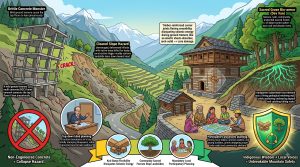
The Architecture of Resilience: Why Modern Glass Fails Where Timber Wins: Santa wants to replace an ancient mountain timber structure with a shiny glass commercial mall. Banta and the village elders intervene with the science of Koti Banal engineering, proving how traditional ecological knowledge (TEK) creates structures that survive Himalayan tremors.
Traditional practices
Santa’s “Nail-It-Quick” Fix vs. Banta’s “Interlocking Embrace”
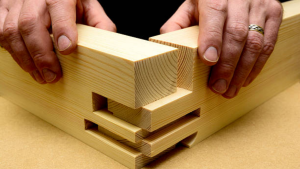
Traditional wooden joinery in the Himalayan region involved intricate housed joints in addition to nailing creating stronger, more rigid connections that distributed forces effectively, enhancing the structure’s ability to resist earthquake shaking without easily loosening or pulling apart.
The House on Stilts and the Race to the Road
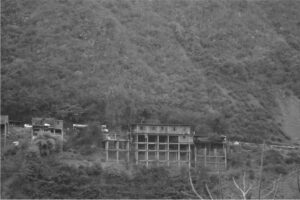
The practice of constructing multi-story, non-engineered stilts on steep slopes to reach road level, which is becoming commonplace in the Himalayan region is extremely hazardous and creates buildings with immense seismic vulnerability.
Santa’s Miracle Tap and the Orphaned Dhara

Over-dependence on distant sources increases vulnerability and can lead to the neglect of traditional water sources and their vital recharge zones and all this has severe, long-term hydrological consequences for slope stability.
Santa’s “Modern Maze” vs. Banta’s “Sensible Rectangle”

Simple rectangular plans with balanced proportions of the traditional Uttarakhandi houses align with modern seismic design codes that advocate for regular and symmetrical building configurations and are a result of sophisticated, practical engineering for resilience.
Banta’s “Interwoven House” and the Strength of Connection

Traditional Himalayan architecture often incorporated horizontal timber lacing which binds the stonework, distribute loads, and provide crucial connections for floor joists and the frames of doors and windows and makes the structure earthquake resilient.
The “Bargain Plot” by the Spring and the Ancestors’ Knowing Wink
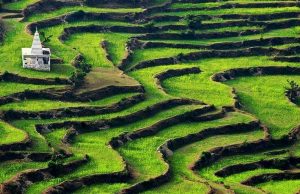
Despite agricultural land and water being being available on m middle and lower valley slopes people of the Himalayan region chose upper slopes for habitation as these places provided safety and strategic advantage. Preferring safety over convenience was the Golden Rule of our ancestors that we are evading.
The Shortcut to Heaven and the Lost Echoes

We have gained speed, but we have lost the Ras. The new “shortcut to heaven” has a hidden cost: the erosion of the communal bonds and traditional wisdom that once kept our villages safe. A moving reflection on why true resilience is found in our shared journeys, not just our destinations.
The Forgotten Leaf and the Weeping Ghost

Improvisation of traditional healing practices can ensure much needed medical assistance in remote areas that have shortage of mainstream health professionals and health care facilities.
Himalayan Habitats: Built on Landslides, Threatened by Negligence

Not landslides, but our ignorance and greed are responsible for increasing losses due to this phenomenon that facilitated growth of habitations in the Himalayan region.