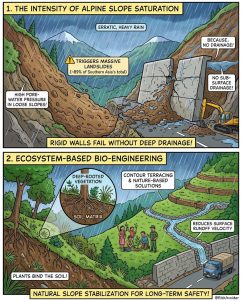
The Myth of the Retaining Wall: Why Concrete Fails Against Himalayan Mudslides: Santa slices through a steep hill slope to build a concrete garage, believing a thin retaining wall can hold back the earth. Banta uses regional landslide data to expose the dangerous mechanics of pore-water pressure, showing why ecosystem-based bio-engineering and proper slope drainage are the only real shields against the mountain’s gravity.
Slope instability
The Wandering Water and the Feverish Slope
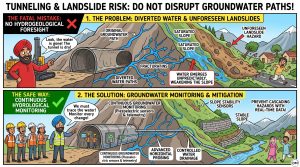
Tunnelling without hydrogeological foresight doesn’t make subsurface water vanish—it merely redirects it, turning once-stable mountain slopes into saturated, high-risk landslide zones. In the deeply interconnected Himalayan terrain, continuous groundwater monitoring during and after excavation is the only way to anticipate and prevent these cascading subterranean hazards.
The ‘Dhaba’ of Doom and the 160-Slide Slide
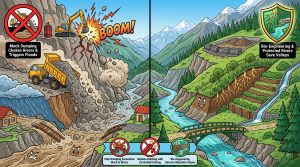
The Flying Dhaba: Why Blasting the Himalayas is a Recipe for Structural Collapse: Santa thinks dynamic slope-cutting and dumping construction muck into rivers is economic progress. Banta drops a brutal hydrological check based on 160 documented slope failures along the Char Dham route, explaining why traditional bio-engineering beats concrete when saving mountain lifelines.
The Tilted Layers of Barfi and the Limit of Greed
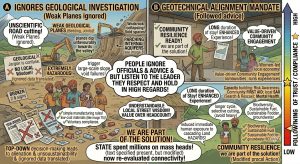
Rushing road alignments through the Himalayas without deep geological and geotechnical investigations invites structural failure, particularly when cutting slopes where weak geological planes dip unfavorably toward the valley. True mountain safety requires us to establish a scientific consensus on non-negotiable “no-go” zones and re-evaluate the assumption that every single settlement must have road connectivity, shifting instead toward a holistic approach that respects strict geographical constraints.
The Cannon on the Slope and the Infrastructure Overload
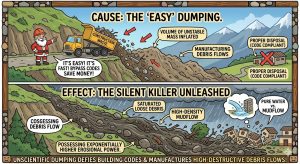
Manufacturing the Next Mudflow: Santa thinks pushing road-widening debris over the cliff is a smart, cost-effective way to clear a construction site. Banta drops a heavy truth bomb on how unscientific waste disposal interacts with climate-induced cloudbursts to create deadly, high-velocity debris flows.
The ‘Lego’ Mountain and the Invisible Blanket
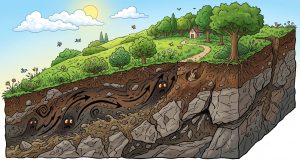
The Blind Spot of Space-Age Maps: Santa thinks his house is safe because a satellite labeled his zone as “solid bedrock.” Banta reveals why modern GIS and Remote Sensing maps miss the invisible, loose debris hiding underneath the grass—the exact material that turns a monsoon into a tragedy.
The Map with the Blind Spot
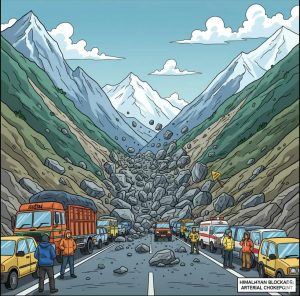
The Danger of the “Silent” Slope: Why a hill that hasn’t moved in 100 years might be your biggest risk. In our latest Santa-Banta series, we explore the “dormancy trap” and why human activities like road building and poor drainage are “infusing” instability into our safest landscapes. It’s time to move beyond generic maps and get back into the field. 🏔️⚠️
The “Lazy” Hill and the Big Surprise

A slope that has been quiet for decades isn’t necessarily safe; it may just be dormant. The first initiation of a landslide after a long period of silence is often the most catastrophic, catching communities entirely off guard. Discover how aggressive human interventions, such as reckless hill-cutting and heavy construction, can “infuse” instability into ancestral slopes, turning a peaceful mountain into an active hazard zone.
The Lazy Mountain and Newton’s Grudge
Does the mountain obey Newton? Santa thinks the hills are lazy, but Banta explains the “Law of Inertia” behind landslides. Discover why the “External Trigger” of rain and earthquakes is the only thing standing between a peaceful slope and a deadly disaster.
The ‘Combo Meal’ of Chaos

What’s worse than a Great Earthquake? An earthquake that strikes during a record-breaking monsoon. Discover why Santa thinks disasters have “manners” and why Banta insists that in 2026, we must prepare for the “Combo Meal” of seismic and climatic fury.