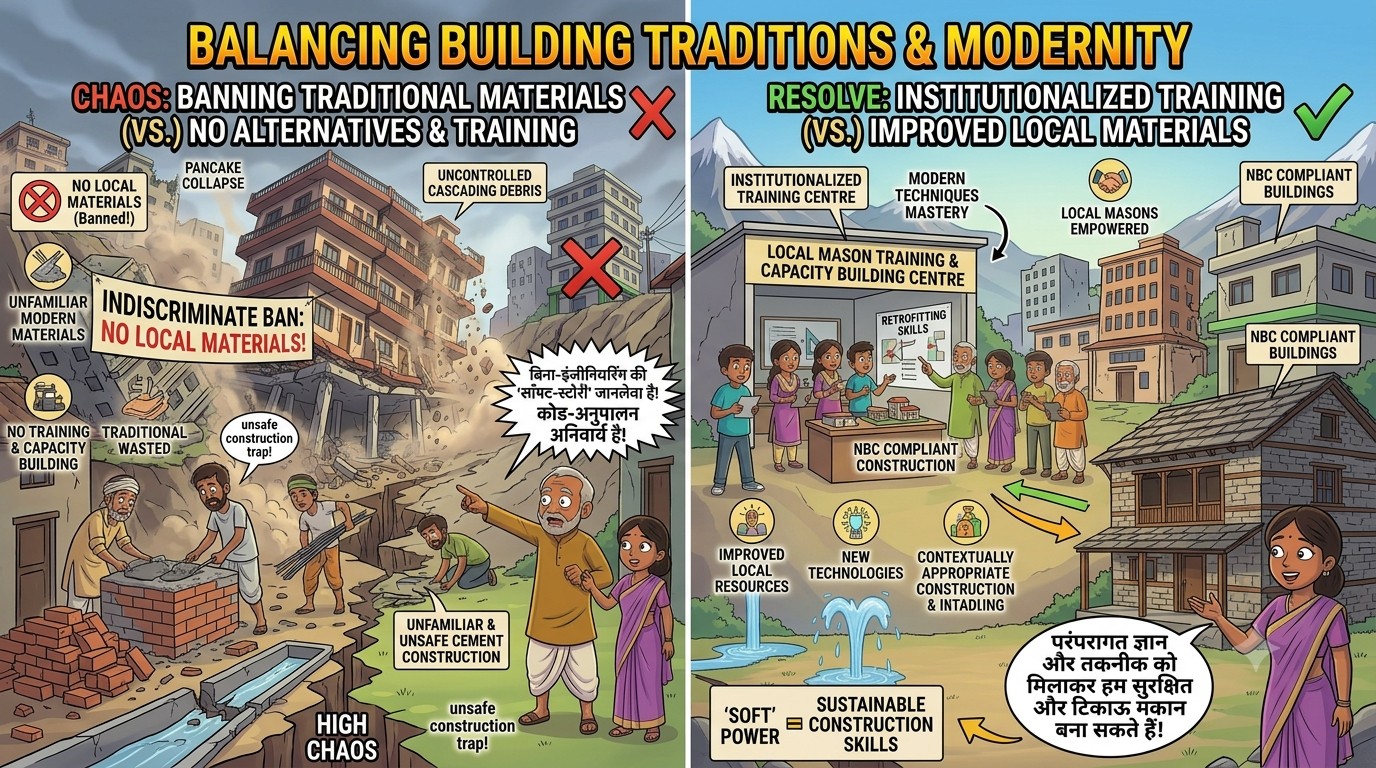
 Santa is fuming, watching old Deenu Kaka, a mason once renowned for his exquisite stonework, awkwardly trying to lay bricks for a small retaining wall.
The line is uneven, and the cement mortar looks a bit too watery.
“Banta, look at this!” Santa complains as Banta approaches.
“I wanted a good, strong stone wall like our grandfathers built.”
“But they say quarrying our good local ‘pathar‘ is mostly banned now for small works – ‘paryavaran ka kanoon‘, they call it!”
“And getting good ‘lakdi‘ for traditional reinforcements is another headache!”
“So, I had to buy these expensive, brittle bricks from the plains.”
He then points an accusing finger at Deenu Kaka.
“And this Deenu!”
“He used to be a magician with stone, creating walls that stood like mountains.”
“Now, with these bricks and cement, he fumbles like a child learning to walk!”
“My wall looks like it’s already had a minor earthquake!”
Deenu Kaka looks down, embarrassed. Banta puts a comforting hand on his shoulder and then turns to Santa.
“Santa, my friend,” Banta says gently, “let’s not be too quick to blame Deenu Kaka.”
“His hands have spent a lifetime understanding the language of stone and wood, the art of balancing them, fitting them with precision.”
“He could make stones ‘sing’ together.”
“But now, we’ve suddenly asked this master musician of stone to play a ‘cement-sitar‘ without giving him any lessons!”
“Cement-sitar?” Santa asks, momentarily distracted by the analogy.
“Yes,” Banta continues.
“After those big earthquakes, a narrative was built that our traditional ways were weak.”
“Then, under the banner of ‘safety,’ cement and concrete were pushed as the only solution.”
“Simultaneously, to protect the environment, which is a noble aim, sometimes very broad, indiscreet bans were placed on quarrying or felling, without always providing sustainable alternatives or clear guidelines for using local materials responsibly.”
“So, people like you were left with little choice but to turn to these ‘alien‘ materials like factory-made bricks and cement, often transported from far away at great cost.”
He looks at Deenu Kaka with empathy.
“And our skilled masons like Deenu Kaka, who were ‘gurus‘ of traditional construction, were suddenly expected to become experts in reinforced cement concrete (RCC) or brickwork overnight.”
“Were there proper, widespread training programs to teach them the science of cement mixes, the importance of curing, the way steel reinforcement needs to be tied for earthquake resistance in concrete?”
“Mostly no.”
“They learned by watching others, or through ‘on-the-job‘ trial and error, often funded by companies keen to sell their cement and steel.”
Santa looks a bit ashamed.
“So, Deenu Kaka isn’t a bad mason; he’s just working with a material whose language he hasn’t been formally taught?”
“And I was forced to use these bricks because the good stone I trust is now forbidden fruit?”
“In many ways, yes, Santa,” Banta affirms.
“The shift in materials happened without a corresponding shift in widespread skill-building.”
“We took away the craftsman‘s familiar tools and materials, gave him new ones, and then wondered why the music wasn’t as sweet.”
“True safety and good construction require that the mason understands his material deeply, whether it’s stone, wood, brick, or cement.”
“And policies need to be balanced – protecting the environment is vital, but so is ensuring people can build safe, affordable homes using materials, local or new, with the right knowledge and skills.”
Deenu Kaka, listening quietly, nods with a sigh of relief.
Santa looks at his wobbly brick wall with new understanding.
“Perhaps, Banta, instead of just blaming Deenu, I should ask the Panchayat to request a proper training workshop for our village masons on these new materials.”
“And maybe we should also ask the authorities if there are ways to sustainably use our good local stone again, with proper guidelines.”
“A mason playing a familiar instrument with skill is better than one fumbling with a new one, however fancy it might seem.”
संता – बंता की इस जुगलबन्दी से आज हमने क्या सीखा:-
-
बिना कोई आसान और सुरक्षित विकल्प दिये स्थानीय व पारंपरिक निर्माण सामग्रियों पर अचानक प्रतिबंध लगाने से लोग ऐसी नई सामग्रियों का उपयोग करने को मजबूर हो जाते हैं, जिनसे वे परिचित नहीं होते / Indiscriminate bans on local, traditional building materials, without providing viable and accessible alternatives or promoting sustainable extraction methods, can force communities towards unfamiliar materials.
-
सीमेंट, सरिया और ईंट जैसी आधुनिक सामग्रियों के उपयोग को प्रोत्साहित करने से पहले स्थानीय राजमिस्त्रियों और कारीगरों को उनका सही इस्तेमाल सिखाने के लिये औपचारिक प्रशिक्षण देना बेहद ज़रूरी है / The shift to modern materials like cement, steel, and bricks must be accompanied by comprehensive, institutionalized training and capacity building for local masons and artisans.
-
बिना किसी सही शिक्षा, प्रशिक्षण या मार्गदर्शन के स्थानीय राजमिस्त्रियों और कारीगरों से यह उम्मीद नहीं की जा सकती कि वे नई तकनीकों और सामग्रियों में तुरंत माहिर हो जाएँगे / Skilled traditional craftspeople cannot be expected to master new materials and techniques without proper education and support.
-
सरकारी नीतियों को पर्यावरण सुरक्षा और सुरक्षित व किफ़ायती मकानों की ज़रूरत के बीच सही संतुलन बनाना चाहिये —जिसमें नये साधनों के साथ-साथ स्थानीय सामग्रियों के बेहतर और सुरक्षित उपयोग को बढ़ावा दिया जाये / Policies should aim for a balance between environmental conservation and the need for safe, affordable, and contextually appropriate construction, ideally promoting improved use of local resources alongside new technologies.
संता–बंता की यह जुगलबन्दी आपको कैसी लगी, कृपया हमें जरुर बताये
व
इस जुगलबन्दी को बेहतर बनाने के लिये अपने सुझाव अवश्य दें।
हमें हमेशा की तरह आपके सुझावों, प्रतिक्रियाओं व कटाक्षो का बेसब्री से इंतजार रहता हैं औरसच मानिये इसी के आधार पर हम अपने आप में, अपनी सोच व रचनात्मकता में सुधार करने को प्रेरित होते है।
सो अच्छा–बुरा जैसा भी आपको महसूस हो, कमेंट जरुर करते रहें।
Leave a Reply