 Santa was sitting in his executive consultancy office, proudly looking at an elaborate commercial master plan for a remote, pristine Himalayan pilgrimage valley.
The blueprint looked like a honeycomb of heavy civil construction—featuring an underground three-story subterraneanparking lot carved directly inside a riverbank cliff, five new road tunnels piercing fragile ridges, and a massive concrete four-lane highway blast–cut along the gorge floor.
Banta walked into the office, carrying a multi-modal transport feasibility assessment, a life-cycle carbon audit, and an aerial cable car engineering layout from the Swiss Alps and South American urban transit networks.
He laid his blueprints right over Santa’s underground honeycomb.
“Santa-ji!”
“Put down your heavy drills and look up into the open sky!” Banta smiled, pointing to his lightweight cable carblueprints.
“Why are you trying to hollow out the subterranean bones of a fragile, sacred mountain when the air above is completely free, clean, and safe?”
Santa laughed, adjusting his branded corporate cufflinks.
“Oye Banta!”
“Cable cars and ropeways are for tourist joyrides, like the British toy trains in Shimla or Darjeeling!”
“Serious mainstream transit requires heavy concrete, straight asphalt lanes, and massive underground caverns!”
“We need to drill underground parking lots so that lakhs of tourist SUVs can park right at the shrine steps!”
“Why look at ropes in the sky when we have dynamite?”
Banta shook his head, holding up a small glass terrarium containing a living, delicate fern growing in a cup of loose, damp soil.
He took a heavy screwdriver and punched five deep holes through the bottom of the glass container—cracking the glass and letting all the soil and water pour out onto the mahogany desk.
“Santa-ji, you think your underground caverns are progressive development, but you are literally cracking the ecological terrarium of the Himalayas!” Banta warned.
“Have we completely lost our respect and compassion for the mountains?”
Santa blinked, watching the water seep across his master plan.
“Oye Banta… what does a glass terrarium have to do with underground parking?”
“Every tunnel you drill alters the internal hydrology of the mountain, Santa!” Banta shouted.
“When you blast underground parking lots and massive road tubes without precision, you puncture ancient subterraneanaquifers!”
“Across our mountain villages, natural freshwater springs—the naulas and dharas that sustain communities—are drying up completely because underground tunnelling channels the water away!”
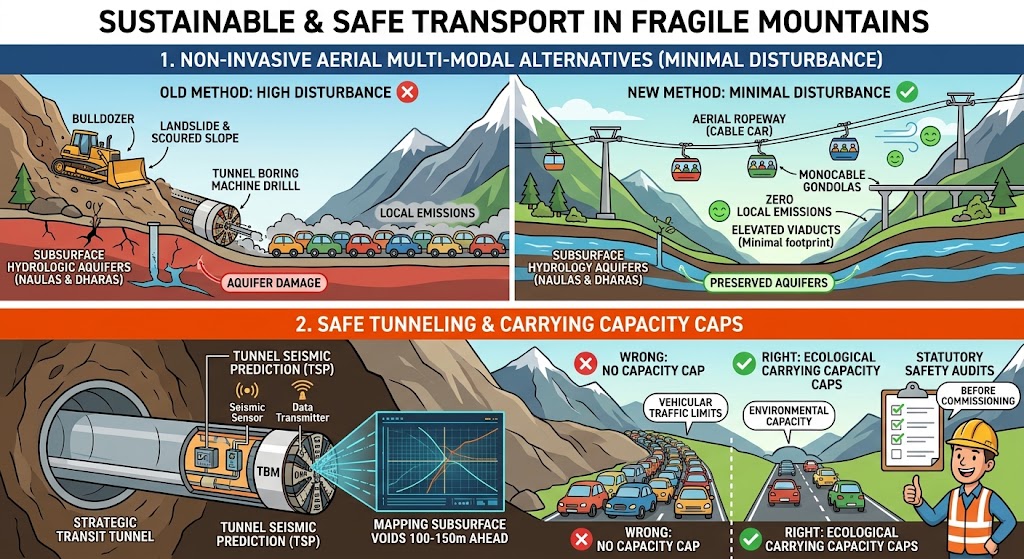
“Look at our viable, modern alternatives: Aerial Ropeways, Cable Transit Networks, and Elevated Viaducts!“
Santa tilted his head, looking at Banta’s blueprints.
“For real transport?”
“Yes, Santa!”
“Modern heavy-duty aerial ropeways and monocable gondolas are not ‘toy rides’—they are high-capacity, zero-emission mass transit systems!” Banta explained.
“Look at La Paz in Bolivia, which runs the world’s largest urban cable car network moving hundreds of thousands of commuters daily over steep vertical terrain with zero slope disturbance!”
“Look at the Swiss and Austrian Alps, where modern ropeways transport heavy cargo, public passengers, and tourists without cutting a single vertical cliff or blasting a single underground cavern!”
“A cable car system has a tiny environmental footprint: you only construct a few anchored pylons on stable bedrock terraces, leaving the mountain slopes, forests, and natural springs completely undisturbed below!”
“And where tunnelling is absolutely unavoidable for strategic national defence, we must enforce strict geotechnical discipline: deploying Tunnel Seismic Prediction (TSP) to scan rock strata ahead of every blast, mandating carrying-capacity limits on tourist traffic, and implementing independent safety audits!”
“True infrastructure progress does not mean proving how deeply we can wound the mountain with dynamite; it means using our highest engineering intelligence to move with lightness, compassion, and respect!”
Santa stared at the cracked terrarium, then at the elegant, sweeping lines of the aerial ropeway blueprint floating peacefully above the green valley canopy.
The illusion that progress required massive subterranean destruction faded from his mind.
He quietly rolled up his underground parking blueprints and picked up Banta’s cable transit proposal.
“Oye Banta… so instead of hollowing out the mountain’s belly until it collapses… we can simply glide over its shoulders with reverence?”
“Precisely, Santa-ji,” Banta smiled warmly.
“The Himalayas are not our enemy to conquer; they are our sacred shield to protect.”
“Let us tread lightly upon their heights, wire our paths with wisdom, and ensure that our progress honours the eternalmountain today, so our children inherit a living sanctuary tomorrow!”
संता – बंता की इस जुगलबन्दी से आज हमने क्या सीखा:-
- पर्यावरण-अनुकूल विकल्प (रोपवे व केबल कार) / Deploying Sustainable Multi-Modal Alternatives (Aerial Ropeways):
- अत्यधिक संवेदनशील पर्वतीय घाटियों में हर जगह सुरंगें खोदने और पहाड़ों को काटने के बजाय पर्यावरण-अनुकूल ‘रोपवे’ (Aerial Ropeways), केबल कार और एलिवेटेड वायाडक्ट्स को प्राथमिकता दी जानी चाहिये। बोलिविया के ला पाज़ और स्विस आल्प्सकी तरह रोपवे प्रणाली बिना पहाड़ों को नुकसान पहुँचाये भारी परिवहन संभाल सकती है और इससे पहाड़ों के प्राकृतिक जलस्रोत (धारे व नौले) सूखने से बचते हैं / Subsurface drilling and aggressive slope slicing must not serve as default transport solutions in ecologically fragile Transport planners must prioritise non-invasive, aerial multi-modal alternatives—such as high-capacity cable car networks, monocable gondolas, and elevated viaducts—which require minimal ground disturbance, preserve natural subsurface hydrologic aquifers (naulas anddharas ), and emit zero localized emissions.
- टनल सीस्मिक प्रेडिक्शन और वहन क्षमता का अनुपालन / Mandatory Tunnel Seismic Prediction (TSP) and Ecological Carrying Capacity:
- जहाँ सामरिक सुरक्षा के लिये सुरंग बनाना अपरिहार्य हो, वहाँ ब्लास्टिंग से पहले 100-150 मीटर आगे की चट्टानों का एक्स-रे करनेवाली ‘टनल सीस्मिक प्रेडिक्शन’ (TSP) तकनीक का उपयोग अनिवार्य होना चाहिये। इसके साथ ही, पर्यटन वाहनों की संख्या को उस घाटी की पारिस्थितिक वहन क्षमता (carrying capacity) के भीतर सीमित रखना आवश्यक है / Where subterranean tunnelling is unavoidable for strategic transit, projects must mandate continuous Tunnel Seismic Prediction(TSP) systems to map subsurface structural voids 100–150 meters ahead of the face, strictly enforce environmental carrying-capacity caps on vehicular traffic, and establish non-negotiable statutory safety audits before project commissioning.
संता – बंता की यह जुगलबन्दी आपको कैसी लगी, कृपया हमें जरुर बताये
व
इस जुगलबन्दी को बेहतर बनाने के लिये अपने सुझाव अवश्य दें।
हमें हमेशा की तरह आप के सुझावों, प्रतिक्रियाओं व कटाक्षो का बेसब्री से इंतजार रहता हैं और सच मानिये इसी के आधार पर हम अपने आप में, अपनी सोच व रचनात्मकता में सुधार करने को प्रेरित होते हैं।
सो अच्छा – बुरा जैसा आपको महसूस हुवा हो, कमेंट जरुर करते रहें।
#AerialRopeways#SustainableHimalayas #TunnelSeismicPrediction #SaveOurSprings #CarryingCapacity#SantaBantaDRR
Leave a Reply