 Santa lets out a long, melancholic sigh.
“It’s so quiet, Banta.”
“Too quiet.”
“I remember when we were young, the evenings used to be filled with the sounds of young men singing, playing Kabaddi, and laughing loudly.”
“Now… all I hear is the echo of my own voice.”
Banta nods, his face reflecting the same melancholy.
“Our village has become a Goonjta Hua Gaon, Santa.”
“It is filled with the loving presence of our elders and the cheerful chirping of our grandchildren, but the strong shoulders that used to lift the heavy logs, the swift feet that used to run for help… most of them are now supporting the big cities.”
“They have to earn a living, Banta,” Santa says defensively.
“There are no opportunities here.”
“I know that, my friend,” Banta says gently.
“And every parent wants a better future for their child.”
“But we must also understand the price we are paying for this exodus.”
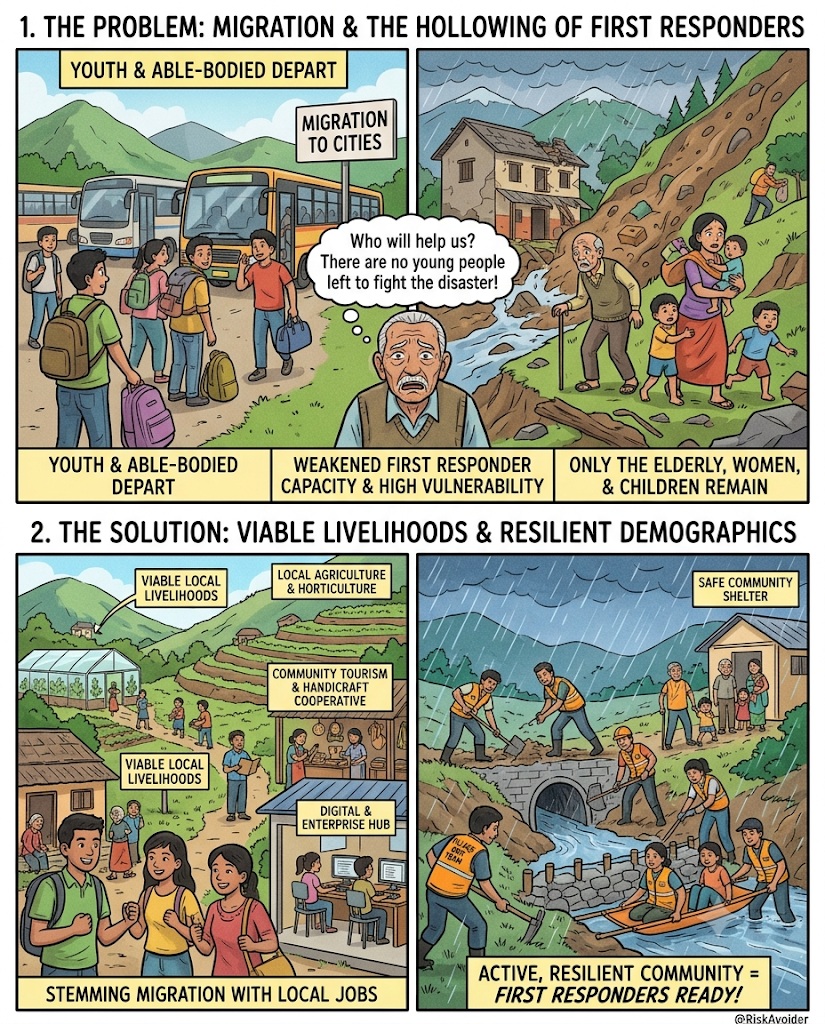
“We have become a frontline community with a hollowed-out army.”
“Hollowed-out army?” Santa asks.
“Think about it,” Banta explains.
“In any disaster – a fire, a landslide, a medical emergency – who are the very first responders?”
“It’s not the police or the army from the district headquarters; they take hours to arrive.”
“The first responders are always us, the community.”
“It’s the neighbours who rush to pull someone out of a collapsed shed, who organize a human chain to carry a sick person to the road head, who fight a small forest fire before it becomes a monster.”
He continues, his voice low and serious, “But who does this physically demanding work?”
“The youth!”
“The strong men and women.”
“With most of them gone, our community’s first response army is now mostly comprised of our revered but aging elders and our young mothers who already have the burden of home, fields, and children.”
“Our capacity to respond quickly and effectively in those first golden hours of a disaster has been severely weakened.”
Santa imagines a scenario, his face paling.
“So if, God forbid, a house catches fire at night… who will climb the roof with buckets of water?”
“Who will run to the next village for help?”
“Me, with my creaking knees?”
“You, with your spectacles?”
“That, Santa, is the frightening question we must all ask,” Banta says grimly.
“Our vulnerability has increased not because the mountains have become more dangerous, but because our villages have become more empty.”
“The social safety net, the very fabric of mutual support that was our greatest strength, gets thinner with every young person who leaves.”
He concludes, “Creating jobs in the cities is one thing.”
“But creating policies that make our villages vibrant, sustainable, and attractive enough for our youth to stay… that is not just an economic issue anymore, Santa.”
“It is now a critical disaster management imperative.”
“We need our young soldiers back to guard their own homes and families.”
Santa looks around at the quiet, darkening village, the silence no longer feeling peaceful, but fragile.
“A hollowed-out army… Banta, you’ve made me realise that the biggest risk to our village might not be the next earthquake, but the next bus that takes our young ones away.”
संता – बंता की इस जुगलबन्दी से आज हमने क्या सीखा:-
- 1. प्राथमिक प्रतिक्रिया क्षमता का ह्रास: युवा पलायन का गम्भीर परिणाम – युवाओं और सक्षम व्यक्तियों के बड़े पैमाने पर पलायन से किसी भी आपदा के समय सबसे पहले मोर्चा सम्भालने या प्रतिवादन करने की गाँव व समुदाय की आंतरिक क्षमता पर अत्यन्त प्रतिकूल प्रभाव पड़ता है / Migration of youth and able-bodied individuals severely weakens a community’s capacity to act as the first responder in any disaster.
- 2. उच्च घातकता वाले वर्ग पर बढ़ता दबाव और संवेदनशीलता – गाँवों में मुख्य रूप से बुजुर्गों, महिलाओं और बच्चों के रह जाने से आबादी की आपदा घातकता (Vulnerability) बढ़ जाती है और आपातकालीन परिस्थितियों से निपटने की उनकी शारीरिक व व्यावहारिक क्षमता सीमित हो जाती है / The remaining population, often comprising the elderly, women, and children, is more vulnerable and has a reduced ability to cope with emergencies.
- 3. सामाजिक पूंजी का क्षरण: पर्वतीय क्षेत्र में बढ़ रहे जोखिम का अदृश्य कारण – सक्षम मानव संसाधन और सामाजिक पूंजी का यह क्षरण हिमालयी व पर्वतीय क्षेत्रो में निवास करने वाले समुदायों के लगातार बढ़ रहे आपदा जोखिम का एक प्रमुख और निरंतर गहरा रहा कारक है / This hollowing out of social capital is a major driver of increased disaster risk in mountain communities.
- 4. स्थानीय आजीविका और जनसांख्यिकीय संतुलन ही वास्तविक सुरक्षा – प्रभावी आपदा जोखिम न्यूनीकरण के लिये विकास से जुड़ी नीतियों का सम्पूर्ण ध्यान गाँव स्तर पर व्यावहारिक व सम्मानजनक आजीविका सृजन पर केंद्रित होना चाहिये, ताकि पलायन रुके और गाँवों में निवास कर रहे समाजो में प्रतिरोध्यता विकसित हो तथा वह सुरक्षित रह सके / Sustainable development policies must focus on creating viable local livelihoods to stem migration and maintain a resilient demographic structure in villages for effective disaster risk reduction.
संता – बंता की यह जुगलबन्दी आपको कैसी लगी, कृपया हमें जरुर बताये
व
इस जुगलबन्दी को बेहतर बनाने के लिये अपने सुझाव अवश्य दें।
हमें हमेशा की तरह आप के सुझावों, प्रतिक्रियाओं व कटाक्षो का बेसब्री से इंतजार रहता हैं और सच मानिये इसी के आधार पर हम अपने आप में, अपनी सोच व रचनात्मकता में सुधार करने को प्रेरित होते हैं।
सो अच्छा – बुरा जैसा आपको महसूस हुवा हो, कमेंट जरुर करते रहें।
Leave a Reply