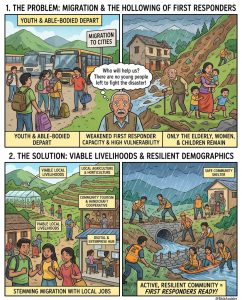
Out-migration of able-bodied youth hollows out mountain communities’ first-responder capacity, leaving elderly and vulnerable populations exposed and turning demographic decline into a critical disaster risk multiplier. Stemming this exodus through viable local livelihoods is essential to preserving the social capital and human agency required for frontline resilience.
Migration
Santa’s Money-Order Ghost and the Forgotten Address
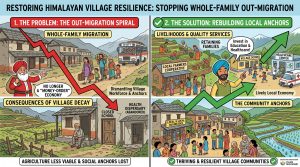
When whole families migrate, mountain villages lose not just their workforce, but the foundational economic and social anchors that sustain rural life. Reversing this downward spiral requires moving beyond basic job creation to invest deeply in local healthcare and quality schooling, ensuring communities have the resilience to stay and thrive.
The Hungry Land of the Forgotten Terraces
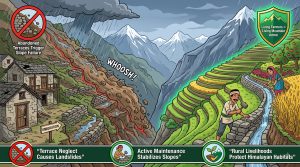
Himalayan agricultural terraces function as vital, engineered slope-stabilization structures that depend entirely on continuous maintenance by local communities. The accelerating decay of these dry-stone retaining systems due to rural outmigration transforms once-stable slopes into severe landslide hazards during heavy monsoon downpours. Revitalizing agrarian livelihoods is not merely an economic imperative, but a fundamental ecological defense required to sustain the human custodianship necessary for stabilizing vulnerable mountain landscapes.
The Shiny Car and the Mirror of Discontent
The visible disparity between urban and rural lifestyles, often highlighted by visiting relatives, is a significant driver of out-migration among youth. Overcoming this requires tangible investment in rural infrastructure and opportunities to reduce the development gap.
The Weeping Terraces of the Ghost Village

Lack of regular upkeep of the agricultural terraces in the Himalayan region enhances the risk of landslides, and this emerging issue needs to be addressed immediately.