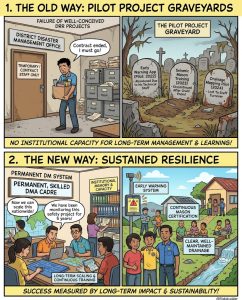
Disaster Risk Reduction initiatives routinely perish in “pilot project graveyards” because institutional memory and execution collapse without permanent, dedicated technical cadres in Disaster Management Authorities (DMAs). True resilience demands shifting from transient, project-based consultancies to sustained investments in permanent human systems capable of institutional learning, continuous scaling, and long-term risk governance.
Himalaya
The Recipe in the Soil and Santa’s Costly Shortcut
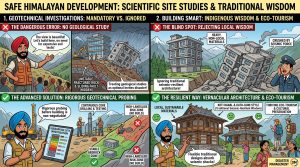
Treating geotechnical site investigations as optional overhead invites disaster in the geologically active Himalayas; safe development demands rigorous subsurface probing before laying a single stone. By integrating vernacular architectural wisdom and local, sustainable materials into modern building codes, mountain regions can simultaneously safeguard lives, celebrate cultural heritage, and unlock resilient eco-tourism economies.
Santa’s Secret Project and Banta’s Open Janam-Patri
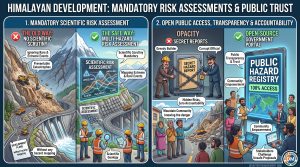
Major infrastructure development in the fragile Himalayas cannot afford to treat scientific scrutiny as an afterthought; making comprehensive, multi-hazard risk assessments mandatory for extreme events is vital to preventing preventable catastrophes. Placing these technical evaluations into open public access empowers mountain communities and stakeholders with the transparency needed to interrogate unsafe engineering and enforce genuine accountability.
The Slashed Slope and the Geotechnical Nail
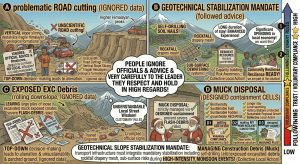
Widening Roads, Triggering Landslides: The Geotechnical Crisis on Himalayan Highways: Santa praises fast vertical rock-cutting to widen mountain highways. Banta shatters the engineering shortcut, showing how unengineered slopes and exposed construction muck create high-velocity landslide risks during peak travel seasons, and why advanced soil nailing is a non-negotiable safety baseline.
Santa’s Strategic Highway that Became a Self-Made Trap
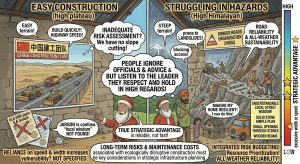
In the rush to build mega-highways through fragile terrains like the Himalayas, we are facing a dangerous paradox: inappropriately designed roads that rely on aggressive slope cutting are actually increasing landslide frequency. Instead of improving connectivity, these corridors are becoming major liabilities—frequently washing out and blocking critical access during monsoons and national security emergencies.
True strategic advantage does not lie in how wide a road is or how fast a vehicle can travel on a clear day; it lies in the reliability and all-weather sustainability of the network when a crisis strikes. Strategic infrastructure planning must shift its focus toward ecological compatibility, ensuring that long-term risks and soaring maintenance costs are factored in before the first excavator touches a fragile slope.
Santa’s “Mute Button” Melancholy vs. Banta’s “Echoes of Chipko”
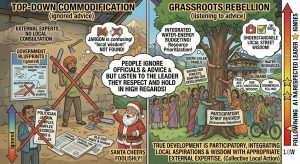
The Grassroots Rebellion against Top-Down Jargon -Santa wants external experts to map our future, blindly trusting top-down plans that ignore the mountain’s soul. Banta stands with the village women to revive our rich history of grassroots movements, proving that true Himalayan resilience is born when local wisdom replaces distant, high-handed political vanity.
Disaster Update: October 4, 2025
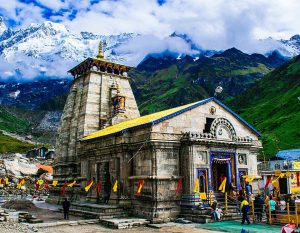
October 4 – Disasters across the globe on this day, particularly in the mountainous regions. Get to know the events of today as also those recorded in history.
Santa’s Blessed Mohalla and the Ignored Landslide Warning

Adherence to disaster safety measures is to come by only with the acceptance that our inherent Positivity Bias makes us ignorant and vulnerable.
The Scientist’s New Compass
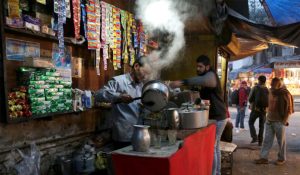
To stop being disaster detective and try becoming community doctor, was Banta’s advise to the brilliant young scientist and he was quick to grasp and launch a new mission.
The Two-Headed Monster of the Rising Lake
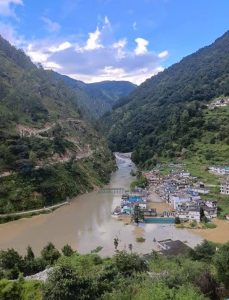
As the landslide-dammed lake begins to rise, Santa worries about his feet getting wet, until Banta tells him the chilling, century-old story of Gohna Tal, revealing the true, two-headed monster they are facing.