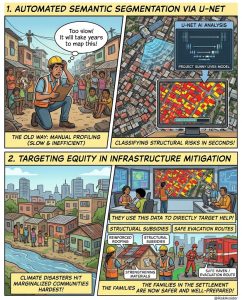
Planetary Intelligence for the Chawls: How U-Net AI Maps Slum Vulnerability: Santa spends weeks using a magnifying glass on paper maps to count vulnerable informal houses. Banta introduces the AI-driven Project Sunny Lives framework, demonstrating how U-Net deep neural networks scan satellite imagery to classify structural risks across thousands of low-income homes in under a minute.
Climate change
The Blindfold Blueprint and the 7% Cloudburst
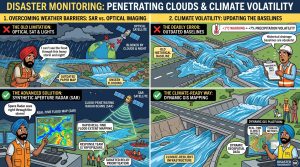
Looking Through the Storm: How Space Radar Defeats Midnight Cloudbursts: Santa attempts to monitor a massive midnight flood using a household flashlight and a paper map. Banta steps in with space-born Synthetic Aperture Radar (SAR) telemetry to show how cloud-penetrating satellite technology maps environmental disasters in real time, bypassing atmospheric barriers to save millions during extreme weather events.
The ‘Dhaba’ on the Edge and the Ticking Water Balloon
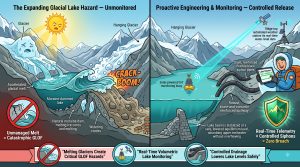
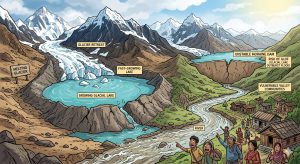
The Sinking Dam: Why Himalayan Glacial Lakes are Ticking Time Bombs: Santa sets up a commercial tea stall directly on a fragile glacial moraine dam, ignoring climate metrics. Banta drops an urgent glaciological reality check based on 388 documented GLOF events, explaining how engineered siphons and controlled drainage are critical to prevent catastrophic outbursts like the South Lhonak and Kedarnath disasters.
The Expanding Bathtub on the Roof of the World
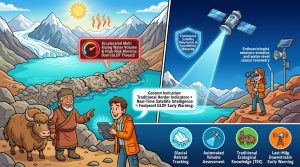
The Overflowing Bathtubs of the Himalayas: Santa sees expanding glacial lakes as a prime real estate opportunity for boating resorts. Banta shatters the illusion, diving into the terrifying mechanics of Glacial Lake Outburst Floods (GLOFs) and outlining the critical three-pronged strategy of volumetric mapping, international data sharing, and indigenous safety drills.
The ‘Resilience Umbrella’
Is your “Earthquake-Proof” house ready for a Cloudburst? Santa wants two separate budgets, but Banta explains why true resilience is like a good khichdi—everything has to be mixed together. A deep dive into why we must factor climate extremes into seismic safety.
Beyond Relief: The Strategic Imperative of Disaster Insurance
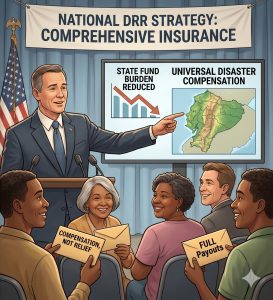
As climate-induced losses overburden public exchequers, the shift from “discretionary relief” to “contractual insurance” is no longer optional. From Nagaland’s blockchain-payouts to the Caribbean’s risk pools, discover how Disaster Insurance is rewriting the rules of global resilience
The White-Out Lockdown – A Case for “Climate-Adaptive Governance”
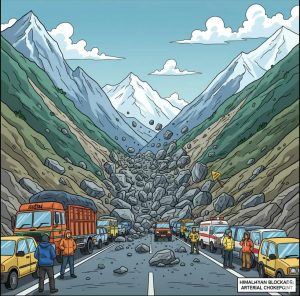
DRR isn’t just about stopping floods; it’s about making sure a clerk doesn’t break their hip on an icy Shimla staircase. We break down the 5 critical DRR lessons from the recent White-Out—from ‘Administrative Exposure’ to ‘Supply Chain Fragility.’ It’s time for Himalayan cities to adopt ‘Climate-Adaptive Governance’ that respects Article 21.
The Climate Change Bill 2025: Statutory Duties or Corporate Smoke?

The Climate Change Bill 2025 creates a sophisticated legal fortress, rebranding industrial neglect as ‘climatic stimuli’ to shield corporations from absolute liability. By centralising oversight and silencing state vetoes, this Act risks transforming our net-zero future into a high-speed corridor for corporate immunity.
The Case of the Greedy Mountain
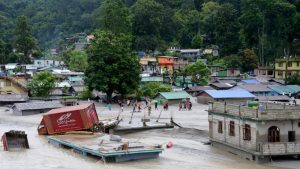
A story about unplanned construction, geological vulnerability, and why you should never build your house in a giant’s mouth.
Dehradun’s Flood Catastrophe and the Global Imperative for Floodplain Resilience

Dehradun’s devastating floods in September 2025 were not an act of God, but a man-made catastrophe. We uncover how the obliteration of the city’s ancient canal network for wider roads turned a manageable downpour into urban ruin.