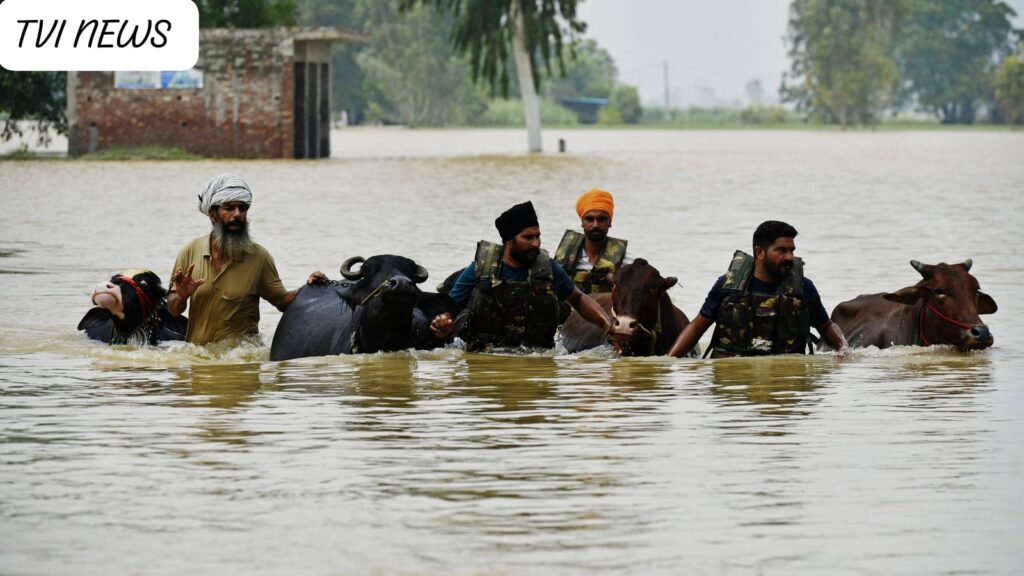
 In the fading days of India’s 2025 monsoon season, a different kind of disaster has gripped the nation. While the mountainous states of Uttarakhand, Himachal Pradesh, and Jammu and Kashmir grappled with the fury of landslides and flash floods, Punjab — the nation’s breadbasket — has been submerged under a slow, relentless deluge of devastating proportions.
Here we delve into the Punjab floods of 2025, a catastrophe born from a mix of extreme weather and decades of systemic failures. It is an exploration not just of the tragedy, but of a precarious regional vulnerability, offering a blueprint for policymakers and disaster managers to move from a cycle of destruction to a future of genuine resilience.
A Monsoon of Unprecedented Mayhem
The 2025 monsoon has been one of the most destructive in recent memory, with heavy rainfall triggering a cascade of disasters across northwest India. The devastation began in the Himalayas, where flash floods and landslides in July and August claimed hundreds of lives and obliterated critical infrastructure. In Uttarakhand alone, over 100 people perished, while Himachal Pradesh reported over 150 deaths. Upstream disasters in Jammu and Kashmir further choked highways and isolated communities, causing economic losses in the billions.
Punjab’s ordeal intensified toward the monsoon’s end in late August and early September, marking the worst flooding since 1988. All 23 districts were declared flood-hit, as the rivers Sutlej, Beas, and Ravi — already swollen by torrential rains in the plains — overflowed from upstream releases.
Unlike the rapid, high-energy flash floods in the mountains, Punjab’s flat terrain turned the inundation into a slow-moving flood, prolonging the suffering and magnifying the damage to agriculture and infrastructure. This pattern highlights a critical lesson: a disaster in the Himalayas often becomes a catastrophe in the plains, underscoring the urgent need for integrated, trans-state disaster management.
A History of Vulnerability: The Indus River Legacy
Punjab‘s vulnerability to floods is not a new phenomenon; it is a direct consequence of its geography as a low-lying riverine plain. Historical records paint a grim picture, with major floods in 1955, 1973, 1988, 1993, 2008, 2019, and 2023. These events have consistently demonstrated that Punjab‘s flood vulnerability index is the highest in the country due to its topography, high population density, and intensive agriculture.
While large dams like Bhakra and Pong were built post-independence to mitigate some of this risk, recurring breaches in “dhussi bandhs” (earthen embankments) and poor maintenance have exposed ongoing frailties. The 1988 floods, for instance, affected over 3.4 million people and killed hundreds, a grim echo of the human and economic toll of the 2025 deluge.
The Human Hand: Decades of Neglect and Misguided Policy
The 2025 crisis was amplified by a mix of policy failures and short-sighted actions that have systematically eroded the state‘s flood defenses over the past few decades. These were not random acts of neglect, but a cumulative failure of foresight.
Rampant Urbanisation and Encroachment
Rapid, unplanned urbanisation has disrupted natural drainage patterns.
The state‘s forest — once a natural buffer against runoff — have shrunk due to illegal logging and land conversion.
Critically, rampant encroachment on the floodplains for housing and agriculture has choked the rivers, forcing these to overflow their banks, even with less provocation.
A Failure of Infrastructure
The very infrastructure meant to protect the state has become a point of failure.
Poor maintenance and inadequate desilting of drains have reduced their carrying capacity, while illegal sand mining has weakened riverbeds, exacerbating erosion.
The lack of implementation of the Punjab State Action Plan on Climate Change, which called for master plans and flood cushions, has left the state‘s infrastructure dangerously unprepared.
Dams and Coordination Breakdowns
The floods were precipitated by heavy Himalayan rains, but their impact was amplified by mismanagement of dams.
The Bhakra Beas Management Board (BBMB) has been criticised for sudden water releases from dams like Bhakra and Pong, which overwhelmed downstream areas already grappling with local downpours.
Inter-state disputes over water releases further delayed critical warnings, and the lack of transparency in dam operations fuelled a blame game that hindered a coordinated response.
These cumulative failures — rooted in short-term economic priorities over long-term resilience—have transformed Punjab from a flood-mitigated state into a perennial hotspot.
The Human and Economic Toll: A Crisis of Epic Proportions
The Punjab floods of 2025 have left the state reeling from an immense human and economic toll.
The Human Cost
At least 43 lives were lost, and over 354,000 people were displaced from their homes, with more than 1,900 villages submerged.
The crisis has exacerbated inequalities, with smallholder farmers bearing the heaviest burden.
The Economic Damage
Agriculture, the state’s lifeline and a critical pillar of national food security, suffered massive losses, with over 365,000 acres of crops destroyed.
This threatens not only the livelihoods of farmers but also the nation’s food supply, as Punjab is a major contributor to India’s wheat and rice pools.
Economic losses are estimated to be in the billions of rupees, with infrastructure damage including washed-out roads, bridges, and homes.
The Social Fallout
The floods have also created a public health crisis from contaminated water and strained the mental health of affected communities, echoing patterns observed in past disasters where resilience erodes over time.
Forging Resilience: A Blueprint for a Flood-Proof Punjab
To break this devastating cycle, Punjab requires a multifaceted strategy that blends immediate fixes with long-term, systemic reforms.
Integrated Basin-Specific Master Plans
The state must develop comprehensive, basin-specific master plans for flood management.
These plans must incorporate adequate flood cushions in reservoirs, real-time monitoring, and a transparent system for coordinating water releases with neighboring states and dam authorities like BBMB.
Strengthening Natural and Built Infrastructure
The state should immediately invest in fortifying embankments through regular maintenance and anti-erosion measures.
This must be complemented by nature-based solutions such as afforestation along riverbanks and the restoration of riparian buffers, which act as natural sponges to absorb runoff.
Enforcing Land-Use Regulations
A complete ban on floodplain encroachments and illegal mining is non-negotiable.
The government must also enforce existing land-use regulations and master plans with strict accountability, ensuring that developmental activities do not inadvertently increase vulnerability.
Leveraging Technology and Community Action
Technology must be the backbone of a new early warning system, using satellite data, resilient crop varieties, and community-based disaster response teams.
This system must be backed by a strong network of local authorities and volunteers to ensure that warnings are not just received, but acted upon.
Mainstreaming Climate Action
The government must mainstream climate action into all developmental planning, with a dedicated focus on securing climate finance for adaptive infrastructure.
This includes exploring global models, such as Bangladesh’s delta plans, to build long-term resilience.
Conclusion: From Tragedy to Transformation
The 2025 Punjab floods are a stark reminder that disasters are not merely acts of God but the tragic intersection of nature’s power and human neglect.
While climate change intensifies rainfall, Punjab’s devastation stems from preventable lapses in governance and planning.
Yet, this crisis presents a pivotal moment. By addressing historical vulnerabilities through bold, integrated, and coordinated strategies, Punjab can emerge more resilient.
Policymakers must act decisively—investing in sustainable infrastructure, enforcing regulations, and fostering collaboration — to safeguard the state’s future.
For the nation‘s food guardian, a flood-proof Punjab is not just a regional necessity, but a national imperative.
आज हमने क्या सीखा
पहाड़ो में बारिश, मैदान में आफत: यह आपदा नदी के सम्पूर्ण जलागम क्षेत्र के लिये आपदा प्रबन्धन या फिर आपदा जोखिम न्यूनीकरण योजना तैयार करने की आवश्यकता साफ-साफ़ दर्शाती हैं। हिमालयी क्षेत्र में घटित होने वाली आपदाये निचले मैदानी इलाको को प्रभावित करती हैं, अतः सम्बन्धित राज्य सरकारों के साथ ही क्षेत्र में अवस्थित बाँधो का संचालन करने वाली संस्थाओ के मध्य समन्वय सुनिश्चित करने के लिये उचित व्यवस्थाये की जानी चाहिये।
अनेको कारण, सबका ध्यान जरूरी: यह आपदा जलवायु परिवर्तन के साथ ही मानवीय गलतियों का नतीजा हैं। अतः भविष्य में इस तरह की घटनाओ की पुनरावृत्ति रोकने के लिये आपदा प्रबन्धन या फिर आपदा जोखिम न्यूनीकरण योजना के अन्तर्गत नदी किनारे विशेष रूप से बाढ़ मैदानों में निर्माण, निवास व खनन प्रतिबन्धित करने तथा बाँधो के संचालन में समन्वय सुनिश्चित करने हेतु प्रभावी उपायों का समावेश जरूरी हैं।
अवसंरचना आपदा का कारण नहीं होनी चाहिये: तटबंधों के साथ ही जल निस्तारण तथा बाँध संचालन व्यवस्थाओ को प्रभावी, मजबूत व पारदर्शी होना चाहिये। धुस्सी बंधो से बार-बार रिसाव तथा बाँधो से अचानक पानी छोड़े जाने की घटनाये व्यवस्थित व प्रभावी रख-रखाव, सुस्पष्ट व्यवस्थाओ तथा पारदर्शिता की आवश्यकता दर्शाती हैं।
हरित अवसंरचना को बढ़ावा: हरित अवसंरचना व प्रकृति आधारित समाधानों को प्रोत्साहित करना आज की आवश्यकता हैं और इससे मुँह नहीं मोड़ा जा सकता हैं। नदी किनारे वृक्षारोपण के साथ ही नदी के बाढ़ मैदान में मानवीय हस्तक्षेप को रोक कर हम बाढ़ से सुरक्षा हेतु एक रक्षा पंक्ति तैयार कर सकते हैं।
दूरगामी सुरक्षा, न कि तात्कालिक लाभ: तात्कालिक फायदों के लिये लम्बे समय तक बाढ़ मैदानों व बाढ़ सुरक्षा उपायों की अनदेखी अंततः विनाशकारी बाढ़ में तब्दील होती हैं और इसी सब का खामियाजा आज समूचा पंजाब भुगत रहा हैं। आपदा प्रबन्धन या फिर आपदा जोखिम न्यूनीकरण योजना को हमेशा ही विकास के प्रत्येक पक्ष से सम्बन्धित होना चाहिये और विशेष रूप से चिरस्थायी व दीर्घकालिक भू-उपयोग नियमन के माध्यम से उच्च जोखिम वाले क्षेत्रों में निवास, अनियोजित शहरीकरण, खेती-बाड़ी, खनन व अन्य किसी भी तरह में मानवीय हस्तक्षेप को प्रतिबन्धित किया जाना चाहिये।
हमें हमेशा की तरह आपके सुझावों, प्रतिक्रियाओं व कटाक्षो का बेसब्री से इंतजार रहता हैं और सच मानिये इसी के आधार पर हम अपने आप में, अपनी सोच व रचनात्मकता में सुधार करने को प्रेरित भी होते हैं।
सो लाइक करे या फिर ना करे, पर अच्छा-बुरा जैसा आपको महसूस हुवा हो, कमेंट अवश्य करें।
Very well compiled report and good suggestions.
Thanks for encouragement