 A Tribute to the Victims and a Desperate Call for Mountain Wisdom
The monsoon-grey quiet of the afternoon on August 5th, 2025, in the sacred valley leading to Gangotri was not broken; it was obliterated.
It was shattered by a sound that the mountains know too well — a deep, guttural roar that is not of thunder, but of moving earth and water.
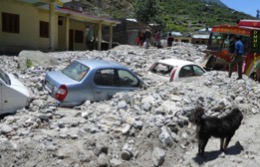
In the small town of Dharali, what followed was a devastating flash flood, a furious, churning torrent of mud, boulders, and memories that has once again scarred the soul of Uttarakhand.
The video clips, a digital torrent of grief and shock now going viral, show a force of nature that seems biblical in its power.
But to call this merely a “natural disaster” is to abdicate our own role in this recurring tragedy.
To label it a “cloudburst” is a convenient, but likely incomplete, diagnosis.
To truly honor those who have been lost, we must look beyond the tragic spectacle and ask the harder questions.
This is not a time for interrogation, but for introspection.
This is a tribute that must be paid not just in words of sorrow, but in the currency of hard-won wisdom.
Deconstructing the Deluge: Beyond the Cloudburst Narrative
News reports are quick to use the term “cloudburst.”
While the region has been undoubtedly facing exceptionally heavy rainfall events — a terrifying new normal in our warming climate — the physics of what we witnessed suggests a more complex and catastrophic mechanism.
General assertion that simple rainwater, however voluminous, would dissipate downslope sequentially is not just plausible; it is the most likely scientific explanation for what separates a flood from a sudden, violent “water front.”
A wall of water, mud, and debris moving with such explosive energy is almost always the signature of a breach event.
The most probable scenario is the formation and subsequent failure of a temporary lake in the upper reaches of the catchment. This happens in a deadly, two-step process:
- The Dam: Intense rainfall triggers a landslide high up in the mountains, out of sight. This mass of rock and debris falls into the path of a stream, creating a weak, unstable dam.
- The Deluge: Water begins to build up rapidly behind this earthen dam. The river’s discharge downstream, as observed from Dharali, would have likely reduced—a subtle, ominous warning. As the pressure of the growing lake increases, the unstable dam gives way. It doesn’t erode; it explodes.
The result is not a flood.
It is a Landslide Lake Outburst Flood (LLOF), releasing the entire volume of the lake in a single, catastrophic wave. This is not just water; it is a high-density slurry of debris that moves with the power to obliterate everything in its path.
The Geography of Grief: Why Here? Why Again?
The tragedy of Dharali is compounded by its predictability.
This is not the first time this community has faced the river’s fury. In 2013, the same nala brought down a torrent of debris that buried the national highway. This pattern reveals a fundamental, uncomfortable truth about our relationship with the mountains.
We have forgotten the River’s Right of Way.
Himalayan rivers are not gentle streams.
These are powerful, geological agents that have carved these valleys over millennia.
These have a memory, and their floodplains are not empty spaces; these are an integral part of the river’s channel during high-discharge events.
For centuries, our ancestors understood this. They built their homes high on stable slopes, choosing safety over comfort.
Today, driven by a complex mix of economic pressures and the magnetic pull of connectivity, we have done the opposite.
We have moved down from the secure ridges and built our shops, hotels, and homes on the river’s very doorstep, in the direct path of its fury.
We have mistaken the river’s low-flow channel for its permanent boundary, and we are repeatedly paying the price for this geographical amnesia.
The Human Fingerprint: Are We Making the Floods Angrier?
While the primary triggers are natural, our actions on the slopes are turning dangerous situations into catastrophic ones. The accelerated pace of construction—roads, buildings, hydropower projects — has led to a crisis of debris.
With no sound debris disposal policy, vast quantities of excavated rock and soil are unscientifically dumped on the slopes.
This anthropogenic debris does two things:
- A significant portion washes into the rivers, raising the riverbed (aggradation). A raised riverbed means the river needs less volume to burst its banks and cause a flood.
- The rest remains precariously perched, a new, unstable mass waiting for a downpour to mobilize it, adding to the destructive volume of any potential flash flood.
We are, in essence, pre-loading the cannons of a flood with more and more ammunition.
From Tribute to Action: A Blueprint for Mountain Resilience
A true tribute to the victims of Dharali is a solemn promise to break this cycle of predictable tragedy. This requires a paradigm shift, rooted in respect for the mountain’s power.
- Heeding the Whispers of the River: Mass awareness and capacity building are paramount. Communities living along rivers must be trained to become frontline observers, to recognize the subtle but critical warning signs like a sudden, unexplained reduction in river flow, which could indicate a dam formation upstream. Clear communication channels must be established to report such observations to authorities instantly.
- Mapping the Invisible Threats: We must urgently undertake detailed mapping of all catchments upstream of vulnerable habitations to identify potential landslide zones and areas where temporary lakes could form. This scientific foresight is the bedrock of any effective early warning system.
- Enforcing the River’s Right of Way: A strict, legally binding land-use zoning policy is non-negotiable. “No-construction zones” in high-risk floodplains must be demarcated and enforced without exception. Development must be pushed up, away from the river, reconnecting with the wisdom of our ancestors.
- Investing in Life-Saving Technology: We must deploy real-time monitoring systems in high-risk catchments. A network of automated weather stations, rain gauges, and river discharge sensors, coupled with satellite imagery analysis, can provide the data needed to issue timely and specific early warnings for LLDB and GLOF events.
Conclusion: The Only True Memorial is a Safer Future
The tragedy of Dharali is not an isolated event. It is a symptom of a deeper malaise in our approach to living in the Himalayas. It is the result of a collective amnesia, where we have forgotten the unwritten laws of the mountains in our pursuit of convenience.
We cannot tame the Himalayan rivers, but we can learn to respect their power and their space.
The viral videos of Dharali’s agony should do more than just shock us; these must educate us.
These must force us to acknowledge that the safest place to be is not in the path of a wounded, overburdened river.
The most profound tribute we can pay to the souls lost in Dharali is not in monuments of stone, but in a living legacy of change. It is in the courage to retreat from high-risk zones, in the wisdom to listen to the river’s warnings, and in the political will to build a future where our sacred valleys are known not for their tragedies, but for their resilience.
आज धराली में जो हुवा वह निश्चित ही दुखद था, पर सच मानिये यह अप्रत्याक्षित भी नहीं था।
2013 के बाद हमने कोई सबक नहीं लिया, हमने सुरक्षा की न तो बात की और न ही उसके लिए कुछ किया।
हमें लगा की यह ऐसे ही कोई घटना है जो आगे होगी नहीं –
तो देख लो नतीजे लापरवाही के –
और ये कोई आखिरी घटना नही है।
हमें हमेशा की तरह आपके सुझावों, प्रतिक्रियाओं व कटाक्षो का बेसब्री से इंतजार रहता हैं और सच मानिये इसी के आधार पर हम अपने आप में, अपनी सोच व रचनात्मकता में सुधार करने को प्रेरित होते हैं।
सो अच्छा – बुरा जैसा आपको महसूस हुवा हो, कमेंट जरुर करते रहें।
दुःख भी अफ़सोस भी, लगाव भी और बिखराव भी,
The thoughtful article. Obviously humans are forgetful and does not learn from past events. The sudden rise of debris laden water caused havoc in those areas of Dharali where the population has made settlements over the flood plain on the outer river bend. Hope new policies will ban the new constructions with a free board above highest flood levels.
The article is very lucidly written with the past experience of the author in disaster domain and suggestions for early warning system should be seriously considered.
Thanks so much for this well-articulated piece from the heart!
धराली की घटना की विशद् व्यख्या । यह प्रकृति से छेड़छाड़ और दोहन का नतीजा है। हार्दिक बधाई।
Sach mein bohat hi dukh ho rha hai is ghatna ko dekh kar , pta ni log ku ni jagruk ho rhe pichli ghatnaon ko dekh kr bhi , logon ko ped lgake ke liye jagruk Krna chahiye , har saal itne programs hote h pedon ko lekar lekin phir bhi log wahi kaam krte hai jo nhi Krna chahiye , nadiyon ke pass ghr dalte hai , pedon ko kat te hai , or jab nuksan hota hai , fir rote hai , sabhi ko samjh na chahiye sarkar ka bhi ismein role hona chahiye ki agr koi bhi ped kat ta hai ya pani ke ass pass ghr dalta hai toh use turant roka jaye , logon ke sath sath sarkar bhi yeh role hai ki vo bde bde complex bnane ke liye ya or kisi bhi parkar ki building bnate hai toh jitne bhi us samay ped kt te hai ussse jyada pedon ko lgaya bhi jaye .