 Santa points to the layer of new silt with a look of mild annoyance.
“Look at this mess the river left behind, Banta!”
“Every time it swells, it throws its mud everywhere.”
“So untidy!”
“Thank goodness for those big embankments they are building upstream to stop this nuisance for good!”
Banta chuckles, picking up a handful of the dark, moist silt. He lets it run through his fingers like fine grains of gold.
“Santa, my friend,” he says with a smile, “what you call a ‘mess,’ the ancient Pharaohs of Egypt would have called a Daawat – a grand feast!”
“They would have declared a Daawat for this!”
“A festival?”
“For mud?” Santa asks, utterly baffled.
“Not for mud, Santa, but for life!” Banta explains.
“The great ancient civilizations – in Egypt along the Nile, in Mesopotamia, and in our own Indus Valley – they didn’t see the annual flood as a curse.”
“They saw it as the river’s greatest Vardaan.”
“This silt, laden with nutrients from the high mountains, was a free, divine gift of fertilizer.”
“It was this annual top-up of fertility that allowed them to grow bountiful crops year after year, feeding entire empires.”
He continues, “The Egyptians even based their calendars on the river’s rhythms.”
“The flood wasn’t a time of fear, but of renewal, of celebration.”
“They knew the river would rise, so they built their homes on higher ground.”
“They knew it would recede, so they chose crops that thrived in its wake.”
“They worked with the river, not against it.”
“They had the power to build giant pyramids, Santa, but you don’t find them building massive walls to confine the entire Nile.”
“Why?”
“Because they were wise enough not to lock up the goose that laid the golden egg, or in this case, the golden silt!”
Santa looks at the silt on the field with a completely new perspective.
“So, this mud is actually Mitti ka Sona?”
“And the ancients welcomed it?”
“They lived by a ‘flood calendar’?”
“They did!” Banta affirms.
“They understood that a river needs space to breathe, to stretch, and to share its gifts.”
“Their wisdom was in adaptation, not confrontation.”
“They respected the river’s power and in return, the river bestowed upon them its prosperity.”
“The real nuisance began much later, when we started thinking we were smarter than the river.”
संता – बंता की इस जुगलबन्दी से आज हमने क्या सीखा:-
-
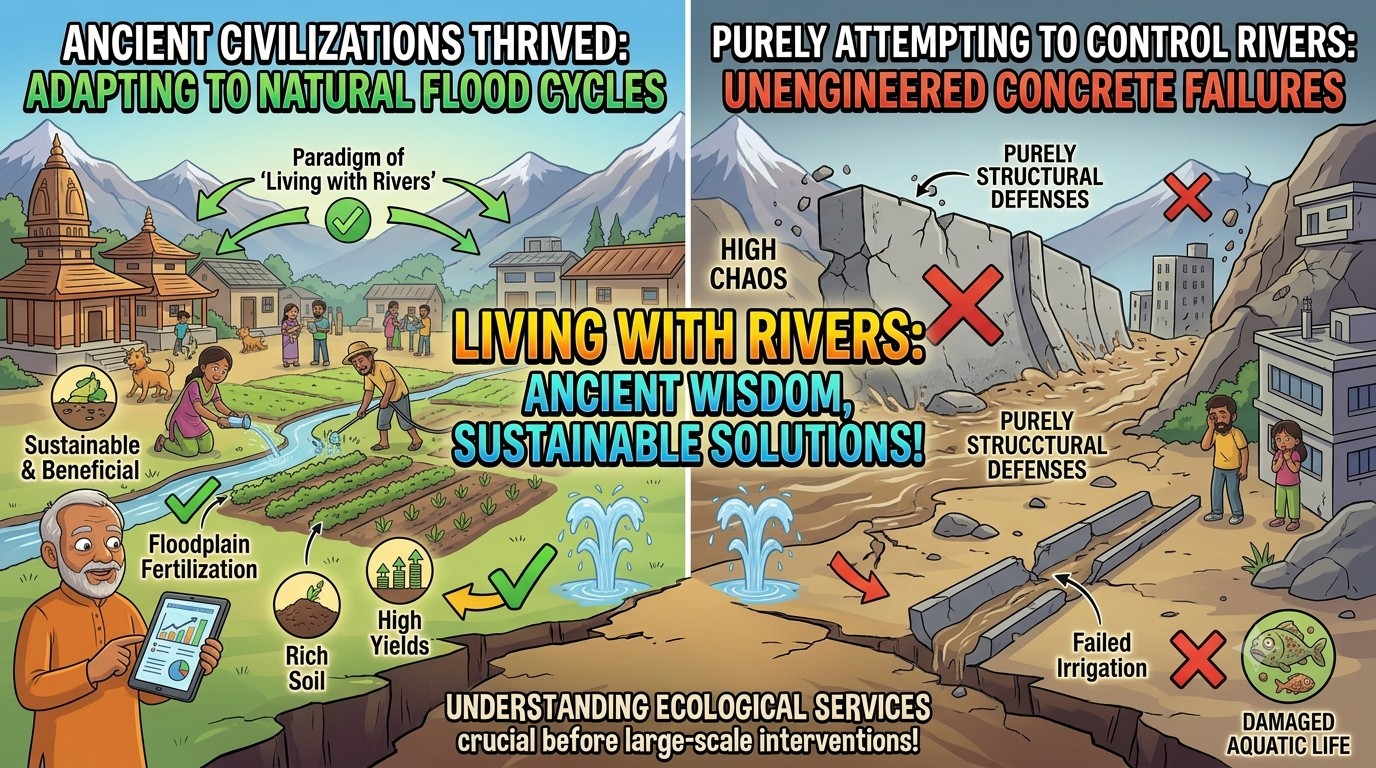
प्राचीन सभ्यताये नदियों के प्राकृतिक बाढ़ चक्रों के अनुसार ढलकर फली-फूलीं, और वे बाढ़ से मिलने वाले लाभों (जैसे बाढ़ के मैदानों की उपजाऊ मिट्टी) का बुद्धिमानी से उपयोग करती थीं / Ancient civilizations thrived by adapting to the natural flood cycles of rivers, utilizing the floods‘ benefits like floodplain fertilization.
-
नदियों को पूरी तरह से नियंत्रित करने की कोशिश करने के बजाय “नदियों के साथ मिलकर रहने” की सोच अधिक टिकाऊ और फायदेमंद हो सकती है / A paradigm of “living with rivers” can be more sustainable and beneficial than one of purely attempting to control them.
-
बड़े पैमाने पर इंजीनियरिंग या निर्माण कार्य शुरू करने से पहले, बाढ़ के प्राकृतिक बहाव से पर्यावरण को मिलने वाले फायदों को समझना बेहद ज़रूरी है / Understanding the ecological services provided by natural flood pulses is crucial before implementing large-scale engineering interventions.
संता – बंता की यह जुगलबन्दी आपको कैसी लगी, कृपया हमें जरुर बताये
व
इस जुगलबन्दी को बेहतर बनाने के लिये अपने सुझाव अवश्य दें।
हमें हमेशा की तरह आपके सुझावों, प्रतिक्रियाओं व कटाक्षो का बेसब्री से इंतजार रहता हैं औरसच मानिये इसी के आधार पर हम अपने आप में, अपनी सोच व रचनात्मकता में सुधार करने को प्रेरित होते है।
सो अच्छा – बुरा जैसा आपको महसूस हुवा हो, कमेंट जरुर करते रहें।
Leave a Reply