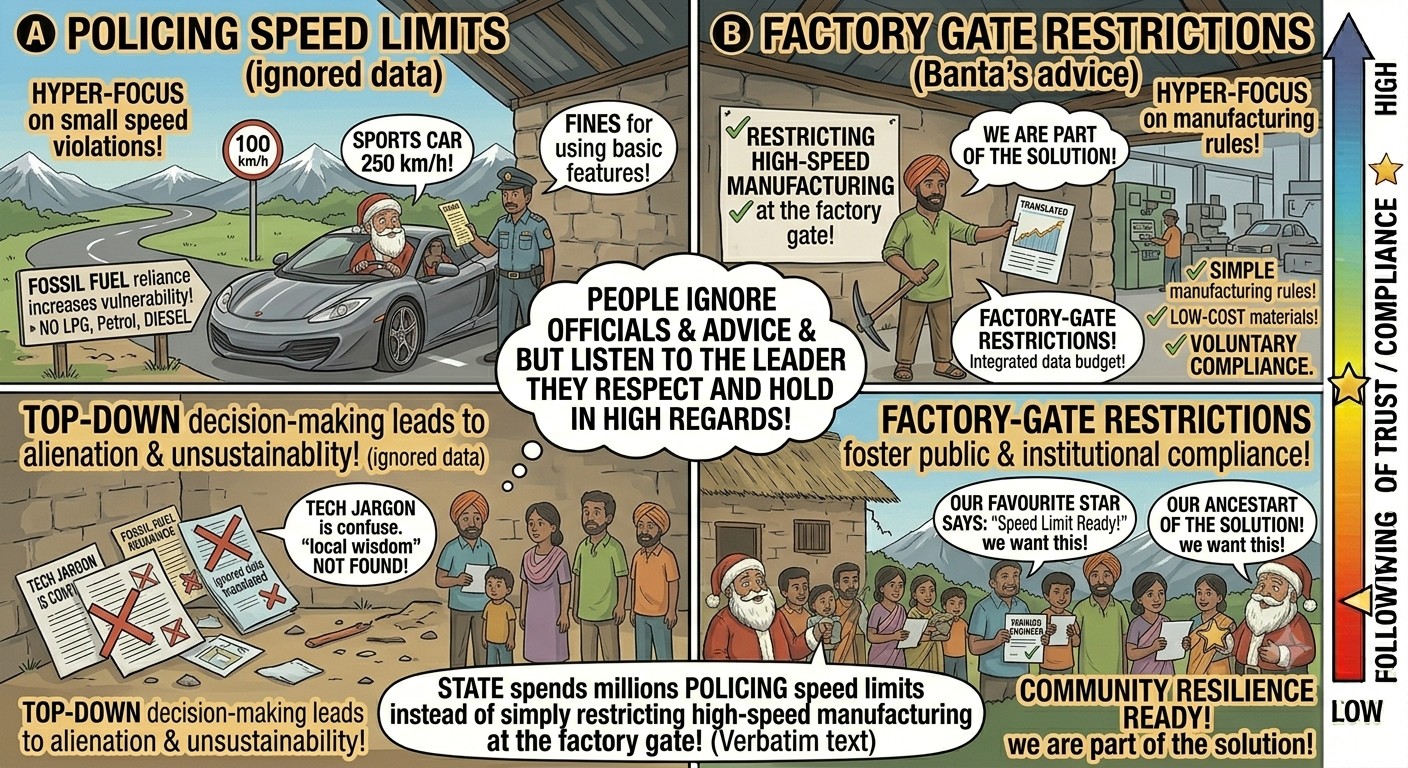
 Santa was standing in his driveway, admiring a brand-new, sleek, fiery-red sports car.
It had dual exhaust pipes, aerodynamic spoilers, and a digital speedometer that capped out at a staggering 250 kilometers per hour.
He was wearing driving goggles and a leather jacket, looking like a racing champion.
Banta walked into the courtyard, holding a government notification sheet and a tape measure.
He looked at the speedometer through the car window and then at Santa.
“Oye, Santa-ji!”
“Are you planning to join the Formula 1 circuit, or are you just trying to see how fast you can get your driving license cancelled by the transport authority?”
Santa patted the steering wheel proudly.
“Banta, this is the machine of the future!”
“It can touch 100 km/h in three seconds flat!”
“It is pure mechanical progress!”
Banta held up the official notification sheet.
“Santa-ji, the state has strictly prescribed a speed limit of 80 km/h on this state highway and 100 km/h on the expressway.”
“They have installed speed cameras, deployed highway police interceptors, and constituted high-level Road Safety Committees to curb accidents.”
“Over-speeding is recognized as the biggest killer on our roads.”
“If you cross 80, the state will fine you heavily.”
“So tell me, why did you buy a machine that goes 250?”
“Because the company manufactures it to go 250, Banta!” Santa argued.
“If it’s an offense to drive at 250, why does the state allow the showroom to sell it to me?”
Banta sat on the bonnet of the car and sighed.
“That, Santa-ji, is the great governance dilemma.”
“The state spends millions on policing, speed-calming measures, and awareness drives to stop you from speeding, but it allows the factory to manufacture a land-rocket!”
“They can mandate electronic speed governors in commercial vehicles, yet they leave private vehicles unrestricted at the assembly line.”
“It’s a classic contradiction: the state punishes the consumer for utilizing the exact capacity that the manufacturer was legally allowed to sell!”
Santa stared at his high-speed dashboard, suddenly feeling very confused.
“So… I bought a tiger, but the government says I can only walk it like a puppy?”
“Precisely, Santa-ji,” Banta smiled.
“A welfare state should enforce safety at the factory gate, not just blame the driver at the toll plaza.”
संता – बंता की इस जुगलबन्दी से आज हमने क्या सीखा:-
- स्रोत पर न्यूनीकरण बनाम व्यवहार नियंत्रण / Mitigation at Source vs. Behavioral Policing:
- वास्तविक जोखिम न्यूनीकरण (risk mitigation) निर्माण के स्तर पर होना चाहिए। गति सीमा तय करने के बावजूद अत्यधिक तेज गति वाले वाहनों के निर्माण की अनुमति देना वित्तीय और नैतिक बोझ पूरी तरह से उपभोक्ता और पुलिस पर डालता है / True risk mitigation must happen at the point of production. Allowing the manufacture of high-speed vehicles while policing speed limits shifts the fiscal and moral burden entirely onto the consumer and enforcement agencies.
- सुरक्षा नियमों में संरचनात्मक एकरुपता / Structural Consistency in Safety Regulations:
- आपदा जोखिम न्यूनीकरण के लिए मैक्रो-नीतियों में एकरुपता आवश्यक है। विनिर्माण के स्तर पर ही खतरनाक उत्पाद क्षमताओं को प्रतिबंधित करना, दंडात्मक उपायों के माध्यम से जन-व्यवहार को नियंत्रित करने की तुलना में कहीं अधिक प्रभावी है / Disaster risk reduction requires consistency across macro-policies. Banning or limiting hazardous product capabilities at the assembly stage is more effective than attempting to control mass behavior through punitive measures.
संता – बंता की यह जुगलबन्दी आपको कैसी लगी, कृपया हमें जरुर बताये
व
इस जुगलबन्दी को बेहतर बनाने के लिये अपने सुझाव अवश्य दें।
हमें हमेशा की तरह आपके सुझावों, प्रतिक्रियाओं व कटाक्षो का बेसब्री से इंतजार रहता हैं औरसच मानिये इसी के आधार पर हम अपने आप में, अपनी सोच व रचनात्मकता में सुधार करने कोप्रेरित होते हैं।
सो अच्छा – बुरा जैसा आपको महसूस हुवा हो, कमेंट जरुर करते रहें।
#RoadSafety #MitigationAtSource #PolicyParadox #SpeedGovernors #GovernanceDilemma #SantaBantaStories
Leave a Reply