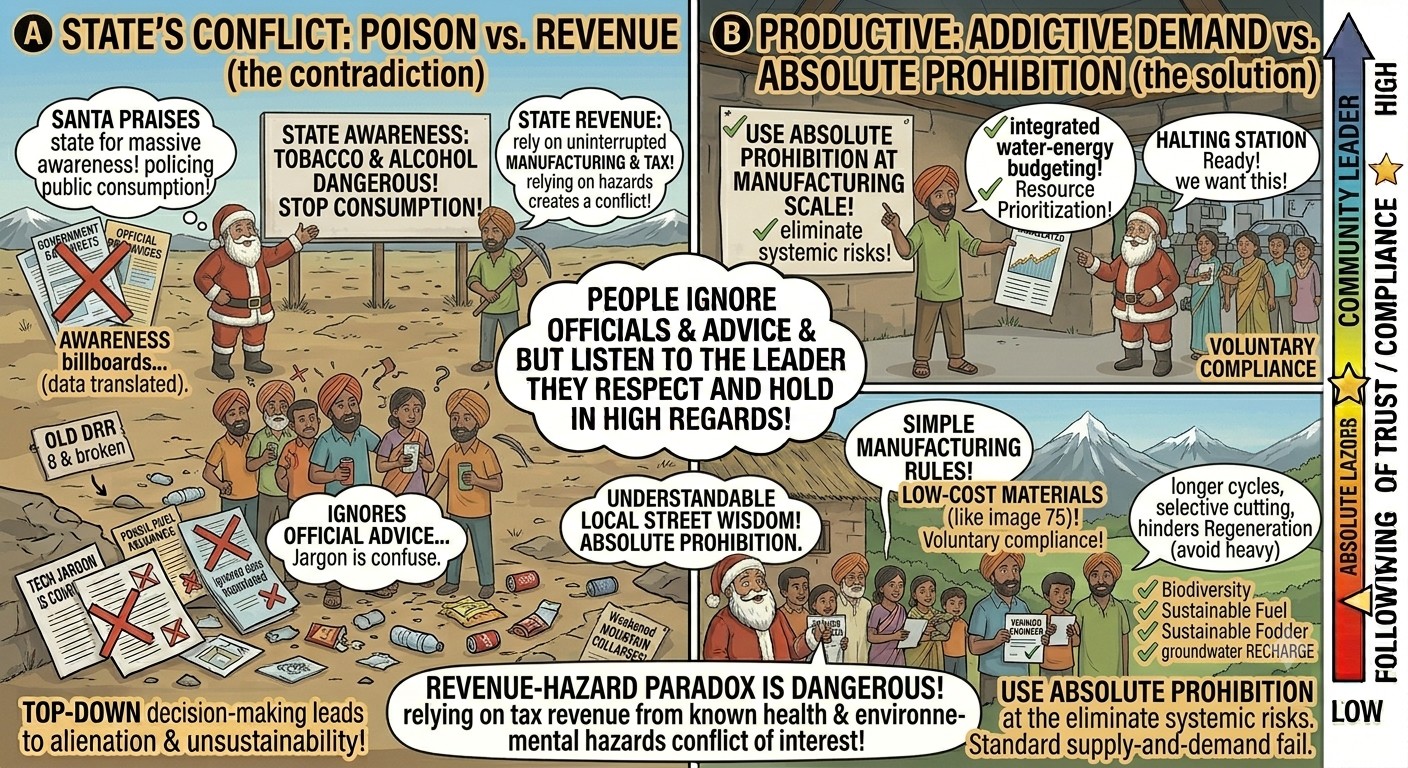
 Santa and Banta were sitting outside the Gram Panchayat office, looking at a massive public health advertisement painted on the wall.
The ad showed graphic images of lung damage from smoking and liver failure from alcohol, accompanied by bold warning text: “TOBACCO AND ALCOHOL DESTROY FAMILIES. PUBLIC CONSUMPTION IS A PUNISHABLE OFFENSE.”
Santa shook his head, looking deeply moved.
“Banta, the state cares so much about our welfare.”
“They have banned smoking in public places, prohibited sales to minors, and completely banned advertising to protect our health.”
“They are spending crores on these awareness drives!”
Banta smiled dryly, pointing a finger at a licensed government liquor store and a tobacco kiosk operating legally just fifty meters away from the health billboard.
“Santa-ji, the state is acting like a doctor who sells you the poison in the morning and charges you for the medicine in the evening.”
“Oye Banta!”
“What kind of talk is that?”
“The government doesn’t sell tobacco!” Santa said, shocked.
“No, but they collect the excise duty and manufacturing taxes on every single bottle and cigarette pack produced, Santa,” Banta explained.
“Most states enjoy massive revenue generation from the sale of these items.”
“No state has banned their actual manufacture.”
“They consider these products a burden on public health infrastructure, yet they rely on them to fill the treasury.”
“It’s a complete moral circle.”
Santa looked from the scary health ad to the busy liquor store.
“So… if they ban the production, the diseases vanish, the awareness budget drops to zero, and the public is safe?”
“Yes,” Banta said.
“But the revenue drops too.”
“Rules of supply and demand suggest production ends when demand stops, but when a product is addictive, demand never stops on its own.”
“A true welfare state is morally and structurally bound to prioritize public welfare and the long-term national exchequer over short-term tax revenue.”
“Banning the production of known hazards is the ultimate test of a government’s safety compass.”
“Until you close the distillery and the tobacco processing plant, the billboard on the wall is just a high-priced mask!”
Santa stood up and walked away from the tobacco kiosk. “You’re right, Banta.”
“If the state won’t stop the factory, I’ll stop my own demand.”
“My family’s treasury is better off without buying their legal poison!”
संता – बंता की इस जुगलबन्दी से आज हमने क्या सीखा:-
- राजस्व-जोखिम विरोधाभास / The Revenue-Hazard Paradox:
- ज्ञात स्वास्थ्य और पर्यावरणीय खतरों से कर-राजस्व (tax revenue) पर निर्भरता जोखिम शासन में हितों का टकराव पैदा करती है, जिससे सार्वजनिक स्वास्थ्य और आपदा प्रतिरोध्यता सम्बन्धित नीतियां कमजोर होती हैं / Relying on tax revenue from known health and environmental hazards creates a conflict of interest in risk governance, undermining public health and disaster resilience policies.
- व्यसनकारी मांग बनाम वैधानिक निषेध / Addictive Demand vs. Statutory Prohibition /:
- जब उत्पाद व्यसनकारी (addictive) होते हैं, तो सामान्य आपूर्ति-और-मांग के नियम विफल हो जाते हैं। प्रणालीगत जोखिमों को समाप्त करने के लिए विनिर्माण स्तर पर पूर्ण प्रतिबंध लगाया जाना चाहिये / Standard supply-and-demand market forces fail when products are addictive or institutionalized. Regulatory agencies must use absolute prohibition at the manufacturing scale to eliminate systemic risks.
संता – बंता की यह जुगलबन्दी आपको कैसी लगी, कृपया हमें जरुर बताये
व
इस जुगलबन्दी को बेहतर बनाने के लिये अपने सुझाव अवश्य दें।
हमें हमेशा की तरह आपके सुझावों, प्रतिक्रियाओं व कटाक्षो का बेसब्री से इंतजार रहता हैं औरसच मानिये इसी के आधार पर हम अपने आप में, अपनी सोच व रचनात्मकता में सुधार करने कोप्रेरित होते हैं।
सो अच्छा – बुरा जैसा आपको महसूस हुवा हो, कमेंट जरुर करते रहें।
#PublicHealthPolicy #ExciseRevenue #RiskGovernance #MoralCompass #SocioEconomics #SantaBanta
Leave a Reply