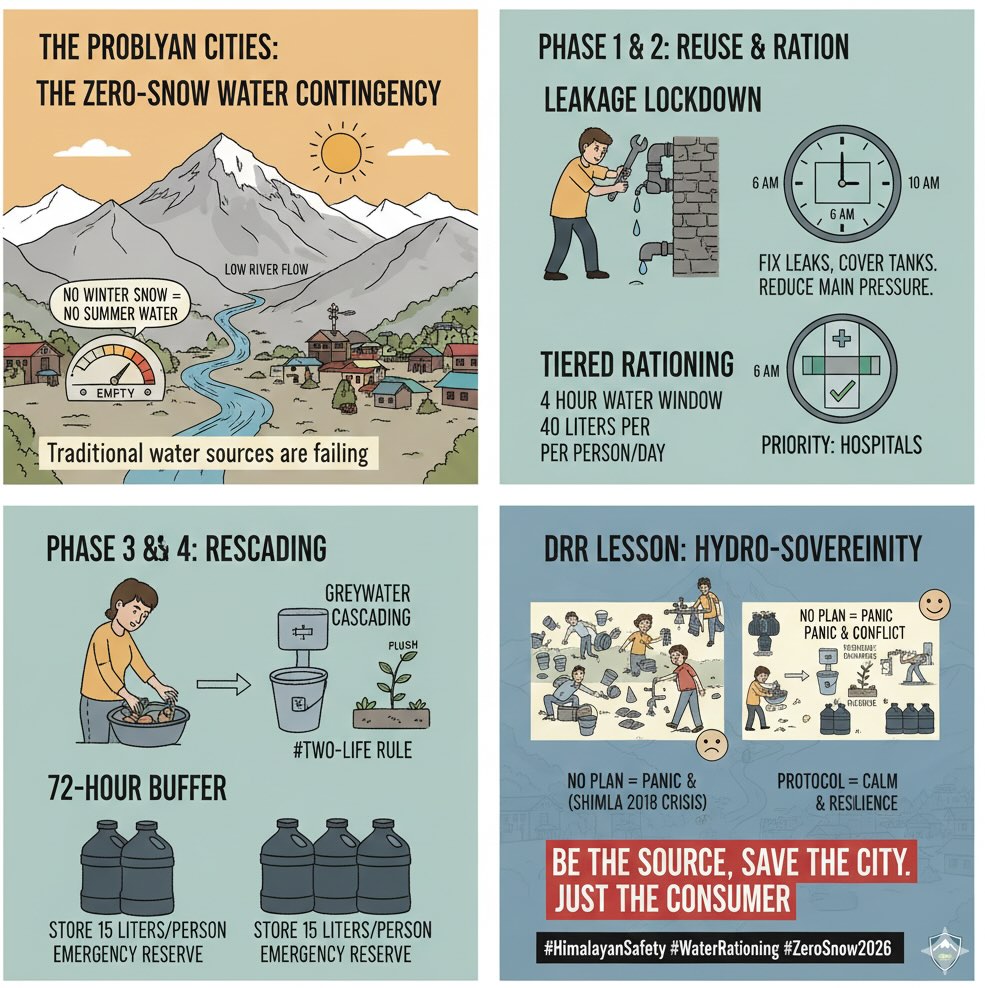
The Himalayan peaks, historically our “Water Towers,” stand today as silent, snowless sentinels. As we navigate through January 2026, the unprecedented failure of winter precipitation has shifted the region from a state of seasonal dryness to a Hydrological Emergency.
For our urban centers—perched on steep ridges and heavily dependent on energy-intensive pumped water systems—this is not merely a shortage; it is a systemic threat to our stability.
When the springs recede and the electricity grids strain under the weight of lifting water from distant valleys, the myth of an “unlimited supply” evaporates.
In the mountains, water is not just a commodity; it is the Arterial Integrity of our existence. This protocol is not just a set of restrictions; it is a Pact of Solidarity. It is a shift from the extractive mindset of “how much can I use?” to the resilient mindset of “how much can we save?”
We must realize that in this parched winter, a single drop wasted at the ridge is a liter stolen from the valley.
The “Zero-Snow” Contingency is our roadmap to Hydro-Sovereignty, ensuring that through collective discipline and decentralized recycling, our mountain cities do not become “Logistical Black Holes,” but remain living, breathing bastions of resilience.
Phase I: The Audit & Leakage Lockdown (Immediate)
Before rationing begins, the community must ensure that every drop entering the system is used.
- The “Weep” Audit: Community volunteers must inspect all exposed gravity-fed pipes. In the current “Thermal Compression” cycle, micro-cracks in PVC and metal pipes are common.
- Airtight Storage: Ensure all communal and individual tanks are covered. In dry, high-altitude air, evaporation can claim up to 5% of stored water daily.
- The “Pressure Drop”: Reduce main line pressure by 20%. This significantly decreases the volume lost through “silent leaks” in aging infrastructure.
Phase II: The Tiered Rationing Schedule
To prevent “Logistical Black Holes,” water distribution should be moved to a timed, predictable cycle.
- The 4-Hour Window: Water supply is restricted to a specific 4-hour window (e.g., 0600 to 1000 hrs). This allows the “head” (pressure) in the tanks to recover for 20 hours.
- Priority Allocation:
- Life-Support: Hospitals and clinics receive 100% of their baseline needs.
- Sanitation:Communal toilets and sewage-clearing systems receive 70%.
- Household: 40 Liters Per Capita Per Day (LPCD) as a hard ceiling.
Phase III: Greywater Cascading (The “Two-Life” Rule)
Every liter of water must serve at least two purposes before it enters the drain.
- The Kitchen-to-Curb Rule: Water used for washing vegetables or boiling food (once cooled) must be collected in buckets to be used for flushing toilets or “Thermal Mulching” for community plants.
- The Hygiene Loop: Water from bathing should be diverted to manual laundry or floor cleaning.
Phase IV: The “Hydro-Sovereignty” Reserve
Each household must maintain a “Strategic Reserve” that is never touched for daily use.
- The 72-Hour Buffer: A minimum of 15 liters per person must be stored in sealed, dark containers. This is the “Inviolable Reserve” for a total system failure or a forest fire event where main lines are diverted for firefighting.
DRR Lesson: “The Friction of Scarcity“
विश्व भर के शहरी क्षेत्रों में विगत में हुवे जल संकटो का इतिहास हमें चेतावनी देता है कि वास्तविक संकट नलों में पानी आना बंद होने से काफी पहले तब शुरू हो जाता है जब हमारे नलों में भरपूर पानी आ रहा होता है, जिसे देख कर हम पानी की कमी वाली वस्तुस्थिति को नकार देते है। इस नियमावली के अनुरूप आज और अभी से पानी की हर बूँद को बचा कर शायद हम वर्षा के द्वारा भू-जल की पूर्ति किये जाने तक स्थिति को सामान्य बनाये रख पाने में सफल हो जाये / The history of urban water collapses warns us that the crisis doesn’t begin when the taps run dry; it begins when we fail to acknowledge the scarcity while the pipes are still full. By implementing this protocol today, we are effectively “stretching” our current reservoir levels to buy the time necessary for the spring recharge.
The silent, dry conduits of historical droughts and the panic of modern ‘Day Zero‘ cities warn us that water is a fleeting guest that only stays where it is respected. These past events tell us that geography is no protection against mismanagement; a mountain can be as parched as a desert if we do not value the flow. Our ongoing initiatives in ‘Community Rationing’ and ‘Greywater Cascading‘ prove that we have the tools to survive this ‘Precipitation Bankruptcy,’ but history warns us that if we do not internalise the reality of scarcity today, we will be forced to endure the tragedy of exhaustion tomorrow. Today tells us the peaks are bare and the springs are low; it warns us that in the Himalayas, the only truly infinite resource is our capacity to adapt.
Leave a Reply