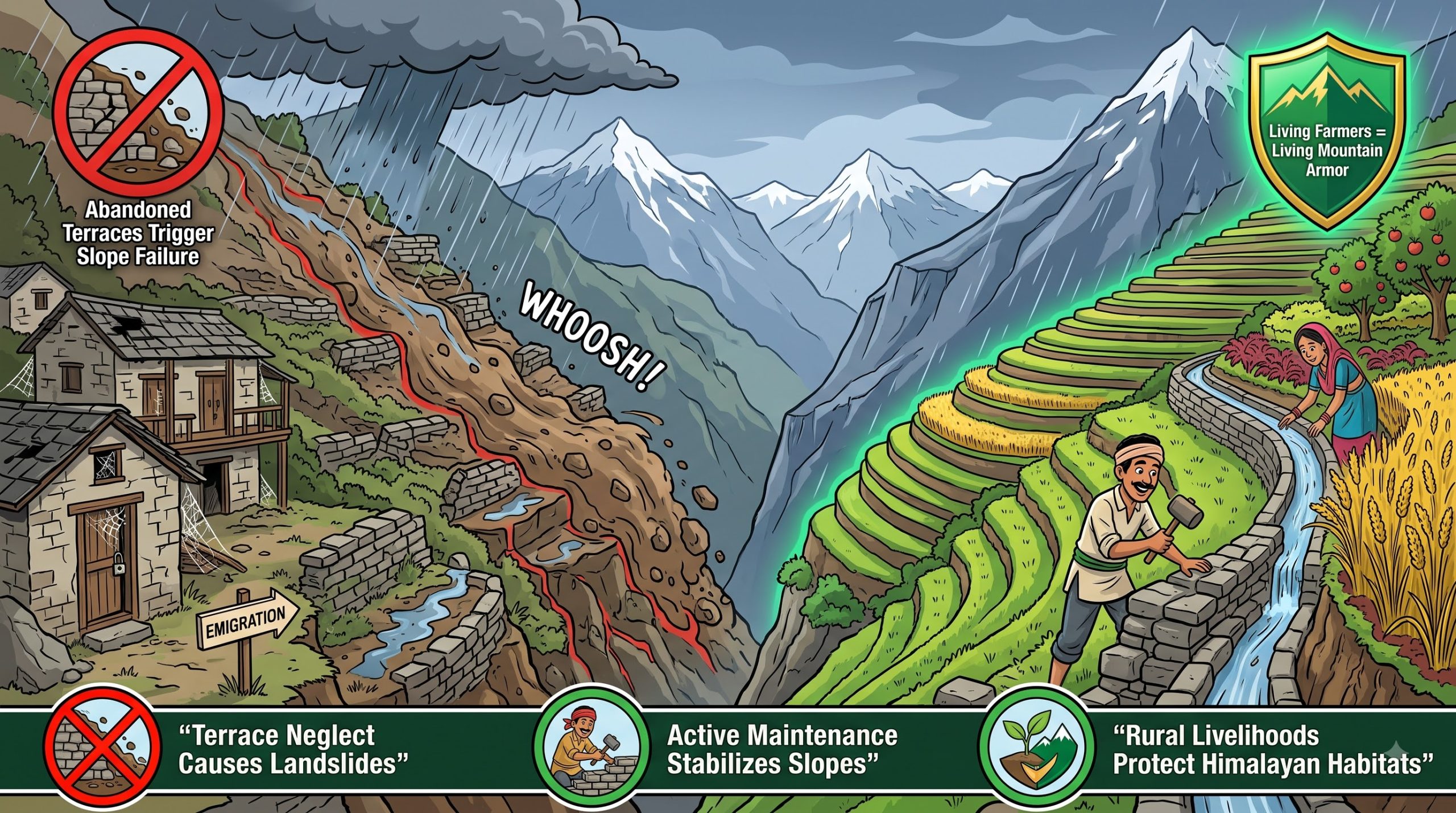
 “Banta,” Santa says, pointing with a trembling finger, “Look at old Rampur village slope!”
“It used to be a patchwork quilt of green fields.”
“Now, it looks like a giant beast has clawed the mountain’s face!”
“That landslide… it happened on land that was farmed for centuries!”
“How is that possible?”
Banta looks at the scar with deep sadness.
“The beast that clawed the mountain, Santa, was not a beast of nature.”
“It was the beast of our Udaseenta.”
“The land did not attack the people; it simply tried to reclaim itself after the people left it orphaned.”
“Orphaned?” Santa asks.
“Yes,” Banta says, his voice taking on a spooky, storytelling tone.
“For generations, the people of Rampur were the land’s guardians.”
“Every year, before the monsoons, the men and women would tirelessly repair the stone walls of their terraces.”
“They would clear the Guls.”
“Their feet, walking on the paths, kept the soil compact.”
“Their crops, with their roots, held the earth together.”
“There was a pact, a promise, between the people and the land: You feed us, said the people, and we will care for you.”
He pauses. “But then, the young generation left for the city.”
“The old hands got too tired to lift the heavy stones.”
“The walls began to crumble.”
“The water channels choked.”
“The land became an orphan, with no one to mend its clothes or comb its hair.”
“The pact was broken.”
“So the land got angry?” Santa whispers.
“Not angry, Santa.”
Hungry,” Banta corrects, his voice chilling.
“A wild, untended land has a natural hunger to return to its original state – a steep, wild slope.”
“The terrace walls were the only things holding back that hunger.”
“With the guardians gone, the first heavy monsoon came like a signal.”
“The choked channels overflowed, the weak walls collapsed, and the hungry land finally took back what it had been denied for centuries.”
“That landslide wasn’t a freak accident; it was a hungry ghost reclaiming its territory.”
“The real horror is that the guardians left the gate unlocked before the beast came knocking.”
Santa stares at the scarred hillside, imagining the terraces like broken promises, and shivers at the thought of the land’s patient, hungry wait.
संता – बंता की इस जुगलबन्दी से आज हमने क्या सीखा:-
-
हिमालय में सीढ़ीदार खेत (Terraces) केवल फसल उगाने के साधन नहीं हैं; वे ढलानों के स्थिरीकरण और भू-प्रबंधन की अत्यंत महत्वपूर्ण संरचनाये हैं, जिन्हें निरंतर रख-रखाव और देखभाल की आवश्यकता होती है / Agricultural terraces in the Himalayas are not just fields; these are crucial slope management structures that require continuous maintenance.
-
पहाड़ों से ग्रामीणों के पलायन के कारण ये सीढ़ीदार खेत लावारिस होकर बिखरने लगते हैं, जिससे भारी मानसूनी बारिश के दौरान पहले से स्थिर ढलानें भी भू-स्खलन के प्रति अत्यधिक संवेदनशील हो जाती हैं / Rural depopulation leads to the abandonment and decay of these terraces, making previously stable agricultural slopes highly vulnerable to landslides during heavy rains.
-
ग्रामीण आजीविका को सशक्त बनाना न केवल आर्थिक दृष्टि से अनिवार्य है, बल्कि इस नाज़ुक और संवेदनशील पर्वतीय परिदृश्य को प्रबंधित और स्थिर रखने के लिए वहाँ इंसानी मौजूदगी को बनाए रखने की एक अनिवार्य आवश्यकता भी है / Supporting rural livelihoods is essential not just for economic reasons, but to maintain the human presence required for managing and stabilizing the fragile mountain landscape.
संता – बंता की यह जुगलबन्दी आपको कैसी लगी, कृपया हमें जरुर बताये
व
इस जुगलबन्दी को बेहतर बनाने के लिये अपने सुझाव अवश्य दें।
हमें हमेशा की तरह आपके सुझावों, प्रतिक्रियाओं व कटाक्षो का बेसब्री से इंतजार रहता हैं और सच मानिये इसी के आधार पर हम अपने आप में, अपनी सोच व रचनात्मकता में सुधार करने को प्रेरित होते हैं।
सो अच्छा–बुरा जैसा आपको महसूस हुवा हो, कमेंट जरुर करते रहें।
Leave a Reply