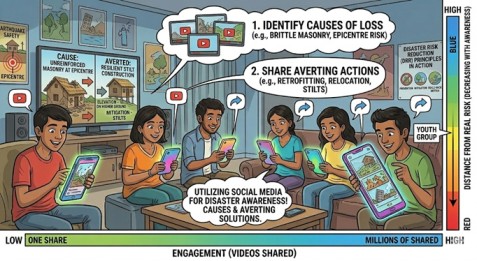
 Santa and Banta were sitting in a local tea stall, watching a news channel flash dramatic headlines about a massive earthquake and subsequent house collapses triggered by a tremor in a neighbouring mountain state of Uttarakhand.
A group of youth at the next table were laughing, re-sharing the video clip, and adding funny overlay emojis to maximize their online shares.
Santa took a sip of his tea and chuckled.
“Oye Banta, look at that!”
“Those folks built their houses right over the cliff edge!”
“What a bunch of fools!”
“Thank goodness we are smart, sitting here safely in our own market.”
“This video is getting millions of shares across India right now!”
Banta didn’t join the laughter.
He looked out the window at the tea stall’s own ceiling—which was made of a heavy, unreinforced concrete slab supported by thin brick walls, packed tightly against fifty other identical buildings along a narrow, choked alley.
“Santa-ji,” Banta said, his voice dropping an octave.
“You are deriving a strange, hidden joy out of that video, thinking their misery is a distant entertainment show.”
“You think geography separates your fate from theirs, but your structural vulnerability is a perfect twin to that collapsed cliffside house.”
“Oye Banta!”
“What kind of dark talk is that?”
“We are in a different state!”
“That disaster is hundreds of kilometers away!” Santa protested, setting his glass down.
“Tectonic stress doesn’t read administrative boundaries, Santa,” Banta said firmly.
“This psychological trap—where we watch disasters online and think ‘it won’t happen to me’—is our biggest vulnerability.”
“We live in high-density, seismically active zones.”
“The long quiescence period under our feet means a major event is a statistical certainty, not an ‘if.’”
“While we are clicking ‘share’ and laughing at their bad construction, time is running out for ours.”
“We need to stop using social media to distance ourselves from risk.”
“We must use it to launch community-led emergency response teams, share evacuation route maps, and organize mass house audits.”
“If we don’t change our attitude today, tomorrow our neighbours will be sharing videos of our market collapsing to get clicks on their feeds!”
Santa looked up at the heavy concrete ceiling, the laughter completely draining from his face.
He slowly pulled out his phone, deleted the funny emoji overlay, and typed a serious message to his neighbourhood WhatsApp group: “Brothers, let’s meet this Sunday to clear our emergency exit paths. The clock is ticking.”
संता – बंता की इस जुगलबन्दी से आज हमने क्या सीखा:-
- अति-आत्मविश्वास से उबरना / Overcoming the Optimism Bias:
- दूरदराज की आपदाओं को देखकर यह सोचना कि “हमारे साथ ऐसा नहीं होगा” एक खतरनाक मानसिक भ्रम है। सोशल मीडिया का उपयोग बाहरी विसंगतियों को देखकर अपने स्थानीय स्तर पर सुधार करने के लिये किया जाना चाहिये / Watching remote disasters often reinforces a dangerous “optimism bias,” making communities believe they are immune. Social media must be used to map local parallels and translate external failures into immediate local mitigation.
- सामाजिक-डिजिटल तैयारी / Socio-Digital Preparedness:
- डिजिटल प्लेटफॉर्म की अपार क्षमता का उपयोग आपदा घटित होने से पहले आपातकालीन निकासी नियमों, स्थानीय घातकता मानचित्रों (vulnerability maps) और पारिवारिक सुरक्षा योजनाओं के प्रचार – प्रसार के लिये किया जाना चाहिये / The high viral potential of digital platforms should be strategically re-engineered to distribute emergency evacuation protocols, local vulnerability maps, and family safety plans before a crisis occurs.
संता – बंता की यह जुगलबन्दी आपको कैसी लगी, कृपया हमें जरुर बताये
व
इस जुगलबन्दी को बेहतर बनाने के लिये अपने सुझाव अवश्य दें।
हमें हमेशा की तरह आपके सुझावों, प्रतिक्रियाओं व कटाक्षो का बेसब्री से इंतजार रहता हैं औरसच मानिये इसी के आधार पर हम अपने आप में, अपनी सोच व रचनात्मकता में सुधार करने कोप्रेरित होते हैं।
सो अच्छा – बुरा जैसा आपको महसूस हुवा हो, कमेंट जरुर करते रहें।
#OptimismBias #RiskPerception #CommunityResponse #SeismicThreat #BehavioralAdaptation #SantaBanta
Leave a Reply