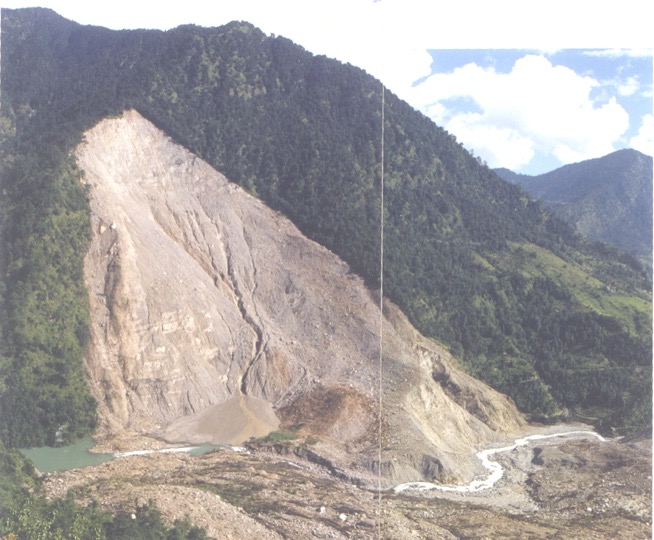
 Santa points towards a large, old landslide scar on the mountainside, now covered with mature trees and thick bushes.
“Look, Banta!”
“That’s where the ‘Great Slip‘ happened when our grandfathers were young.”
“A huge chunk of the mountain came down.”
“Such a destructive, ugly scar it was for years.”
“It’s amazing how nature has tried to heal it with greenery.”
Then he notices a small, clear spring trickling out from the base of the old slide.
“But wait… how can water be coming out from such a cursed place?”
“Surely, a landslide just destroys everything, including water sources?”
Banta smiles knowingly.
“Santa, what we often see as just a ‘scar‘ or a ‘cursed place’ can, over a very long time, transform in remarkable ways.”
“The mountain has its own slow magic.”
“That old landslide, after its initial fury, has likely become a ‘paani ka anmol ghada‘ for this area.”
“Inside that pile of rubble?” Santa asks, incredulous.
“Exactly,” Banta explains.
“Think about it.”
“When that landslide happened, it was a chaotic mix of big boulders, small stones, soil, clay, and silt.”
“For many years, as the monsoon rains fell on this loose debris, the water would percolate down.”
“Initially, it would wash away some of the finest particles, the clay and silt – a process scientists call ‘piping of fines‘.”
“So, it was cleaning itself?”
“In a way, yes,” Banta continues.
“But here’s the clever part.”
“This landslide debris isn’t uniform, like sand in a sack.”
“It has many large, immovable boulders trapped within it.”
“As the water carried these finer clay and silt particles downwards, these big boulders acted like filters or barriers, slowing down the water in certain places.”
“This allowed those fine particles to settle and deposit deep within the landslide mass.”
“So, the mud got trapped by the big stones inside?” Santa tries to visualise.
“Precisely!” Banta affirms.
“Over many, many rainy seasons, perhaps hundreds of years, this continuous process of finer particles being washed down and then settling against these internal barriers of larger rocks gradually formed a dense, continuous layer deep inside the landslide.”
“A layer so compact that water could no longer easily pass through it – an impervious layer, much like a clay pot buried underground.”
He gestures to the green patch above the spring.
“Now, the loose, porous material above this hidden clay-like layer, the old landslide debris, acts like a sponge.”
“It soaks up the monsoon rainwater.”
“But because the water cannot seep further down past that impervious layer, it gets stored there, forming what we call a ‘perched aquifer‘ – a small, elevated body of groundwater.”
“A hidden, high-up water tank made by the landslide itself!” Santa exclaims, his eyes wide.
“Exactly, Santa,” Banta concludes.
“And this spring we see is the gentle overflow from that naturally formed, perched water tank.”
“So, you see, an old, stabilised landslide isn’t just a scar; it can evolve into a life-giving womb of water, a testament to the slow, patient, constructive power of nature, even after apparent destruction.”
“It’s why many of our most reliable springs in the Himalayas are often found near these ancient landslide zones.”
Santa looks at the old landslide and the clear spring with newfound wonder.
“So, the mountain weeps, then it heals, and in its healing, it sometimes gives us the gift of water.”
“That’s a story I never knew, Banta!”
#piyoosh #piyooshrautela #riskavoider #riskavoideracademy #inari
संता – बंता की इस जुगलबन्दी से आज हमने क्या सीखा:-
- पुराने व स्थिर हो गये भू-स्खलन क्षेत्र में जल संसाधन उपलब्ध्ता में महत्वपूर्ण योगदान देते है / Old, stabilised landslides can play a crucial role in local hydrology by forming perched aquifers.
- इस प्रक्रिया के अन्तर्गत पहले तो भू-स्खलन के मलबे का आन्तरिक क्षरण होता है और क्षरित हो रहे अवयवों का जुड़ाव मलबे की जल संचयन क्षमता को बढ़ाता है / This process involves rainwater percolation, internal erosion (piping of fines), and subsequent deposition of fine particles against larger boulders within the debris, creating an impervious layer over time.
- भू-स्खलन का मलबा वर्षा के पानी को संचयित करता है और पहाड़ी ढाल पर जल स्त्रोतों को जन्म देता है / The porous material above this layer stores water, feeding springs and seepages, often making these zones important water sources.
- भू-स्खलन व जल स्त्रोतों की उत्पत्ति के मध्य के रिश्तो की समझ हमें बात-बेबात प्रकृति को कोसने के हमारे व्यवहार की पुनर्विवेचना का अवसर प्रदान करता है / Understanding this geomorphic evolution helps appreciate the complex, sometimes beneficial, long-term roles of natural processes often perceived only as hazards.
संता – बंता की यह जुगलबन्दी आपको कैसी लगी, कृपया हमें जरुर बताये
व
इस जुगलबन्दी को बेहतर बनाने के लिये अपने सुझाव अवश्य दें।
हमें हमेशा की तरह आपके सुझावों, प्रतिक्रियाओं व कटाक्षो का बेसब्री से इंतजार रहता हैं और सच मानिये इसी के आधार पर हम अपने आप में, अपनी सोच व रचनात्मकता में सुधार करने को प्रेरित होते हैं।
सो अच्छा – बुरा जैसा आपको महसूस हुवा हो, कमेंट जरुर करते रहें।
Leave a Reply