 Fodder is becoming scarce as the dry season progresses.
Santa, armed with a sharp sickle, is eyeing a young, healthy oak tree, planning to lop off several large branches for his cattle.
“This one has so many leaves, Banta!” he says to Banta, who is collecting only dry, fallen twigs nearby.
“My cows will feast today.”
“A quick way to get good fodder.”
Banta looks at the young tree, then at Santa’s determined expression.
“Santa, that tree is still young and full of life.”
“Lopping it so heavily, especially now before it has had a chance to flower and set seed properly, might give your cows a good meal today, but it could harm the tree, and our forest, in the long run.”
“Harm the tree?” Santa scoffs.
“It’s a strong oak!”
“It will grow new leaves.”
“And there are so many trees.”
“Besides, our animals need to eat.”
“They do, Santa, and providing for them is our duty,” Banta agrees.
“But our ancestors, who also depended heavily on these forests for fodder and fuel, developed very specific, customary rules about how, when, and how much to lop, especially within the community forests and particularly in or near the sacred groves.”
“These rules weren’t just arbitrary restrictions; they were based on a deep understanding of the tree’s life cycle and the forest’s health.”
“Rules about cutting branches?” Santa asks, pausing his action.
“Yes,” Banta explains.
“They knew that if you lop a tree too heavily and too frequently – say, every year or two – you are constantly stressing it.”
“It uses all its energy to regrow leaves and branches, and often doesn’t get a chance to produce flowers and then seeds, its ‘beej‘.”
“Without seeds, how will new trees sprout to replace the old ones?”
“Heavy, repeated lopping can also make a tree weak, its ‘ras‘ diminishes, it might age and die prematurely, and its ability to ‘coppice‘ – to send up new shoots from the cut stump – also reduces.”
He continues, “The traditional regulations, often enforced through the village council or the deity‘s rules for a sacred grove, might have specified longer lopping cycles – perhaps once every three or four years for a particular section of the forest.”
“They might have restricted the use of very sharp axes that damage the main trunk, or dictated that only certain side branches could be cut, leaving the leading shoot intact.”
“This ensured that the trees had time to recover, to flower, to produce seed, and to remain healthy and vigorous for many decades, providing a sustainable supply of fodder and fuel for generations.”
Santa looks at the young oak tree with a new consideration.
“So, by lopping a tree too hard and too often, I am essentially stopping it from having children and making it old before its time?”
“And the old rules were like a ‘family planning’ guide for trees, ensuring the forest family continued?”
Banta smiles.
“A very insightful way to put it, Santa!”
“Those regulations were indeed about ensuring the forest’s regeneration and its long-term well-being.”
“They understood that a healthy forest, with trees of all ages and good seed production, was not only vital for their animals but also, as we discussed, crucial for their water sources.”
“The two were inseparably linked.”
“It was a holistic system where sustainable use ensured continued abundance.”
Santa lowers his sickle.
“Perhaps I will look for some older, more mature trees that can better withstand lopping, or focus more on grasses and fallen leaves today.”
“It seems a ‘quick fodder fix’ might lead to a long-term fodder famine if we forget the tree’s own need to live and grow strong.”
संता – बंता की इस जुगलबन्दी से आज हमने क्या सीखा:-
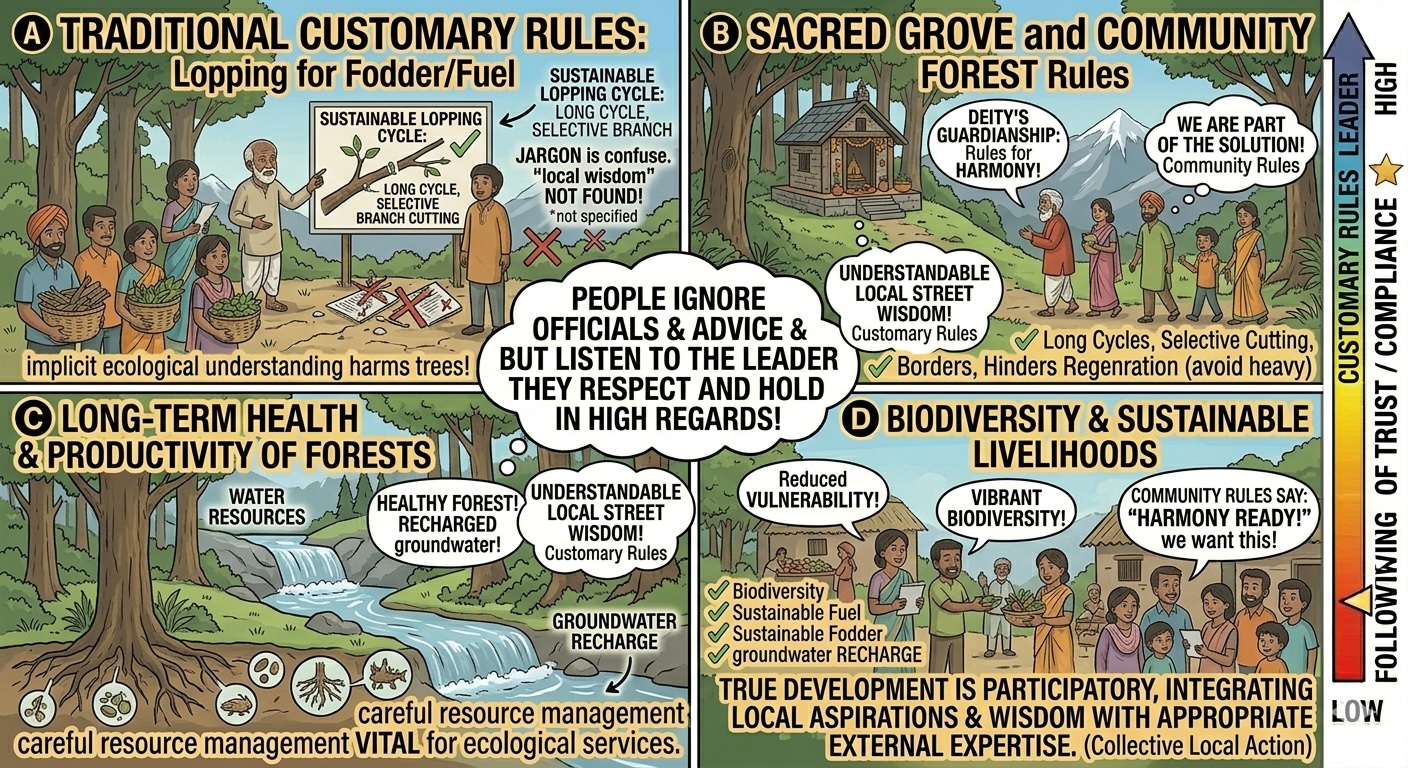
- विशेष रूप से स्थानीय देवी – देवताओ को अर्पित तथा समाज के लिये सामरिक महत्त्व के वनों से संसाधनों के दोहन के लिये परम्परागत रूप से स्थापित अनेको दैवीय व सामाजिक प्रतिबन्ध व नियम थे / Traditional communities had sophisticated, customary rules regulating the lopping of trees for fodder and fuel, especially in sacred groves and community forests.
- यह दैवीय व सामाजिक प्रतिबंधों व नियमो का आधार यहाँ के लोगो की यह पर्यावरणीय समझ थी कि बार-बार कांटे-छांटे जाने से वृक्षों की उत्पादकता पर प्रतिकूल प्रभाव पड़ सकता है / These rules were based on an implicit ecological understanding that heavy and frequent lopping harms trees, reduces seed production, and hinders forest regeneration.
- वनों से संसाधनों के दोहन के लिये परम्परागत रूप से स्थापित दैवीय व सामाजिक प्रतिबंधों व नियमो के द्वारा स्थानीय लोग वन सम्पदा के संरक्षण के साथ ही सतत उपयोग सुनिश्चित करते थे / Sustainable lopping practices (e.g., longer cycles, selective branch cutting) ensured the long-term health and productivity of forests.
- यह परम्परागत विधिया भू-जल संवर्धन तथा जैव विविधिता व पर्यावरण संरक्षण सहित वनों के द्वारा दी जा रही अनेको सेवाओं के महत्त्व का स्वीकरण है / This careful resource management was vital for maintaining the ecological services of forests, including groundwater recharge and biodiversity.
संता – बंता की यह जुगलबन्दी आपको कैसी लगी, कृपया हमें जरुर बताये
व
इस जुगलबन्दी को बेहतर बनाने के लिये अपने सुझाव अवश्य दें।
हमें हमेशा की तरह आपके सुझावों, प्रतिक्रियाओं व कटाक्षो का बेसब्री से इंतजार रहता हैं और सच मानिये इसी के आधार पर हम अपने आप में, अपनी सोच व रचनात्मकता में सुधार करने को प्रेरित होते हैं।
सो अच्छा – बुरा जैसा आपको महसूस हुवा हो, कमेंट जरुर करते रहें।
#TraditionalWisdom #SacredGroves #CommunityForestry #ResourceManagement #RiskAvoider #EcoResilience #HimalayanEcology
Leave a Reply