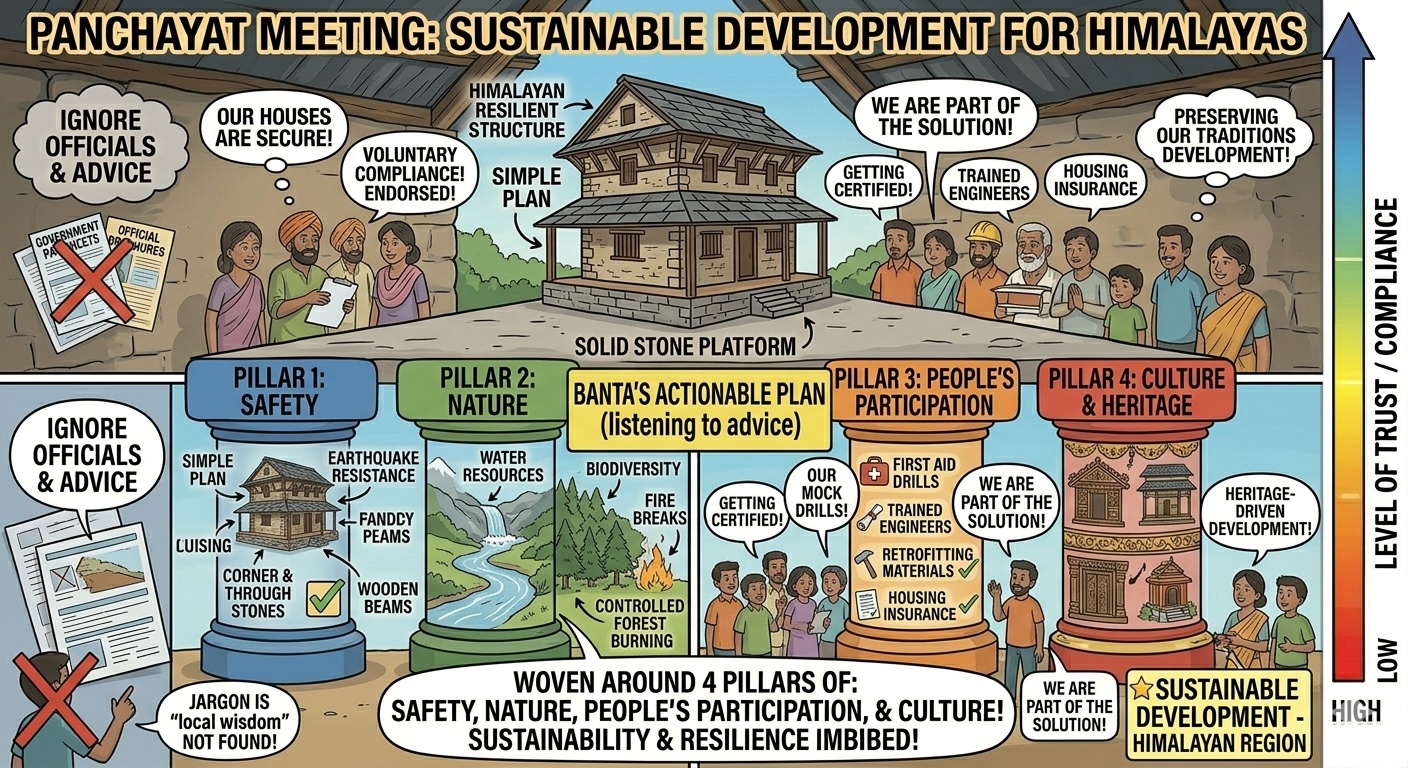
 The government officer has just finished his presentation, showing glossy pictures of the proposed resort.
He asks for questions. The villagers are silent, looking intimidated and a bit lost, as usual.
But then, to everyone’s surprise, Santa gets to his feet. His hands are trembling slightly, but his voice is clear.
“But before we talk about beautiful buildings, we, the people of this village, would like to discuss our Panchamrit of Resilience!”
The officer looks utterly baffled. “Pancha… what?”
Banta, sitting in the corner, watches with a proud, suppressed smile.
Santa, taking a deep breath and remembering his long conversations with Banta, raises four fingers.
“First, Suraksha!”
“Before you decide on the spot, have your engineers come and talk to our elders.”
“Our old Manbir Chahu can read the ground like a book; he knows which land has a memory of slipping.”
“Let’s ensure the resort is absolutely safe from floods and landslides, based on both your science and our lived experience.”
The officer, surprised by this organized response, starts to take notes.
“Second,” Santa continues, his confidence growing, “Prakriti!”
“Where will the water come from?”
“Will it affect our village dhara?”
“Where will the garbage go?”
“We don’t want our sacred forest to become its dustbin.”
“The project must include a solid plan to protect our natural environment, not just use it as a pretty backdrop.”
A few more villagers nod in agreement, finding their voice through Santa.
“Third,” Santa says, his voice getting stronger, “Jan-Bhagidari!”
“This is our land, our village.”
“We want to be partners, not just labourers.”
“Will our youth be trained for good jobs in this resort?”
“Will our local produce be bought for its kitchen?”
“Will the community get a share of the profits for our school and health center?”
“We want development with us, not just next to us.”
Finally, Santa raises his fourth finger. “And fourth, Sanskriti!”
“Let it be built with elements of our traditional architecture.”
“Let the tourists who come here learn about our way of life, not just stay in a concrete box that could be anywhere in the world.”
Santa sits down, his heart pounding but his head held high. A murmur of approval ripples through the villagers.
The officer, initially stunned, now looks at the community with newfound respect.
Later, Banta walks home with Santa.
“Santa,” he says, his voice thick with emotion, “today, you were not just Santa.”
“You were the voice of this mountain.”
“You didn’t just ask questions; you offered a complete, wise framework for development.”
“The Panchamrit has found its voice!”
Santa grins, a happy, tired grin.
“I was just repeating your words, Banta!”
“I might have mixed up the analogies a bit in my head, but the core idea… it felt right.”
“It felt strong.”
“For the first time, it felt like we weren’t just complaining; we were proposing.”
“And it felt… powerful.”
Banta claps him on the back.
“That, my friend, is the first, most important step.”
“When the community finds its voice and starts asking the right questions with wisdom and courage, that’s when a truly sustainable and resilient future begins to be built.”
#piyoosh #piyooshrautela #riskavoider #riskavoideracademy
संता – बंता की इस जुगलबंदी से आज हमने क्या सीखा:
-
प्रतिरोध्य बुनियादी ढांचे के चार स्तंभ / Four Pillars of Resilient Infrastructure:
- संवेदनशील पहाड़ी पारिस्थितिकी तंत्र (mountain ecosystems) में बुनियादी ढांचे का विकास केवल आर्थिक लाभ के लिए नहीं होना चाहिए। इसे चार मुख्य स्तंभों के इर्द-गिर्द एकीकृत किया जाना अनिवार्य है: भू-तकनीकी और संरचनात्मक सुरक्षा (Safety) को प्राथमिकता देना, प्रकृति (Nature) के प्राकृतिक जल मार्गों का सम्मान करना, जनभागीदारी (People’s participation) सुनिश्चित करना और स्थानीय संस्कृति एवं विरासत (Culture & Heritage) के पारंपरिक स्थापत्य ज्ञान को शामिल करना / Infrastructure development in fragile mountain ecosystems must not focus solely on economic utility. It must be structurally integrated around four core pillars: prioritizing geotechnical and structural Safety, respecting and preserving Nature‘s hydrological pathways, ensuring active People’s participation, and integrating localised Culture & Heritage architectural wisdom.
-
जनभागीदारी से स्वैच्छिक अनुपालन / Community-Led Voluntary Compliance:
- स्थानीय संस्कृति और जनभागीदारी को विकास से जोड़ने पर आपदा जोखिम न्यूनीकरण (DRR) एक कानूनी मजबूरी के बजाय समुदाय की अपनी जिम्मेदारी बन जाता है। इससे जमीनी स्तर पर सुरक्षा नियमों का स्थायी और स्वैच्छिक अनुपालन (voluntary compliance) सुनिश्चित होता है / Weaving development around local culture and people’s participation shifts disaster risk reduction (DRR) from a forced legal mandate to an internalized community asset, fostering permanent and voluntary safety compliance at the grass-roots level.
संता – बंता की यह जुगलबन्दी आपको कैसी लगी, कृपया हमें जरुर बताये
व
इस जुगलबन्दी को बेहतर बनाने के लिये अपने सुझाव अवश्य दें।
हमें हमेशा की तरह आपके सुझावों, प्रतिक्रियाओं व कटाक्षो का बेसब्री से इंतजार रहता हैं और सच मानिये इसी के आधार पर हम अपने आप में, अपनी सोच व रचनात्मकता में सुधार करने को प्रेरित होते हैं।
सो अच्छा – बुरा जैसा आपको महसूस हुवा हो, कमेंट जरुर करते रहें।
It is excellent