 Santa and Banta are walking past a small, fenced enclosure near the Panchayat Ghar.
In the premise, a weather station with a rain gauge and other instruments, installed a few years ago with much fanfare, stands silent and neglected.
Some wires are loose, and a bird has built a nest in the solar panel.
“Remember this, Banta?” Santa says wistfully.
“That dynamic Mrs. Deepshikha from the State Disaster Management Authority, the one who was so passionate about community-based early warning systems?”
“She helped us set this up.”
“For two years, we had our own weather readings!”
“Young Raju from our village was trained to note them down and send alerts.”
“We even got advance warning of a very heavy hailstorm once.”
Banta nods. “Yes, Santa, I remember Mrs. Deepshikha.”
“She was a very capable and dedicated officer.”
“That project was a model for other villages.”
“But then,” Santa continues with a sigh, “Mrs. Deepshikha‘s contract wasn’t renewed, or she found a better job with a consultancy firm, I heard.”
“She left.”
“For a few months, Raju tried to manage, but there was no one at the SDMA to guide him, no one to check the data or maintain the instruments.”
“The new contractual officers who came later were busy with other ‘new-found‘ and ‘media savvy‘ priorities.”
“And now… it’s just a monument to a good idea that died young.”
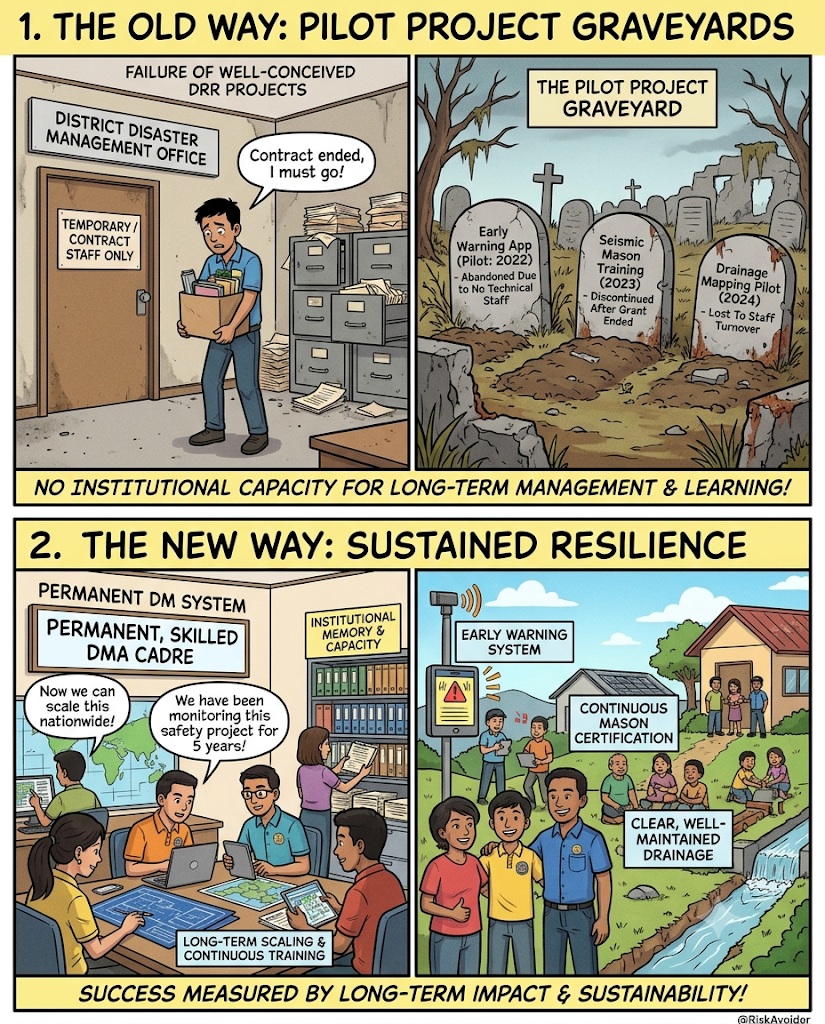
“This, Santa, is the unfortunate fate of many excellent initiatives when they are not anchored in a system with permanent roots and sustained commitment,” Banta explains.
“Mrs. Deepshikha, with her expertise and drive, planted a very good seed.”
“But good seeds also need consistent watering, nurturing, and skilled gardeners to ensure they grow into strong trees and bear fruit year after year.”
“Our SDMAs, often functioning with the uncertainty of contractual positions, struggle to be those consistent gardeners.”
He elaborates, “A politician or a senior officer might launch a ‘model project‘ with great enthusiasm.”
“A skilled contractual expert might even execute it brilliantly.”
“But if there isn’t a permanent team with the mandate, training, and resources to integrate that project into the long-term functioning of the SDMA, to learn from it, to upscale it, and to maintain it, then it often withers away as soon as the initial funding dries up or the key individual moves on.”
“It’s a loss of public money, a loss of community enthusiasm, and a loss of a potentially life-saving system.”
“So, we keep having these ‘siren songs‘ of wonderful new projects that sound beautiful for a while and then fade away?” Santa asks sadly.
“It often seems that way,” Banta agrees.
“The real ‘tangible output’ that our policymakers should seek is not just the inauguration of a new project, but the creation of a sustainable system with skilled, permanent people who can ensure that good initiatives thrive and contribute to lasting resilience.”
“Imagine if every DDMA and the SDMA had a core team of permanent technical experts – hydrologists, geologists, remote sensing experts, communication specialists, community mobilizers.”
“They could nurture hundreds of such local early warning systems, ensuring they work year after year, becoming part of our village’s own Kavaach”
Santa looks at the silent weather station and is again reminded of Mrs. Deepshikha.
“So, for our safety to be more than just a fleeting song, the singers in the SDMA need to be permanent members of the choir, not just guest artists.”
“That Disaster Management Act needs to give them a permanent stage and a secure voice.”
संता – बंता की इस जुगलबन्दी से आज हमने क्या सीखा:-
- 1. स्थायी व कुशल मानव संसाधन का अभाव अर्थात बेहतरीन योजनाओं की विफलता – आपदा प्रबंधन प्राधिकरणों (SDMAs & DMAs) में स्थायी, समर्पित और दक्ष तकनीकी स्टाफ की कमी के कारण आपदा जोखिम न्यूनीकरण (DRR) की बेहतरीन और महत्वाकांक्षी परियोजनायें भी एक सीमा के बाद दम तोड़ देती हैं / Lack of permanent, skilled staff in SDMAs and DDMAs leads to poor sustainability of DRR projects and initiatives, even if they are well-conceived.
- 2. “पायलट प्रोजेक्ट्स का कब्रिस्तान”: संस्थागत क्षमता का संकट – दीर्घकालिक प्रबंधन, संस्थागत अनुभव और सफल पहलों को बड़े पैमाने पर लागू (Upscale) करने की स्थायी क्षमता न होने के कारण अधिकांश महत्वाकांक्षी व उपयोगी योजनायें भी केवल ‘पायलट प्रोजेक्ट‘ बन फाइलों के कब्रिस्तान में दफन हो कर रह जाती हैं / “Pilot project graveyards” are a common outcome when there is no institutional capacity for long-term management, learning, and upscaling.
- 3. स्थायी प्रणालियों और मानव संसाधन में निवेश ही सच्ची सुरक्षा – प्रभावी आपदा जोखिम न्यूनीकरण (DRR) केवल तदर्थ (Ad-hoc) या संविदात्मक व्यवस्था से संभव नहीं है; इसके लिए ऐसे स्थायी मानव संसाधन और संस्थागत ढांचे में निवेश अनिवार्य है जो सुरक्षा पहलों को वर्षों तक निरंतर पोषित और संचालित रख सके / Effective disaster risk reduction requires investing in systems and permanent human resources that can nurture and sustain beneficial initiatives over time.
- 4. स्थायित्व और प्रभाव ही सफलता का असली पैमाना – आपदा जोखिम न्यूनीकरण सम्बंधित पहलों व नवाचारों की वास्तविक सफलता अल्पकालिक आयोजनों से नहीं, बल्कि उनके दीर्घकालिक प्रभाव और निरंतरता से मापी जानी चाहिये, जो सीधे तौर पर प्राधिकरण के कर्मचारियों की गुणवत्ता, विशेषज्ञता और उनकी सेवाओं के स्थायित्व से जुड़ी है / The success of DRR interventions should be measured by their long-term impact and sustainability, which is directly linked to the quality and permanence of SDMA staff.
संता – बंता की यह जुगलबन्दी आपको कैसी लगी, कृपया हमें जरुर बताये
व
इस जुगलबन्दी को बेहतर बनाने के लिये अपने सुझाव अवश्य दें।
हमें हमेशा की तरह आप के सुझावों, प्रतिक्रियाओं व कटाक्षो का बेसब्री से इंतजार रहता हैं और सच मानिये इसी के आधार पर हम अपने आप में, अपनी सोच व रचनात्मकता में सुधार करने को प्रेरित होते हैं।
सो अच्छा – बुरा जैसा आपको महसूस हुवा हो, कमेंट जरुर करते रहें।
Leave a Reply