 Strategic Brief: Turning “Waste” into a “Reservoir”
As the snowless winter depletes our primary water sources, every household must transition from being a “consumer” to a “water treatment plant.”
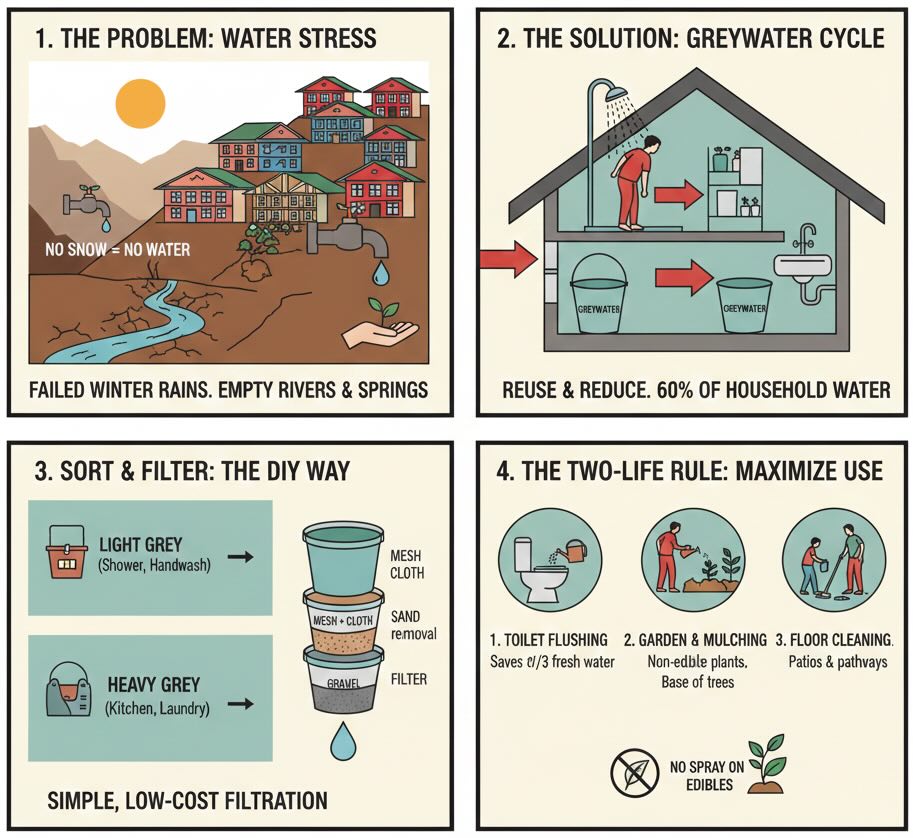
Greywater—water from sinks, showers, and washing machines—represents nearly 60–70% of total household outflow.
In a Himalayan “Hydro-Famine,” this is not waste; it is your secondary survival supply.
Household Greywater Recycling Guide: The “Five-Step Recovery”
1. Source Identification: Know Your Streams
Not all “used” water is equal. In the Himalayas, where drainage is steep, separation at the source is key.
- Light Greywater: Shower, bathroom sink, and final rinse from laundry. (Highest reuse potential).
- Heavy Greywater: Kitchen sinks (fats/oils) and laundry wash cycles (detergent heavy). (Requires filtration).
- Blackwater: Toilet waste. (Never recycle at home—strictly for sewage).
2. The “Basin-to-Bucket” Collection
In an urban mountain setting like Shimla, retrofitting pipes can be hard. Start with manual collection:
- The Shower Capture: Place a large bucket in the shower area to catch the “run-up” water (while waiting for it to get warm) and the splash-back.
- The Kitchen Siphon: Use a bowl in the kitchen sink to wash vegetables. Instead of pulling the plug, carry the bowl to your “Treatment Corner.”
3. On-Site “Gravity Treatment” (DIY Filter)
For water containing light oils or detergents, use a simple vertical filtration stack to avoid soil “clogging” in your garden:
- Top Layer: Fine Mesh/Cloth (to catch lint and hair).
- Middle Layer: Activated Charcoal or Sand (to neutralise odors and small particulates).
- Bottom Layer: Coarse Gravel (to provide a clear path for output).
- The Result: “Clear-Grey” water suitable for non-edible plants and toilet flushing.
4. The “Two-Life” Rules for Reuse
- The Sanitation Loop: Use Light Greywater exclusively for flushing toilets. One 10-liter bucket saves one full flush of fresh water.
- The Horticultural Loop: Use Heavy Greywater (filtered) for ornamental plants or “Thermal Mulching.”
- Warning: Do not spray greywater on the leaves of edible vegetables; apply it directly to the roots.
- The “Soap Shift”: Switch to biodegradable, phosphate-free detergents. This turns your laundry water into a nutrient-rich “liquid fertilizer” for your mountain garden.
5. Safe Storage & Hygiene
- The 24-Hour Rule: Never store untreated greywater for more than 24 hours. Without treatment, bacteria multiply rapidly, and it will turn into Blackwater (foul-smelling and toxic).
- The “Dark Tank”: If you must store it, use an opaque, lidded container to prevent algae growth and mosquito breeding.
DRR Lesson: “Decentralised Resilience”
पेयजल उपलब्धता की विफलता का इतिहास स्पष्ट बताता है कि केन्द्रीकृत व्यवस्था ही सबसे पहले चरमराती हैं। जल स्तर कम होने पर पानी उठाने वाले पम्पो के काम करना बंद कर देने कि स्थिति में केवल विकेन्द्रीकृत रूप से जल शोधन कर रहे घर व उपक्रम ही ठीक से काम कर पाते हैं। उपयोग किये गये जल के शुद्धीकरण व उपयोग के द्वारा मुख्य व्यवस्था के भार को 40 प्रतिशत तक कम कर के हम पूरे समाज के लिये आपातकालीन आपूर्ति सुनिश्चित कर सकते हैं / The history of urban water failures (like the 2018 Shimla crisis) teaches us that central systems are the first to break. When the main pumps fail due to low river levels, the only houses that stay “functional” are those that have a decentralised recycling loop. Recycling greywater reduces your demand on the municipal grid by 40%, creating a “buffer” for the entire community.
The Day Zero warnings from global megacities and the dry taps of our own Himalayan summers warn us that ‘flush-and-forget’ is a luxury we can no longer afford. These past events tell us that in a water-scarce future, the most resilient household is the one that mimics the mountain itself—recycling and filtering every drop. Our ongoing initiatives in household recycling prove that individual actions can prevent a systemic collapse, but history warns us that if we do not normalize ‘Greywater Cascading‘ now, we are wasting the very resource that could save us during the next heatwave. Today tells us the reservoirs are low; it warns us that a drop used only once is a drop stolen from tomorrow.
Leave a Reply