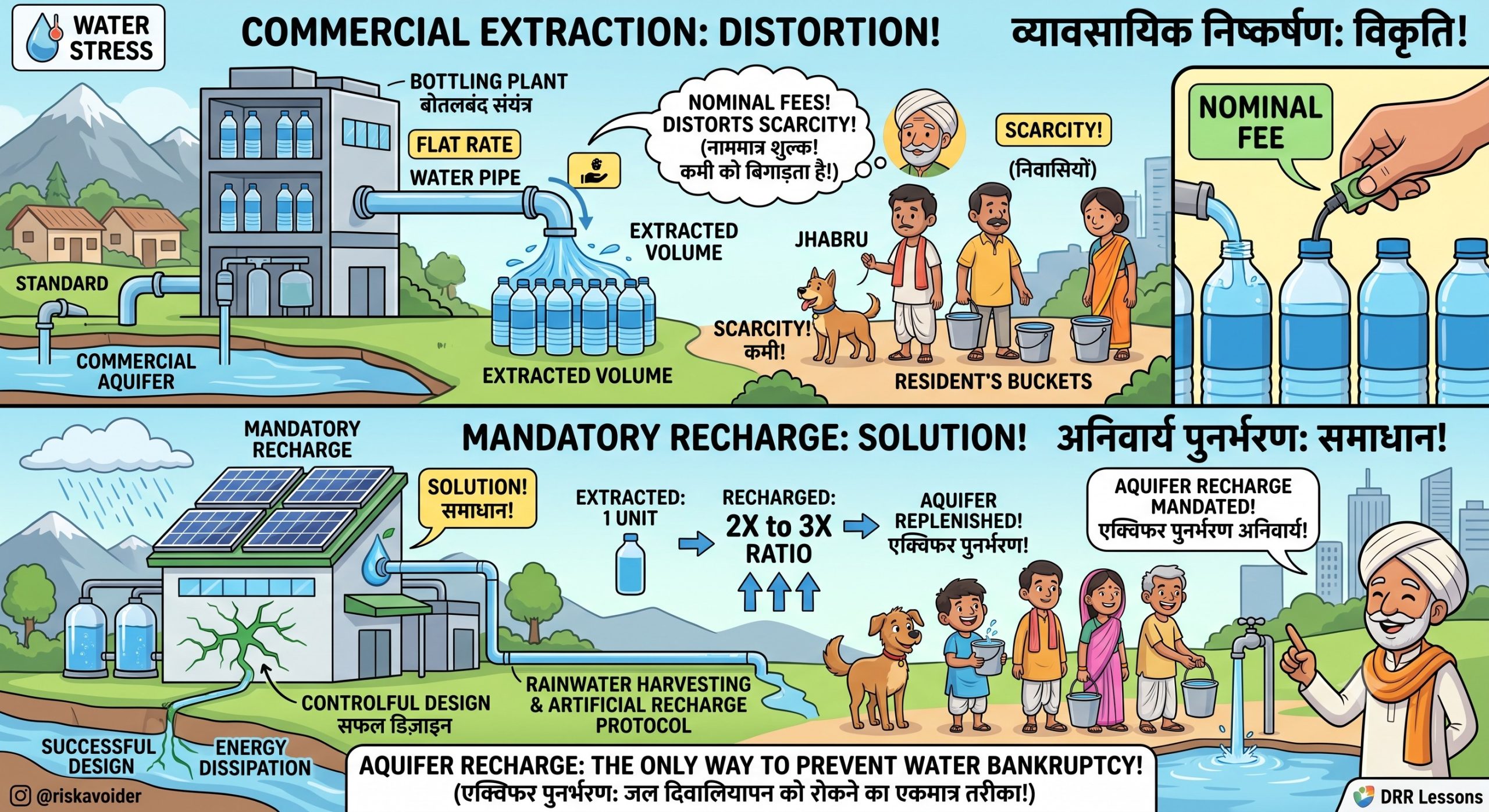
 Santa was standing outside a hyper-modern, gleaming glass bottling plant on the highway, proudly carrying a tray of chilled, plastic-wrapped 1-liter water bottles.
He held up a bottle to the sun, admiring its sparkling purity.
“Oye Banta, look at this incredible wealth!” Santa cheered, wiping a speck of dust off a bottle.
“I am setting up a distribution network for this liquid gold.”
“We pump groundwater from the deep borewell behind the factory, run it through an automatic Reverse Osmosis (RO) machine, slap a beautiful mountain-view sticker on the plastic, and boom—sold for ₹20 a bottle!”
“The market size of this industry is a staggering ₹20,000 to ₹30,000+ crore!”
“It’s pure profit, Banta!”
Banta walked up, holding a tiny piece of paper with a government stamp and a bucket of muddy water from a nearby village well.
He checked his ledger.
“Santa-ji, your profit model is brilliant, but your math is missing the cost of the crime.”
“Do you know what the factory pays the Central Ground Water Board (CGWB) as a royalty fee for extracting that water?”
“Oh, it must be huge, Banta!”
“To sell water for ₹20, the raw water must cost at least ₹5!” Santa said confidently.
“It costs less than a few paise per thousand liters, you naive businessman!” Banta said, waving the tiny receipt.
“The raw water cost is a tiny fraction of the final product price—often less than 1%!”
“The company makes massive 10% to 30%+ net profit margins by monetizing a common-pool resource for pennies.”
“Meanwhile, look at the farmer across the fence.”
“The bottling plant extracts massive volumes of water day and night, dropping the regional water table so fast that the local village wells are going completely dry!”
“We are allowing commercial companies to monetize our underground life insurance for the price of a scrap newspaper, while leaving local communities with empty buckets!”
Santa looked at the ₹20 price tag on his bottle, then at the dried-up village well down the road.
“Oye… so the water inside is essentially free to the company, but the scarcity is passed onto the village for free?”
“Precisely, Santa-ji,” Banta said.
“True risk mitigation requires Volumetric Pricing.”
“Commercial users must pay extraction fees tied to the actual scarcity value of the aquifer, and no new bottling permits should ever be issued in overexploited blocks unless they recharge the ground at two to three times their extraction rate!”
संता – बंता की इस जुगलबन्दी से आज हमने क्या सीखा:-
- वाणिज्यिक दोहन का मूल्य-असंतुलन / The Commercial Volumetric Deficit:
- जल-तनाव वाले क्षेत्रों (water-stressed blocks) में व्यावसायिक बॉटलिंग प्लांटों से नाममात्र का शुल्क लेना एक गंभीर विसंगति है, जो भूमिगत जलभृतों (aquifers) के वास्तविक संकट और मूल्य को नहीं दर्शाता है / Charging nominal, flat-rate royalties for commercial groundwater bottling plants in water-stressed blocks creates an artificial market distortion, failing to reflect the true scarcity value of common-pool aquifers.
- अनिवार्य जलभृत पुनर्भरण नियम / Mandatory Aquifer Recharge Ratios:
- जल दिवालियापन (water bankruptcy) को रोकने के लिए, व्यावसायिक दोहन परमिटों में उनके द्वारा निकाले गए कुल पानी की तुलना में 2 से 3 गुना अधिक मात्रा में वर्षा जल संचयन और कृत्रिम पुनर्भरण (recharge) को कानूनी रूप से अनिवार्य किया जाना चाहिए / To prevent catastrophic water bankruptcy, commercial extraction permits must mandate a certified rainwater harvesting and aquifer artificial recharge protocol at a 2x to 3x ratio of their total extracted volume.
संता – बंता की यह जुगलबन्दी आपको कैसी लगी, कृपया हमें जरुर बताये
व
इस जुगलबन्दी को बेहतर बनाने के लिये अपने सुझाव अवश्य दें।
हमें हमेशा की तरह आपके सुझावों, प्रतिक्रियाओं व कटाक्षो का बेसब्री से इंतजार रहता हैं औरसच मानिये इसी के आधार पर हम अपने आप में, अपनी सोच व रचनात्मकता में सुधार करने कोप्रेरित होते हैं।
सो अच्छा – बुरा जैसा आपको महसूस हुवा हो, कमेंट जरुर करते रहें।
#GroundwaterMonetization#VolumetricPricing #WaterStress2026 #CGWBNorms #BottledWaterParadox #SantaBantaStories
Leave a Reply