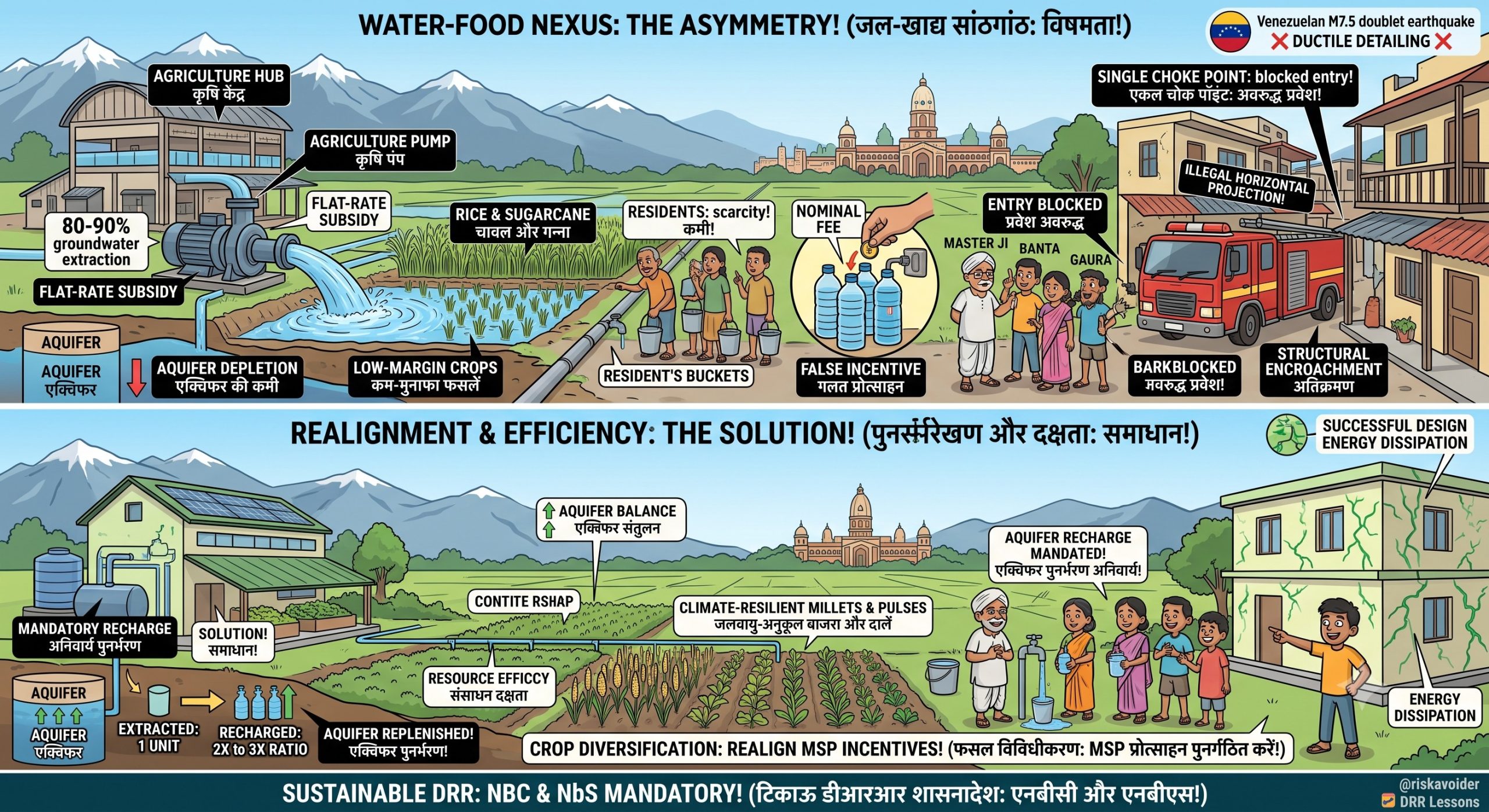
 Santa was sitting on his tractor, watching a field of thirsty paddy crops absorb millions of liters of water from a continuous, heavily subsidized agricultural tube well.
He was calculating his crop returns on a piece of paper, looking stressed.
“Banta, look at the injustice of the market!” Santa sighed, throwing down his pencil.
“I use millions of liters of groundwater to grow wheat and rice to feed this country.”
“I get heavily subsidized flat-rate electricity, and my water costs are nearly zero.”
“Yet, after spending months dealing with climate risks, debts, and input costs, my profit margins are razor-thin!”
“But that corporate bottling plant down the road takes the exact same water, puts it in small bottles, and prints a fat profit!”
“Why is the revenue model so biased against the farmer?”
Banta sat on the mud bund, holding a direct income support voucher and a water-saving drip nozzle.
“Santa-ji, you have identified the exact knot of the Water-Energy-Food Nexus.”
“Both you and the bottling company have near-zero marginal water costs, but you are playing two completely different financial games.”
“How, Banta?”
“Water is water, whether it goes into a crop or a plastic bottle!” Santa grumbled.
“The difference is in the value monetization and volume footprint, Santa,” Banta explained.
“Agriculture consumes 80% to 90% of India’s groundwater, mostly for low-value, water-intensive crops like paddy and sugarcane because of distorted Minimum Support Price (MSP) incentives.”
“You use massive volumes for thin margins, facing ultimate water bankruptcy in states like Punjab and Haryana.”
“The bottling company uses a tiny fraction of your volume but monetizes it at a premium after basic filtration and RO processing.”
“The true bias isn’t just in the pricing; it’s that when the aquifer depletes, the factory can simply lower its high-powered submersible pumps deeper or shift to another district.”
“But you, the small farmer, bear the entire brunt of the environmental damage!”
“Your wells dry up, your pumping costs skyrocket, and your land loses value.”
“We are risking our long-term food security by using free power to encourage water overuse, rather than shifting our agricultural policies toward direct income support and water efficiency!”
Santa looked from his flooded field to the small drip nozzle in Banta’s hand.
“Oye… so my free power is actually a golden noose around my farming legacy?”
“Exactly, Santa-ji,” Banta said.
“True agricultural resilience means moving away from flood irrigation toward subsidized drip systems and diversifying into less water-intensive crops like millets and pulses.’
“We must stop measuring success by how much water we pump, and start measuring it by how much water we save!”
संता – बंता की इस जुगलबन्दी से आज हमने क्या सीखा:-
• जल-खाद्य गठजोड़ की विसंगति / The Asymmetry of the Water-Food Nexus: भारत के 80-90% भूजल का उपयोग कृषि कार्यो हेतु सस्ती दरों पर बिजली दिये जाने की व्यवस्था के कारण होता है, जिससे कम मुनाफे वाली फसलों के लिये जलभृतों का अत्यधिक दोहन किया जाता है। नीतियो को संसाधन की मात्रा (volume) पर सब्सिडी देने के बजाय सीधे संसाधन की दक्षता (efficiency) का समर्थन करने पर ध्यान केंद्रित करना चाहिये / Agriculture utilizes 80–90% of India’s groundwater under flat-rate power structures, driving massive aquifer depletion for low-margin crops. Policy must shift from subsidizing resource volume to directly supporting resource efficiency.
• फसल विविविधीकरण के लिए प्रोत्साहन संरेखण / Incentive Realignment via Crop Diversification: कृषि क्षेत्र में जल संकट को कम करने के लिये, पानी की कमी वाले क्षेत्रों में अत्यधिक जल-खपत वाले धान/गन्ने के बजाय जलवायु-अनुकूल बाजरा, मक्का और दलहन फसलों के लिये न्यूनतम समर्थन मूल्य (MSP) और खरीद प्रोत्साहनों को पुनर्गठित करना आवश्यक है / Mitigating water bankruptcy in agricultural heartlands requires re-aligning MSP and procurement incentives away from water-intensive rice/sugarcane in scarce blocks toward climate-resilient millets and pulses.
संता – बंता की यह जुगलबन्दी आपको कैसी लगी, कृपया हमें जरुर बताये
व
इस जुगलबन्दी को बेहतर बनाने के लिये अपने सुझाव अवश्य दें।
हमें हमेशा की तरह आपके सुझावों, प्रतिक्रियाओं व कटाक्षो का बेसब्री से इंतजार रहता हैं औरसच मानिये इसी के आधार पर हम अपने आप में, अपनी सोच व रचनात्मकता में सुधार करने को प्रेरित होते है।
सो अच्छा – बुरा जैसा आपको महसूस हुवा हो, कमेंट जरुर करते रहें।
#WaterEnergyFoodNexus#AgriculturalResilience #MSPOrientation #DripIrrigation #AquiferBankruptcy#SantaBantaStories
Leave a Reply