 Netaji Santa, wearing a crisp white kurta and a very important expression, is standing before the assembled villagers.
“Mere Pyaare Bujurgo, Mataao, Bhaiyo aur Bahano!” he booms, pointing towards a slope where a small landslide recently occurred.
“Darne ki Koi Baat Naaahi!”
“I have spoken to the PWD engineers in Dehradun!”
“We will sanction a massive, ten-crore rupee Suraksha Deewar here!”
“A concrete wall so high and so strong, no landslide will dare to cross it!”
“I will personally inaugurate it!”
“Your troubles are over!”
The villagers clap politely, though some look sceptical.
Banta, standing at the back, listens patiently. After the speech, Netaji Santa walks over to him, seeking approval.
“Well, Banta ji!”
“A masterstroke, don’t you think?”
“A permanent solution!”
“Netaji,” Banta replies with deep respect, “your concern for our safety is like a cool breeze on a hot day.”
“And a strong wall is indeed a good thing.”
“But permit this old villager to ask a simple question.”
“If we have a beautiful new bucket made of the strongest steel, but it is full of tiny, invisible holes, will it hold water?”
Netaji Santa looks puzzled.
“A leaky bucket?”
“Of course not, Banta ji.”
“What an odd question!”
“Our village’s safety, Netaji, is like that bucket,” Banta explains gently.
“This grand wall you promise is like the strong steel frame of the bucket, which is excellent.”
“But our village has many Chhed.”
“Look at the new houses being built – with untrained masons and questionable designs.”
“That’s one Chhed.”
“Look at our natural drains, choked with plastic and construction debris, forcing rainwater to weaken the slopes.”
“That’s another Chhed.”
“Look at our young masons, who have no formal training in safe building practices, learning their trade through guesswork.”
“That’s a very big Chhed.”
He continues, “You can build the mightiest Suraksha Deewar in the world, Netaji.”
“But if the slope behind the wall is being constantly weakened by the water from our own badly planned houses and choked drains, then one day, the pressure will build up, and the entire leaky bucket – slope, wall, and all – might just give way.”
“The real, lasting solution is not just one grand project, but a hundred small, continuous efforts.”
“We need to plug the Chhed.”
“Plug the Chhed?” Netaji Santa asks, his grand vision now seeming a little less grand.
“Yes, Netaji,” Banta affirms.
“Invest a part of that budget in training and certifying our local masons, so they build safely.”
“Start a powerful awareness campaign, so people manage their waste and water responsibly.”
“Help us revise our local building rules to be practical and enforceable.”
“Empower the community to be the vigilant caretakers of its own safety.”
“If we do that, we not only make your Grand Suraksha Deewar more effective, but we also make the entire village stronger from within.”
“A resilient community is a far greater achievement for a leader than just a single concrete wall.”
Netaji Santa is silent for a long time, looking from the slope to the village houses.
“A leaky bucket… Banta ji, you have given me a very simple but profound lesson.”
“It seems my speech should have been less about the wall and more about fixing the Chhed.”
“I will carry this thought back with me to the engineers in Dehradun.”
संता – बंता की इस जुगलबन्दी से आज हमने क्या सीखा:-
-
केवल कंक्रीट की विशाल संरचनाओं पर निर्भरता की सीमाएं / The Inadequacy of Sole Reliance on Heavy Grey Infrastructure:
-
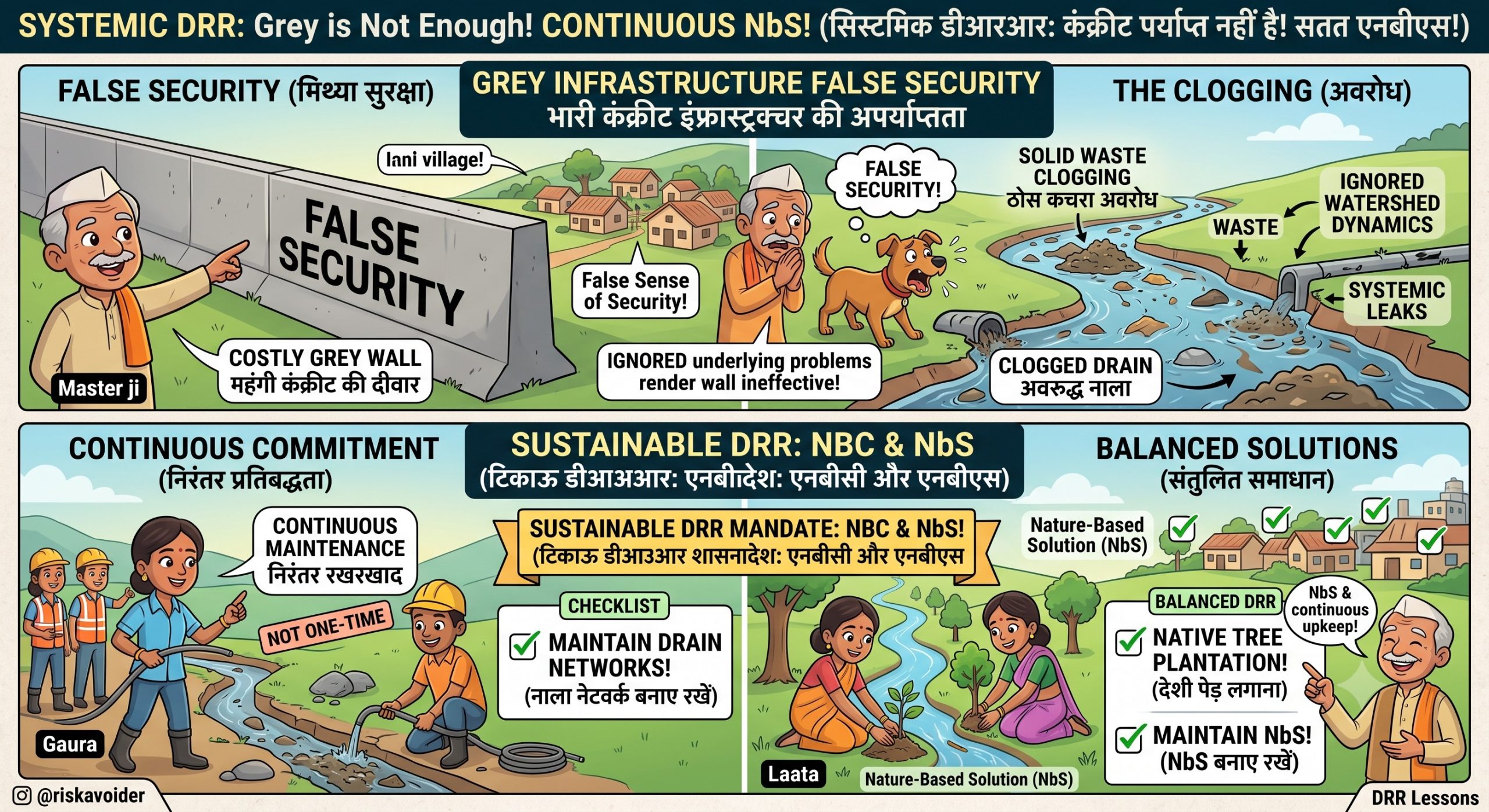
केवल बड़ी और खर्चीली कंक्रीट की दीवारों या तटबंधों (grey infrastructure) का निर्माण कर लेने से आपदा सुरक्षा की गारंटी नहीं मिलती, यदि नीचे के जल निकासी नालों, कचरे के अवरोधों और प्राकृतिक जल-चैनलों की अनदेखी की जाए। स्थायी आपदा जोखिम न्यूनीकरण के लिए भारी निर्माण के बजाय नियमित रखरखाव और प्रकृति-आधारित समाधानों का संतुलन आवश्यक है / Constructing costly, massive concrete walls or flood barriers (grey infrastructure) provides a false sense of security if underlying drainage networks, solid waste clogging, and regional watershed dynamics are ignored. Sustainable Disaster Risk Reduction (DRR) requires balancing engineering works with localized maintenance and Nature-Based Solutions (NbS).
-
-
मूल कारणों का निवारण और सतत रखरखाव / Addressing Systemic Leaks and Continuous Maintenance:
-
बाढ़ प्रबन्धन कोई एक बार का भारी-भरकम निर्माण कार्य नहीं है, बल्कि एक निरंतर चलने वाली रखरखाव प्रक्रिया है। यदि व्यवस्था के मूल ‘रिसावों’—जैसे बंद पड़े नालों, कचरे के जमाव और प्राकृतिक बफ़र्स के विनाश—को ठीक नहीं किया जाएगा, तो भारी मानसून के दौरान भव्य से भव्य कंक्रीट की दीवारें भी बाढ़ को रोकने में पूरी तरह विफल साबित होंगी / Flood risk management is not a one-time, high-budget construction project, but a continuous operational commitment. Neglecting the “leaks”—such as clogged drains, unlined wastewater outlets, and loss of natural buffers—renders even the grandest structural walls ineffective during severe monsoonal extremes.
-
संता – बंता की यह जुगलबन्दी आपको कैसी लगी, कृपया हमें जरुर बताये
व
इस जुगलबन्दी को बेहतर बनाने के लिये अपने सुझाव अवश्य दें।
हमें हमेशा की तरह आपके सुझावों, प्रतिक्रियाओं व कटाक्षो का बेसब्री से इंतजार रहता हैं औरसच मानिये इसी के आधार पर हम अपने आप में, अपनी सोच व रचनात्मकता में सुधार करने को प्रेरित होते है।
सो अच्छा – बुरा जैसा आपको महसूस हुवा हो, कमेंट जरुर करते रहें।
Leave a Reply