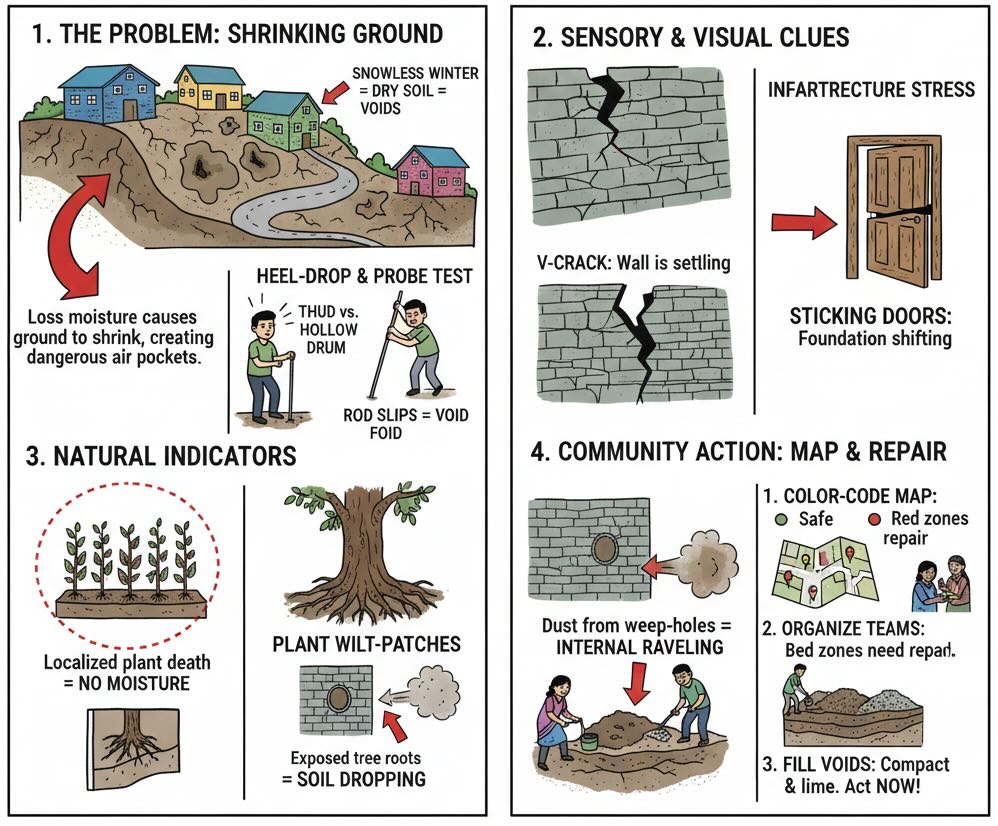
 In this unprecedented snowless winter, the Himalayas are undergoing “Sub-Surface Desiccation.” As moisture leaves the soil, the ground literally shrinks, creating hidden pockets of air or “voids.” These hollow zones are the birthplaces of future sinkholes and landslides. Identifying them now, while the ground is dry, is our best defense against the first heavy rains.
Community Void-Mapping Guide: Identifying the “Hollow Zones”
1. The “Heel-Drop” & “Rod-Probe” Test
Surface inspection is the first line of defense.
-
The Heel-Drop: As mentioned in today’s ordinance, stomp firmly on unpaved ground. A “drum-like” or hollow reverberation indicates a cavity within the top 2–3 feet of soil.
-
The Rod-Probe: Take a 4-foot t-shaped iron rod (rebar). Push it into the soil in areas where you suspect a void. If the rod suddenly “slips” or meets no resistance for several inches before hitting a hard layer, you have found a Desiccation Crack or a developing void.
2. Visual “Stress Markers” in Infrastructure
Voids beneath the surface exert uneven pressure on the structures above.
-
The “V” Crack: Look at your boundary walls. A diagonal crack that is wider at the top than the bottom (a ‘V’ shape) often indicates that the ground under one side of the wall is hollowing out.
-
The Door-Frame “Stick”: If doors or windows that previously moved smoothly are suddenly sticking or “out of plumb” during this dry spell, it’s a sign that the foundation is settling into a subsurface void.
-
The Paver “Dip”: On tiled or paved walkways, look for “puddling zones”—areas where tiles have slightly dipped below the level of the surrounding path, even if the ground is currently dry.
3. Vegetative “Wilt-Patches”
Plants are natural sensors for what is happening underground.
-
Localized Wilting: In a community park or garden, if a specific patch of grass or a particular shrub is dying while the plants just three feet away are healthy, it often means a void has formed beneath its roots, cutting off the “capillary rise” of deep-soil moisture.
-
Root Exposure: Look for trees where the soil has seemingly “dropped” away from the base of the trunk, exposing fine feeder roots that were previously buried.
4. Mapping the “Hydro-Pathways”
Voids often follow old water paths.
-
Trace the Springs: Map where the “Bawris” (springs) or seepages usually flow during the monsoon. In this dry winter, these “veins” of the mountain are empty. These are the most likely locations for Internal Erosion and void formation.
-
Check the “Weep-Holes”: If a retaining wall’s weep-holes are showing fresh soil “crumbling” out of them in dry weather, the mountain is literally shedding its internal structure into the void behind the wall.
The “Community Void-Map” Protocol
-
Divide and Conquer: Assign one “Block Captain” per 10 houses to perform the Rod-Probe test.
-
Color-Code the Map:
-
Green: Solid ground/No cracks.
-
Yellow: Minor “V” cracks in walls or sticking doors.
-
Red: Hollow sound on Heel-Drop or Rod-Probe “slips.”
-
-
The Intervention: For Red Zones, do not wait for rain. These areas should be “Top-Dressed” with compacted clay or a mixture of stone-dust and lime to “plug” the air pocket before it can fill with water.
DRR Lesson: “The Invisible Hazard”
2023 में उत्तराखण्ड के जोशीमठ शहर में हुवा भू-धंसाव यह बताता है कि आपदा हमेशा शोर-शराबे के साथ चेतावनी दे कर नहीं आती है – स्थितियाँ चुपचाप, धीरे-धीरे जमीन के धसने व घरो तथा अन्य संरचनाओं में दिखाई दे रही छोटी-बड़ी दरारों के साथ अचानक विकराल रूप भी ले सकती है। सजग व जागरूक समाज आज और अभी समझदारी के साथ भूमिगत खाली स्थानों को चिन्हित कर के, सम्बंधित प्राधिकारियों के सहयोग से भविष्य में अचानक होने वाले भू-धंसाव का निराकरण कर सकता है। हिमालय में सामने दिखायी दे रही बर्फ से ढकी पहाड़ियों को निहारने के साथ ही जमीन के नीचे कि स्थितियों पर भी ध्यान देना जरूरी है / The history of the 2023 Joshimath Subsidence warns us that ground failure doesn’t always start with a roar; it starts with a “whisper” of settling soil and micro-cracks. A community that maps its “Hollow Zones” today can prevent the “Sudden Collapse” of tomorrow. In the Himalayas, the ground you don’t see is just as important as the peaks you do.
The sinking streets of Joshimath and the sudden collapses in Mexico City warn us that the earth is not a static platform, but a living, breathing entity that reacts to the loss of water. These past events tell us that once the ‘Internal Raveling’ starts, the window for intervention is small. Our ongoing initiatives in community void-mapping prove that collective vigilance is the best subsurface sensor, but history warns us that if we ignore the ‘V-crack’ and the ‘hollow stomp’ during the dry season, we are choosing to be surprised by the collapse when the rains return. Today tells us the ground is thirsty and brittle; it warns us that a mountain that loses its moisture is a mountain that loses its bones.
Leave a Reply