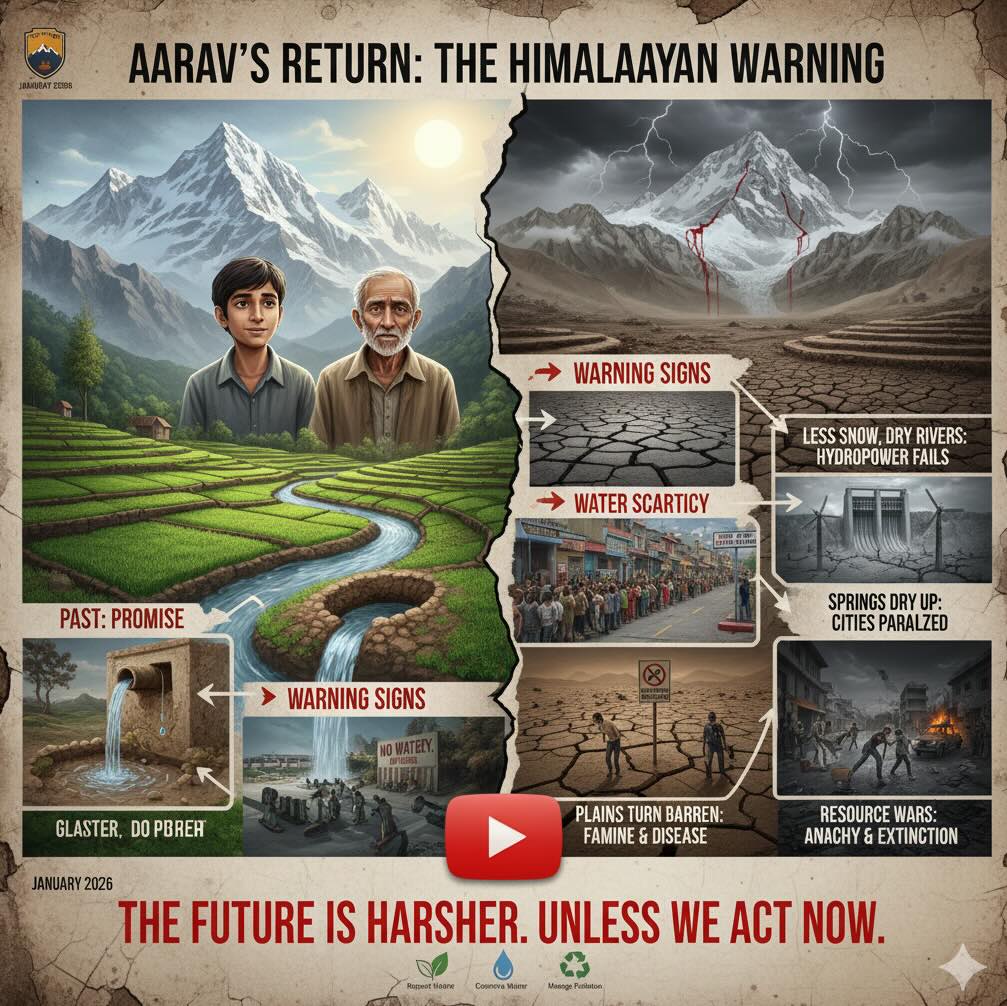
 The dust swirled around Aarav’s worn hiking boots, each step on the cracked earth a crunch against a memory. He shielded his eyes, looking up at the mountains that once stood like benevolent giants. Now, they were gaunt, their snow-capped crowns drastically receded, revealing jagged, raw rock. He hadn’t been back to his ancestral village in the Himalayas for twenty years, chasing a corporate dream in a distant, rain-soaked city. He’d returned, drawn by a growing unease, a feeling that something profound had shifted.
The village of ‘Shanti-Gaon’ – Village of Peace – was anything but. The once-lush terraced fields, vibrant with kodo and jhingora, were now a mosaic of withered stalks and barren patches. The musical gurgle of the ‘dhara,’ the village spring, was replaced by a pathetic drip, a mournful echo in the dry air. Children, their faces etched with premature worry, carried small pitchers, their laughter replaced by the scuff of their sandals on the dusty paths.
“Aarav-bhaiya!” a frail voice called. It was old Devi Singh, his childhood friend, his face now a map of worry lines.
“You’ve come back to a dying land.”
Aarav’s heart sank. He remembered stories his grandmother told, of winters so heavy with snow, the rooftops groaned under its weight, of springs that burst forth with icy, life-giving water. Those stories now felt like ancient myths.
“Where is the snow, Devi?” Aarav asked, the question a whisper against the vast silence of the mountains.
Devi pointed to the distant peaks, once pristine white. “Gone.”
“The Chandra Glacier, which fed our streams for generations, is a ghost.”
“Last year, in Chile’s Atacama Desert, they saw ancient mummies literally exposed by the rapidly shrinking ice.”
“We thought that was distant, a foreign problem.”
“But now, it’s our reality.”
Aarav remembered the news from the plains – the once-mighty Ganga and Yamuna, reduced to skeletal streams outside the monsoon, barely trickling through their vast beds. He’d seen images from Pakistan’s Indus river basin, where ancient civilisations thrived on its abundance, now facing unprecedented water scarcity, impacting millions.
“What about the rivers, Devi?”
“The hydropower projects?” Aarav thought of the massive dams he’d seen on his journey, monuments to human ambition.
Devi scoffed, a dry, rasping sound.
“For a few months after the monsoons, they churn electricity.”
“But come November, the turbines stand still.”
“The reservoirs are mud pits.”
“In places like California, they are already building ‘pumped hydro’ storage for when the sun doesn’t shine and the wind doesn’t blow.”
“But what happens when the very water to pump is gone?”
He spoke of the dharas and naulas drying up, forcing even the larger Himalayan towns, reliant on multi-stage pumping from distant sources, into a desperate struggle for survival. No electricity, no pumps, no water. It was a terrifying domino effect.
Aarav felt a chill that had nothing to do with the mountain air. He remembered the headlines from Syria, where a prolonged drought in the 2000s, exacerbated by climate change, drove farmers off their land, fueling an urban migration that contributed to social unrest and conflict. Was this what awaited India?
“The plains, Devi… what about the plains?” Aarav asked, picturing the vast agricultural heartland.
Devi’s eyes held a haunted look.
“They say the Indo-Gangetic plain will turn into a second Sahara.”
“Already, the groundwater tables are plunging like stones thrown into a bottomless well.”
“We saw it in Ethiopia, a few years back, entire villages abandoning their homes because the well ran dry.”
“Here, it will be on a scale unimaginable.”
He spoke of industries grinding to a halt, food security collapsing, malnutrition becoming rampant – not just a ‘developing world’ problem, but a global reality. Healthcare systems, already strained, would crumble under new waves of waterborne diseases, pandemics thriving in conditions of poor sanitation.
“The worst, Aarav,” Devi whispered, pulling him closer, his voice hoarse, “is what it does to us.”
“To our spirit.”
“When there’s no water, there’s no harvest.”
“No harvest, no food.”
“No food, no peace.”
“We’ve seen it start already – arguments over a bucket of water, fights over a shrinking patch of arable land.”
“The state… the government… they cannot deliver when the very earth has turned against us.”
“What then?”
“Back to square one.”
“Survival of the fittest.”
“Anarchy.”
“We’ll tear each other apart for a sip of water, a morsel of food.”
Aarav looked at the barren mountains, their majestic peaks now symbols of a dying world. He thought of the scientific reports he’d dismissed as alarmist, the climate conferences he’d seen as political theater. He’d lived in a bubble of denial, believing the mountains would always provide, that human ingenuity would always find a way.
But now, standing in Shanti-Gaon, he saw the truth. The dark facts were no longer distant projections; they were etched in the parched earth, in Devi’s haunted eyes, in the silent, desperate faces of the children. The arrogant human belief that we could endlessly exploit nature had come home to roost. The planet was not just warming; it was suffocating. And in its final gasp, it might take humanity with it.
He thought of the words from the article he’d read before his journey: “Anarchy and complete confusion. There would be anarchy or maybe extinction of Homo sapiens.” It no longer sounded like hyperbole. It sounded like a chillingly accurate prophecy, playing out before his very eyes.
Aarav looked at the distant, retreating glaciers, the silent witnesses to humanity’s folly. He knew then that the time for debate was over. The time for action was yesterday. The question was, could humanity collectively learn to manage pollution, change living habits, respect nature, and conserve resources – water, especially – before the curtain fell on the greatest show on Earth? Before the mountains themselves became our tombstone.
आरव की कहानी से आज हमने क्या सीखा / DRR Lessons:
- आपदा उपरांत प्रतिवेदन से प्रतिरोध्यता की ओर /The Shift from Response to Resilience: आपदा जोखिम न्यूनीकरण के अन्तर्गत समय रहते स्थितियों का पूर्वानुमान करते हुवे कार्यवाही की जनि चाहिये। जल स्त्रोतों के सूखने से पहले जल संचय सम्बन्धित कार्यवाही न करना आपदा जोखिम न्यूनीकरण की विफलता है। विगत की प्रचुर उपलब्धता के स्थान पर भविष्य के जलवायु प्रक्षेपणों के आधार पर संसाधनों का प्रबन्धन किया जाना चाहिये / DRR must prioritise anticipatory action. Waiting for a spring to dry up before building a water-harvesting system is a failure of risk management. We must manage resources based on future climate projections, not past bounty.
- “जल मीनारों की रक्षा” / Protecting the “Water Towers”: आपदाओं का जोखिम कभी भी स्थान विशेष तक सीमित नहीं होता है। गंगा – यमुना के मैदान में किये जाने वाले आपदा जोखिम न्यूनीकरण कार्यो के अन्तर्गत हिमालयी क्षेत्र में अवस्थित हिमनदों को बचने पर भी विचार किया जाना चाहिये / Disaster risk is not local; it is basin-wide. DRR initiatives in the Indo-Gangetic plains must include the protection of Himalayan headwaters and glacial health.
- धीरे – धीरे प्रकट होने वाली आपदाओं की पहचान / Recognising the “Slow-Onset” Disaster: नीतिगत रूपरेखाओं के अन्तर्गत धीरे – धीरे प्रकट होने वाली आपदाओं को भी बराबर अधिमान दिया जाना चाहिये और इसके अन्तर्गत भूमिगत जल स्तर की गिरावट तथा भूमि की काम होती उर्वरता पर विशेष ध्यान दिया जाना चाहिये / Policy frameworks must give equal weight to slow-moving risks. This includes monitoring groundwater depletion and soil health as key indicators of impending disaster.
- सामाजिक विखंडन की रोकथाम / Preventing Social Fragmentation: आपदा जोखिम न्यूनीकरण को हमेशा ही समाज को एकजुट बनाये रखने हेतु काम करना चाहिये। समाज आधारित संसाधन प्रबन्धन व्यवस्था के विकास से संसाधनों की कमी होने पर भी समाज में आपसी सहयोग व भाईचारा बना रहता है / DRR is as much about Social Capital as it is about engineering. Building community-based resource management systems (like traditional Van Panchayats or Water User Groups) ensures that when resources get scarce, cooperation prevails over conflict.
- घातकता का प्रतिपुष्टि पाश / The “Feedback Loop” of Vulnerability: एक विफलता प्रायः दूसरी विफलता को जन्म देती है। आपदा जोखिम न्यूनीकरण के अन्तर्गत महत्वपूर्ण अवसंरचनाओं को विकेन्द्रित संचालन योग्य बनाया जाना चाहिये / Systemic Risk. One failure (energy) leads to another (water pumping), which leads to another (sanitation and pandemics). DRR planning must use “systems thinking” to ensure that critical infrastructure (hospitals, schools) has decentralized, off-grid backups.
Leave a Reply