 Santa was standing at a scenic viewpoint on the highway near Kasol, Himachal Pradesh.
He was eating a bag of crispy potato chips and drinking a sugary energy drink from a bright blue plastic bottle.
The moment he finished, he casually flipped the shiny, multi-layered foil wrapper and the empty bottle directly over the concrete railing into a deep, forested Himalayan gorge below.
Banta walked up behind him, wearing a heavy canvas backpack and holding a long wooden grabber tool.
He pointed down into the gorge where thousands of matching snack wrappers, instant noodle foils, and plastic caps formed a massive, colourful, non-biodegradable glacier of trash.
“Oye, Santa-ji!” Banta called out, his voice echoing off the rock walls.
“Congratulations!”
“You have just contributed your daily quota to the destruction of the Third Pole!”
“But tell me, do you think that gorge is a magic portal that deletes your trash when it falls out of sight?”
Santa laughed, dusting salt off his hands.
“Banta, the valley is thousands of feet deep!”
“There is infinite space down there, and the monsoon rain will simply wash it away down to the plains.”
“The state promoter on TV said tourist footfall is booming—we are hitting a projected 6.7 crore arrivals in Uttarakhand by 2026 and 3.11 crore in Himachal!”
“We are bringing massive economic growth to the hills!”
Banta grabbed Santa by the arm and pulled out a pocket data sheet from the 2024 Himalayan Cleanup campaign.
“The rain doesn’t delete plastic, Santa—it just grinds it into your own drinking water!”
“Across the Indian Himalayan Region, our mountains are suffocating under 14,450 tonnes of solid waste every single day!”
“That’s over 5 million metric tonnes a year.”
“When you hike or visit these hills, studies show that each visitor dumps an average of 288 grams of waste per day.”
“In just one 19-kilometer tourist trek stretch over a single 4-month season, that adds up to 29 metric tonnes of raw garbage left unmanaged!”
Santa blinked, looking at his empty hands.
“But Banta, it’s just a single wrapper!”
“Surely the local municipal garbage truck will come down into this deep canyon to pick it up?”
“Garbage trucks don’t have wings, Santa!” Banta shouted.
“In the brutal mountain terrain, collection and transport are extremely expensive and physically dangerous.”
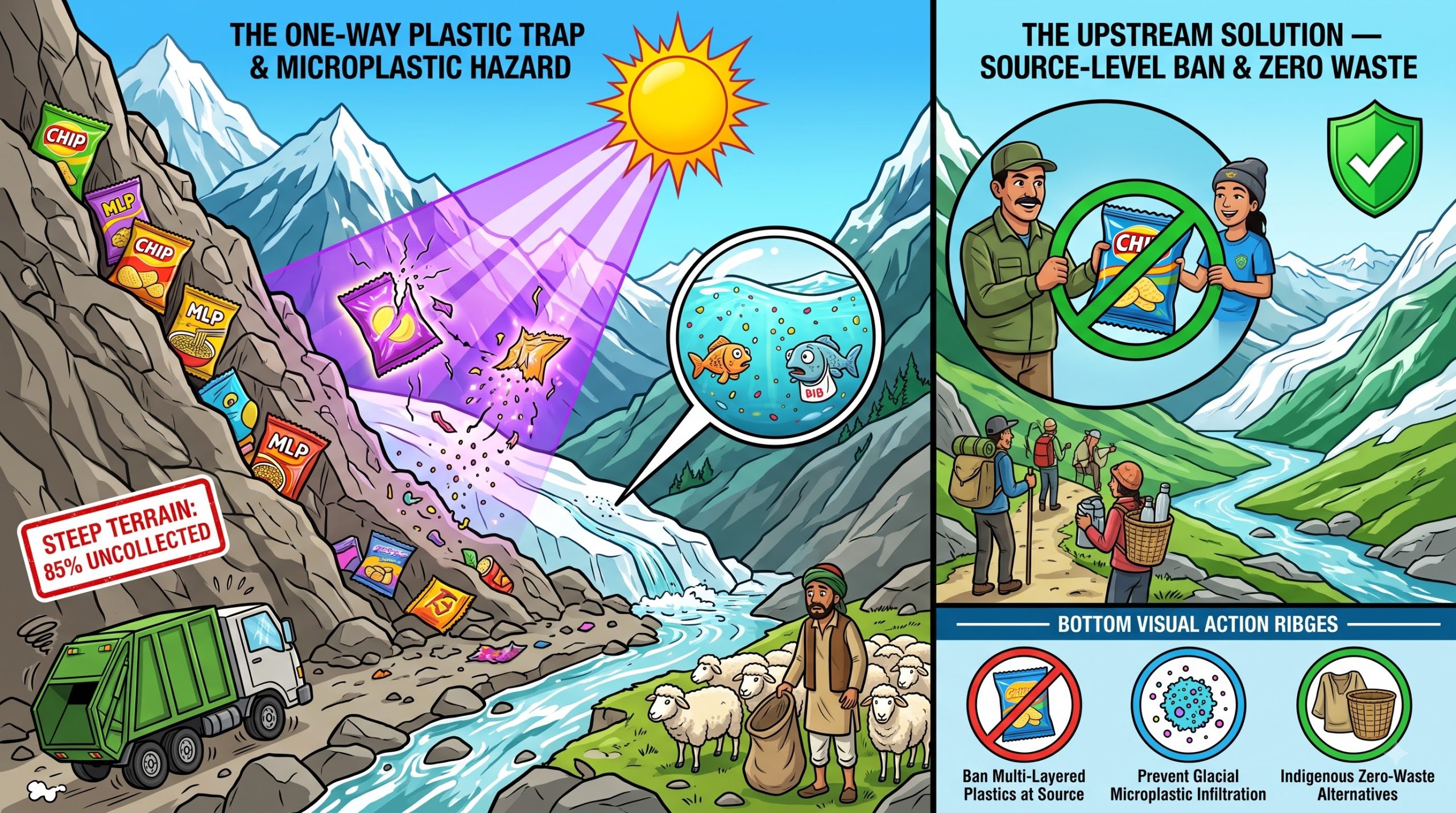
“Over 85% of plastic waste in remote high-altitude zones remains completely uncollected.”
“And look at your wrapper—it’s multi-layered plastic (MLP).”
“The Himalayan Cleanup audits proved that 88% of all collected mountain waste is plastic, and over 71% of it is completely non-recyclable single-use food and beverage packaging!”
“Ragpickers won’t touch it because it holds zero market value.”
“It sits there for centuries, undergoing UV–photooxidation from intense mountain sunlight, fragmenting into toxic microplastics that have now been detected in snow above 5,000 meters and inside the waters of the Ganga, Yamuna, and Sutlej!”
“You think you are buying convenience, but you are actually seasoning your own river system with microscopic plastic poison!”
संता – बंता की इस जुगलबन्दी से आज हमने क्या सीखा:-
- उच्च-पर्वतीय कचरा संचय की विडम्बना / The High-Altitude Accumulation Paradox:
- उच्च-पर्वतीय क्षेत्रों में प्लास्टिक केवल एकतरफा यात्रा करता है; भौगोलिक विषमताओं के कारण 85% से अधिक कचरा कभी इकट्ठा ही नहीं हो पाता है। यह सूर्य की तीव्र यूवी किरणों (UV rays) के कारण विखंडित हो कर माइक्रोप्लास्टिक में बदल जाता है, जो ग्लेशियरों और नदियों के पानी को जहरीला बना देता है / High-altitude mountain terrain features a one-way plastic trajectory; due to topographical constraints, over 85% of remote waste remains uncollected. It undergoes UV–photooxidation, fragmenting into microplastics that contaminate critical glacier systems and downstream river lifelines.
- गैर-पुनर्चक्रण योग्य पैकेजिंग का जाल / The Non-Recyclable Packaging Trap:
- हिमालयी प्लास्टिक कचरे का लगभग 71% हिस्सा गैर-पुनर्चक्रण योग्य मल्टी-लेयर प्लास्टिक (MLP) होता है, जिसका कोई बाजार मूल्य नहीं होता।इसके स्थायी समाधान के लिए कचरा प्रबंधन के बजाय विनिर्माण के स्तर पर ही सिंगल-यूज़ पैकेजिंग पर पूर्ण प्रतिबंध लगाना अनिवार्य है / Up to 71% of Himalayan plastic waste consists of non-recyclable multi-layered plastics (MLP) from food and beverage packaging with zero market value. Strategic risk mitigation requires a systemic pivot away from centralized post-consumer management toward absolute source-level production bans.
संता – बंता की यह जुगलबन्दी आपको कैसी लगी, कृपया हमें जरुर बताये
व
इस जुगलबन्दी को बेहतर बनाने के लिये अपने सुझाव अवश्य दें।
हमें हमेशा की तरह आपके सुझावों, प्रतिक्रियाओं व कटाक्षो का बेसब्री से इंतजार रहता हैं औरसच मानिये इसी के आधार पर हम अपने आप में, अपनी सोच व रचनात्मकता में सुधार करने कोप्रेरित होते हैं।
सो अच्छा – बुरा जैसा आपको महसूस हुवा हो, कमेंट जरुर करते रहें।
#HimalayanGarbageCrisis #MicroplasticsAt5000m #HimalayanCleanup #MultiLayeredPlastics #ThirdPoleEmergency #SantaBantaStories
Leave a Reply