 Santa is excitedly talking about the new dam project announced upstream.
“Banta, I was just thinking!”
“This dam will be great for our village boys!”
“So many jobs – labourers, guards, jeep drivers!”
“For a few years at least, our youth won’t have to migrate to the cities to earn a living.”
“The dam will bring prosperity right here!”
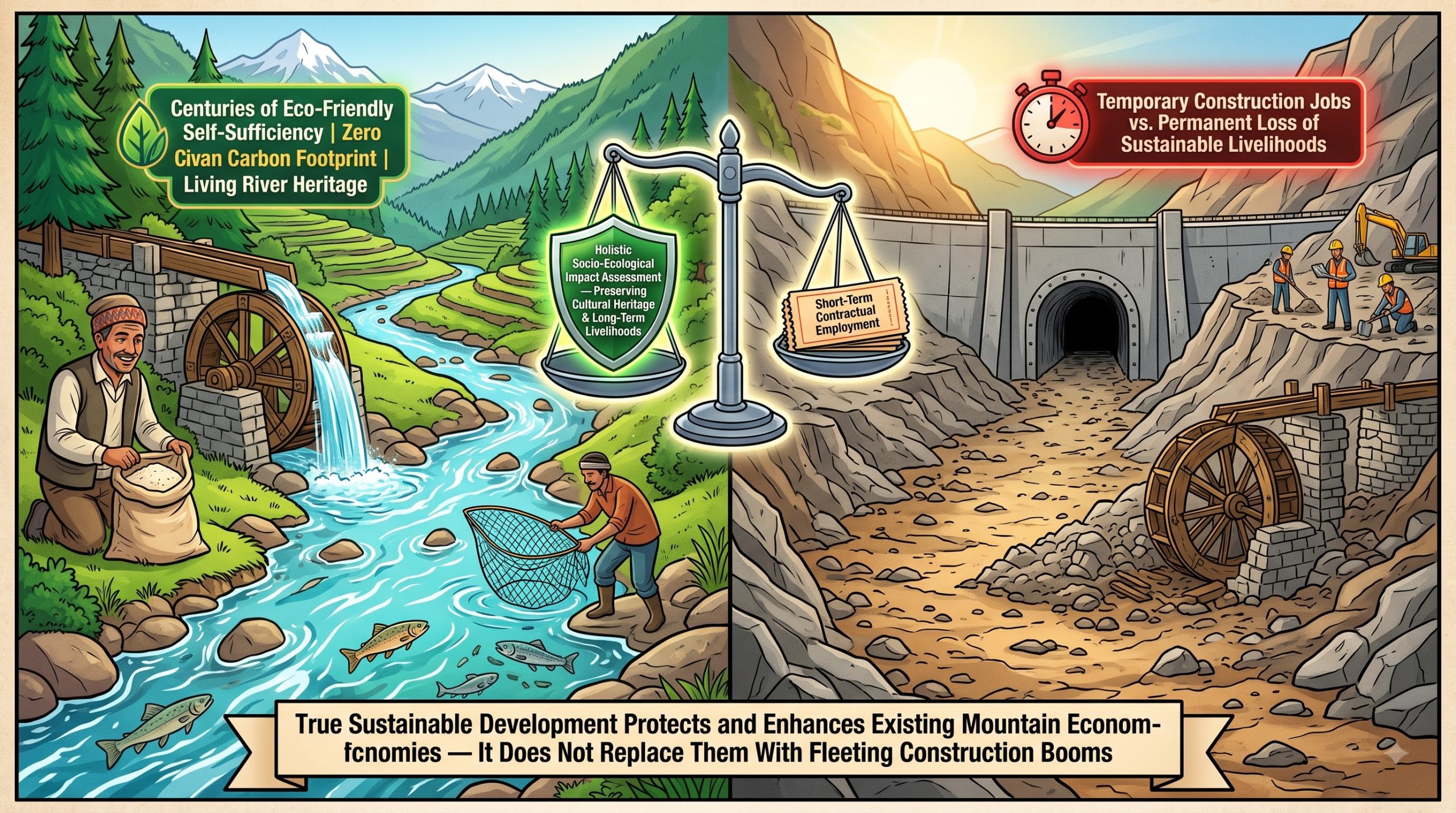
Banta listens, then stops near the moss-covered, silent ruins of an old stone watermill, its wooden wheel long gone, the channel that fed it now dry.
“Prosperity is a good thing, Santa,” he says quietly.
“But sometimes, a new, loud prosperity can silence an old, quiet one forever.”
“Do you remember what this place used to be?”
“Of course!” Santa replies.
“This was old Manbir Kaka‘s Gharaat.”
“He used to grind our Gehu and Mandua into flour.”
The Thak-Thak-Thak of his Gharaat was a constant, happy sound in this valley.”
“It was,” Banta agrees.
“And Manbir Kaka‘s family had been doing it for generations.”
“It was a permanent, sustainable livelihood.”
“He wasn’t dependent on a contractor or a project.”
“His only partner was the free-flowing, powerful river.”
“He was a true Pahadi Udyami – a mountain entrepreneur.”
“So what happened?” Santa asks, though he vaguely knows.
“The last big dam that was built upstream happened,” Banta explains.
“They started regulating the river’s flow.”
“The powerful, year-round current that was needed to turn the heavy millstones became a weak, unpredictable trickle for most of the year.”
“The Gharaat couldn’t run.”
“Manbir Kaka‘s livelihood, which had survived for centuries, was washed away without a flood.”
“His son, who should have been a miller, now drives a taxi in Rishikesh.”
He then points towards the river.
“And do you remember the Mahseer fish, the big ones with shining scales that used to be found here?”
“They were a source of food and sometimes income for families.”
“But the dams block their path to travel upstream for spawning, and the changed water temperature and flow have made our river inhospitable for them.”
“So, the fishermen‘s livelihood also vanished.”
Santa looks uneasy.
“But… the dam will give new jobs!”
“Yes, Santa,” Banta affirms gently.
“It will give some jobs.”
“For a few years, during construction.”
“They are temporary, dependent on the project‘s timeline.”
“But in exchange, we are permanently losing livelihoods that were self-sufficient, sustainable, and woven into our culture and ecology for centuries – the miller, the fisherman, and others who depended on the river’s natural, untamed state.”
“We are trading a permanent, self-owned shop for a temporary job on daily wages.”
“Is it always a good bargain?”
Santa looks at the silent, ruined Gharaat, the sound of its rhythmic Thak-Thak now just a faint echo in his memory.
“So, the dam‘s big promise of jobs comes after it has silently drowned the smaller, older jobs of the river itself?”
“I never saw it that way, Banta.”
“The dam‘s salary slip has a hidden deduction column for lost livelihoods.”
Banta nods sadly.
“A very heavy deduction indeed, Santa.”
“A truly sustainable project should add new opportunities without destroying the old, resilient ones.”
संता – बंता की इस जुगलबन्दी से आज हमने क्या सीखा:-
जलविद्युत परियोजनाये (हाइड्रोपावर प्रोजेक्ट) नदियों के प्राकृतिक बहाव को बदलकर पारंपरिक और पर्यावरण-अनुकूल आजीविकाओं—जैसे घराट (पनचक्की) संचालन और मछली पालन—को नष्ट कर देती हैं / Hydropower projects, by altering river flows, can destroy traditional, sustainable livelihoods like operating watermills (‘Gharaats) and fishing.
परियोजना निर्माण के दौरान मिलने वाली अस्थायी नौकरियों के लालच को इन आत्मनिर्भर और टिकाऊ स्थानीय व्यवसायों के स्थायी नुकसान के सामने तौलना बेहद ज़रूरी है / The promise of temporary construction jobs must be weighed against the permanent loss of these self-sufficient, eco-friendly local economies.
किसी भी परियोजना के समग्र प्रभाव आकलन (Impact Assessment) में नदी के प्राकृतिक स्वरूप पर निर्भर रहने वाली स्थानीय आजीविकाओं और सांस्कृतिक परंपराओं पर पड़ने वाले दीर्घकालिक प्रभावों को अनिवार्य रूप से शामिल किया जाना चाहिए / A holistic impact assessment must include the project‘s long-term effects on local livelihoods and cultural practices that depend on the river’s natural state.
सच्चा विकास वही है जो पहले से मौजूद टिकाऊ और पारंपरिक आजीविकाओं को सहारा देकर मजबूत बनाए, न कि उन्हें खत्म करके उनकी जगह कुछ समय का रोजगार दे / True development should support and enhance existing sustainable livelihoods, not replace them with short-term employment.
संता – बंता की यह जुगलबन्दी आपको कैसी लगी, कृपया हमें जरुर बताये
व
इस जुगलबन्दी को बेहतर बनाने के लिये अपने सुझाव अवश्य दें।
हमें हमेशा की तरह आपके सुझावों, प्रतिक्रियाओं व कटाक्षो का बेसब्री से इंतजार रहता हैं औरसच मानिये इसी के आधार पर हम अपने आप में, अपनी सोच व रचनात्मकता में सुधार करने कोप्रेरित होते हैं।
सो अच्छा – बुरा जैसा आपको महसूस हुवा हो, कमेंट जरुर करते रहें।
Leave a Reply