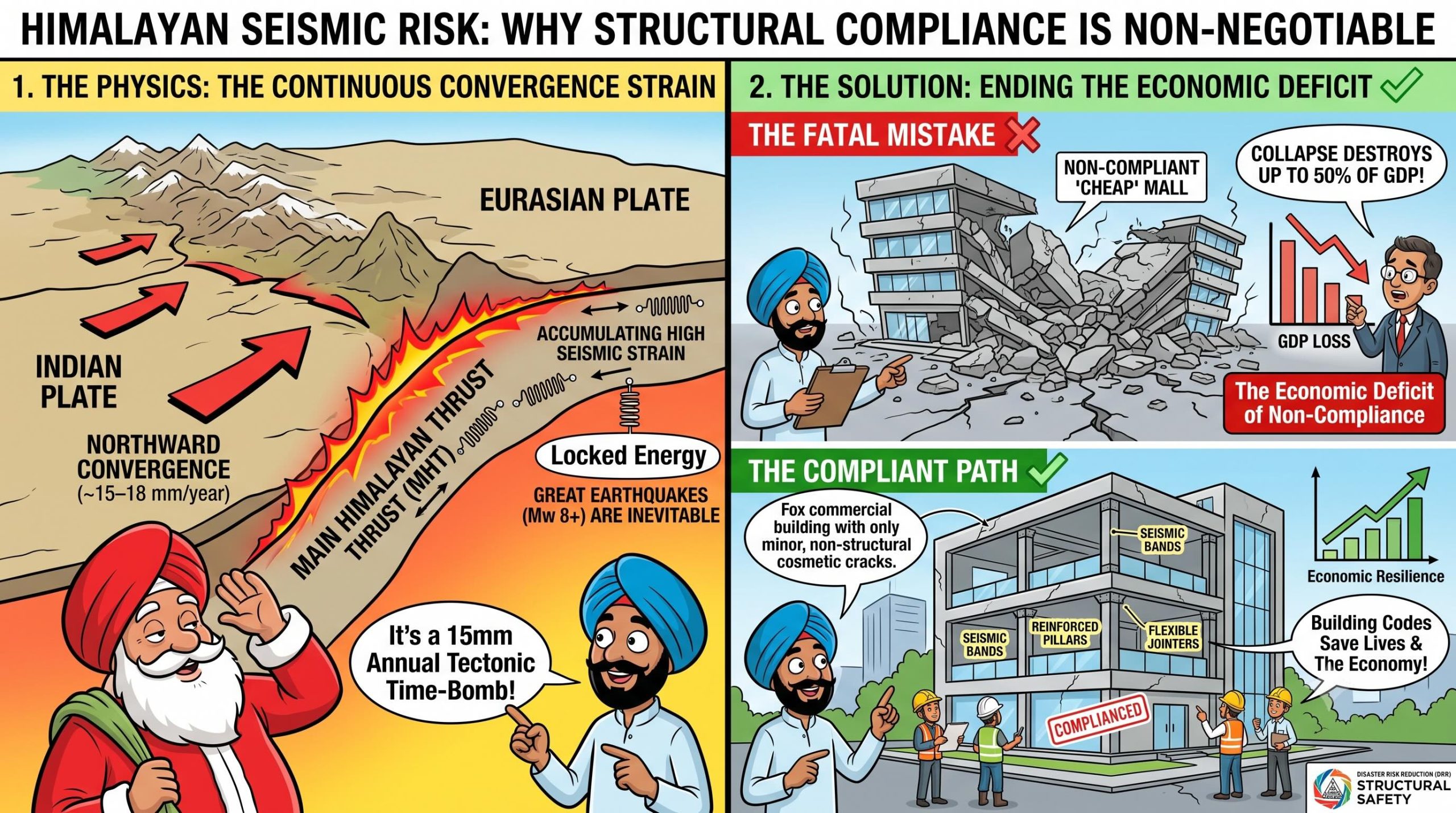
 Santa was standing inside his newly built, six-story luxury commercial shopping complex in a high-density hill town, admiring a massive glass chandelier hanging from the ceiling of the wide atrium.
The building was constructed using slender concrete pillars, without any diagonal steel cross-bracing or ductile structural detailing.
Banta walked into the lobby, carrying a heavy geodetic GPS tracking antenna and a mechanical stress-strain model.
He set the antenna on the floor and pointed a red laser pointer at the joints of Santa’s top-heavy concrete pillars.
“Oye, Santa-ji!”
“Look at this incredible architectural marvel!” Santa beamed, spinning around on the marble floor.
“The pillars are sleek, the glass lets in the mountain view, and I completed the construction in just six months by bypassing those lengthy structural safety clearances!”
“We haven’t had a major earthquake in this specific valley since my grandfather’s childhood.”
“Everything is rock solid!”
“Chalta hai!”
Banta took out a pair of large, heavy wooden blocks and began pressing them together with immense force until they started to warp, creak, and slip violently.
“Santa-ji, your rock-solid building is actually sitting right on top of a ticking geological time-bomb!” Banta shouted as a low, mechanical grinding noise from a nearby construction cement mixer made Santa jump.
“You think the ground under your boots is static, but the Indian tectonic plate is aggressively ramming into the Eurasian plate at a rate of 15 to 18 millimeters every single year!”
“This unstoppable collision builds an immense, silent seismic strain along the Main Himalayan Thrust (MHT).”
“The Himalayas accumulate seismic energy equivalent to a Magnitude 7.3 earthquake annually!”
“Over a century, that locked pressure can support a catastrophic Magnitude 8.6 event—just like the massive 1934 Bihar-Nepal or 1950 Assam great quakes!”
Santa shrugged, looking at his marble columns.
“Oye Banta!”
“15 millimeters is just the width of a small peanut!”
“Why panic over a tiny peanut-sized movement?”
“Because when a peanut-sized movement is backed by an entire continent moving across centuries, it packs a punch that can trigger a nocturnal disaster with over 100,000 fatalities, Santa!” Banta countered.
“In the 2015 Gorkha earthquake in Nepal, a Mw 7.8 rupture wiped out nearly 9,000 lives and caused losses equal to 50% of Nepal’s entire GDP because non-engineered concrete frames pancaked instantly!”
“The ground doesn’t kill people; our non-compliant, fragile building frames do!”
“Large parts of our northern hills sit squarely in high-risk Zone V.”
“If you don’t ruthlessly enforce building codes and replace this casual ‘Chalta hai’ shortcut with heavy ductile detailing, the plate boundary will finish its 15mm punch right through your chandelier before your customers can even find the staircase!”
Santa watched Banta’s wooden model snap violently, the illusion of his unreinforced concrete palace cracking instantly in his mind.
He grabbed a marker from his pocket.
“Oye… so the earth is slowly pulling back its fist every single day while I am putting up cheap walls?”
“Exactly, Santa-ji,” Banta said.
“And when that fist slips, only the structures engineered with ductile compliance will survive the blow.”
संता – बंता की इस जुगलबन्दी से आज हमने क्या सीखा:-
- निरंतर टेक्टोनिक प्लेट अभिसरण / The Continuous Convergence Strain:
- भारतीय टेक्टोनिक प्लेट का यूरेशिया से लगातार टकराना (~15-18 मिमी/वर्ष) ‘मेन हिमालयन थ्रस्ट‘ (MHT) पर भारी तनाव पैदा करता है, जिससे बड़े भूकंप आना तय है। निर्माण कार्यों को इतिहास के शांत काल के भरोसे न छोड़कर अत्यधिक गतिशील ताकतों को झेलने के लिए डिज़ाइन किया जाना चाहिये / The relentless northward convergence of the Indian plate against Eurasia (~15–18 mm/year) accumulates high seismic strain along the Main Himalayan Thrust (MHT), making great earthquakes (Mw 8+) inevitable. Structural engineering must be calculated for inevitable extreme dynamic forces rather than historical calm periods.
- गैर–अनुपालन का आर्थिक और मानवीय नुकसान / The Economic Deficit of Non-Compliance:
- 2015 का गोर्खा (नेपाल) भूकंप यह सिखाता है कि असुरक्षित इमारतों का गिरना कुछ ही मिनटों में एक विकासशील अर्थव्यवस्था का आधा सकल घरेलू उत्पाद (GDP) एक झटके में नष्ट कर सकता है। भूकम्प सुरक्षित निर्माण नियमों (Building Codes) का पालन करना एक आवश्यक सुरक्षा कवच है / The 2015 Gorkha earthquake demonstrates that structural collapses can destroy up to 50% of a developing economy’s GDP in minutes. Enforcing seismic building codes is an essential macroeconomic safeguard, not an administrative choice.
संता – बंता की यह जुगलबन्दी आपको कैसी लगी, कृपया हमें जरुर बताये
व
इस जुगलबन्दी को बेहतर बनाने के लिये अपने सुझाव अवश्य दें।
हमें हमेशा की तरह आपके सुझावों, प्रतिक्रियाओं व कटाक्षो का बेसब्री से इंतजार रहता हैं औरसच मानिये इसी के आधार पर हम अपने आप में, अपनी सोच व रचनात्मकता में सुधार करने को प्रेरित होते हैं।
सो अच्छा – बुरा जैसा आपको महसूस हुवा हो, कमेंट जरुर करते रहें।
#HimalayanSeismicRisk #TectonicConvergence #MainHimalayanThrust#GorkhaLessons #BuildingCodeCompliance #SantaBantaStories
Leave a Reply