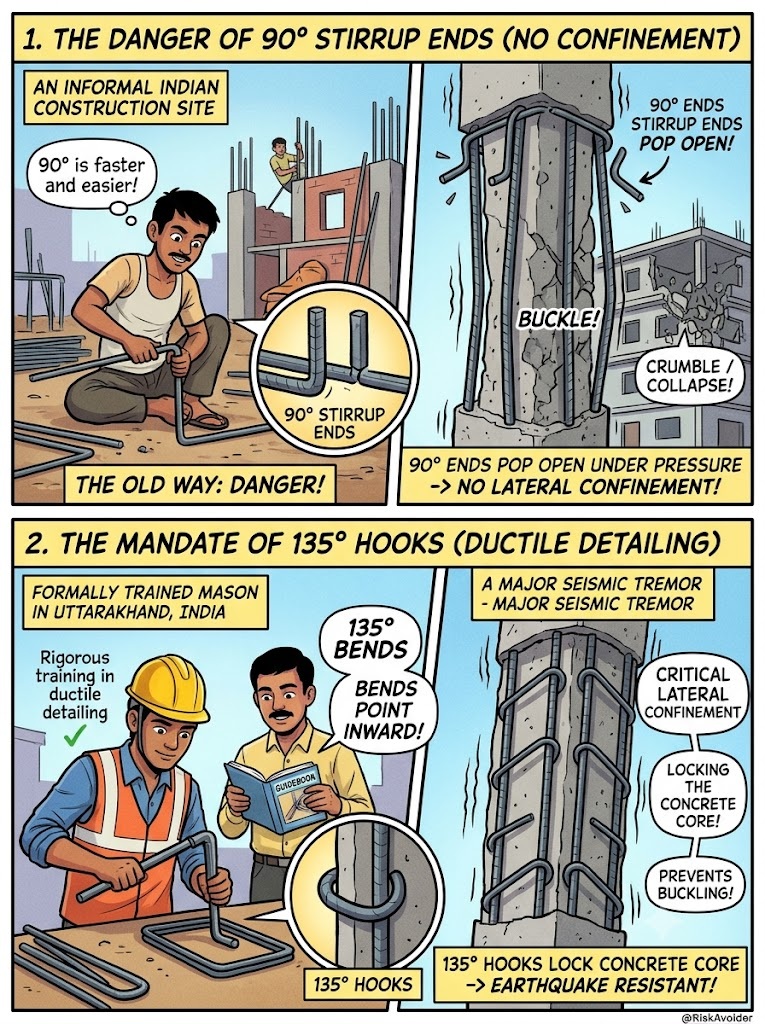
 Santa was standing inside a residential construction site, watching a worker bend heavy steel reinforcement bars (rebars) for a vertical column.
He pointed to a pile of square steel rings—the stirrups—which had their ends bent at a simple, lazy 90-degree angle.
“Oye Banta, look at this clean, geometric symmetry!” Santa smiled, pointing to the neat 90-degree corners.
“My worker wanted to bend these stirrup ends inward at a difficult 135-degree hook, but I told him to keep it simple!”
“90 degrees is much faster to bend, looks incredibly neat, and saves us valuable steel!”
“It’s a double win for the budget!”
Banta walked over, picked up one of Santa’s 90-degree stirrups, and placed it around a bundle of rebars.
He gave the column a sharp, horizontal shake; the 90-degree ends easily popped open under the slight pressure, releasing the main steel bars like an untied shoelace.
“Santa-ji, your geometric symmetry is an invitation to a structural disaster!” Banta said, throwing the opened stirrup to the ground.
“You have just cut the safety belt of this entire building!”
“Oye Banta!”
“It’s steel!”
“How can a small bend in a steel ring make a difference during a shake?” Santa grumbled.
“The bend is what keeps the concrete core locked inside, Santa!” Banta explained.
“When an earthquake strikes, the ground moves in a violent, horizontal tug-of-war.”
“The main vertical steel bars try to buckle outward under the pressure.”
“If your stirrup ends are bent at only 90 degrees, the concrete swells, the stirrup easily pops open, and the column collapses instantly!”
“But if you bend the ends inward at a strict 135-degree hook and overlap them properly, the hooks lock themselves deep inside the concrete core.”
“This is called ductile detailing—it allows the concrete and steel to flex, bend, and absorb seismic energy without sudden, catastrophic failure!”
“Untrained masons often treat steel reinforcement like rigid structural frames, skipping these vital overlapping and hook protocols because they require more effort.”
“You are saving a few centimeters of steel but ensuring your entire family is crushed under the roof!”
Santa stared at the popped-open stirrup, his hands turning cold.
“Oye Banta… so the 135-degree hook is like the knot on a shoelace that stops the whole shoe from falling off?”
“Precisely, Santa-ji,” Banta smiled.
“If you don’t tie the knot correctly, the mountain will trip your structure.”
संता – बंता की इस जुगलबन्दी से आज हमने क्या सीखा:-
- डक्टाइल डिटेलिंग (Ductile Detailing) की अनिवार्यता / The Necessity of Ductile Detailing:
- भूकंप प्रतिरोधी निर्माण के लिए संरचना में लचीलापन होना आवश्यक है। इसके लिए कॉलम के छल्लों (stirrups) के सिरों को 90 डिग्री के बजाय अंदर की ओर 135 डिग्री के हुक (hooks) पर मोड़ा जाना चाहिए, ताकि भूकंप के झटके में कॉलम खुले नहीं / Earthquake resistance requires structures to flex under dynamic loads. Masons must be rigorously trained in ductile detailing, ensuring that column stirrups have strict 135-degree hooks pointing inward to lock the concrete core.
- मुख्य सरियों (Rebars) का सुदृढ़ीकरण / Confinement and Buckling Prevention:
- 90 डिग्री पर मुड़े हुए छल्ले भूकंप के कंपन में आसानी से खुल जाते हैं, जिससे कॉलम के मुख्य सरिये बाहर की ओर मुड़ जाते हैं और इमारत गिर जाती है। 135 डिग्री के हुक कंक्रीट को मजबूती से जकड़ कर रखते हैं / Stirrups with 90-degree ends pop open under lateral seismic pressure, causing the vertical steel rebars to buckle and columns to collapse. 135-degree hooks provide critical lateral confinement.
संता – बंता की यह जुगलबन्दी आपको कैसी लगी, कृपया हमें जरुर बताये
व
इस जुगलबन्दी को बेहतर बनाने के लिये अपने सुझाव अवश्य दें।
हमें हमेशा की तरह आपके सुझावों, प्रतिक्रियाओं व कटाक्षो का बेसब्री से इंतजार रहता हैं औरसच मानिये इसी के आधार पर हम अपने आप में, अपनी सोच व रचनात्मकता में सुधार करने को प्रेरित होते हैं।
सो अच्छा – बुरा जैसा आपको महसूस हुवा हो, कमेंट जरुर करते रहें।
#DuctileDetailing #EarthquakeResistance #StirrupHooks #StructuralEngineering#MasonUpskilling #SantaBanta
Leave a Reply