 Santa was working as the site superintendent on an underground hydroelectric power channel in a deep Himalayan river basin.
He was standing near the muck car railway tracks deep inside the mountain, wiping his dripping forehead with a towel.
The air inside the excavation was thick, humid, and unusually hot—reaching nearly 42 degrees Celsius—and a foul, sulfuric smell like rotten eggs was wafting from a freshly blasted rock face.
Santa pulled a box of wooden safety matches from his pocket and was about to strike one to light a small celebratory beedi on his break.
Banta leaped forward from the survey trolley, snatched the matchbox out of Santa’s hand, crushed it into the mud, and slammed his multi-gas detector onto the rock ledge.
The digital screen was flashing an angry red alert with a piercing audio squeal: CH4 (METHANE) CONCENTRATION: 4.8% — EXPLOSIVE LIMIT APPROACHING! H2S TOXIC HAZARD!
“Santa-ji!”
“Don’t you dare create a single friction spark in this tunnel!” Banta yelled through his breathing mask.
“You are standing inside a natural bomb chamber!“
Santa coughed, waving his hands defensively.
“Oye Banta!”
“What a drama over a tiny matchstick!”
“The rock is wet, water is leaking everywhere from the roof, and we are surrounded by cold stone.”
“How can a wet mountain catch fire?”
“That smell is just harmless mineral water from ancient springs!”
“Chalta hai!”
“The wet mountain will blow you straight out of the portal like a cannonball, Santa!” Banta shouted, dragging him back toward the ventilation intake duct.
“You think you only have to worry about falling rocks, but you are completely blind to subsurface chemical and geothermal traps!“
Santa blinked through the stinging humidity.
“Oye Banta!”
“Rocks don’t breathe gas!”
“Where does fire come from inside a mountain?”
“From ancient buried carbon and deep tectonic heat, you reckless foreman!” Banta warned.
“The Himalayas are filled with compressed organic deposits, buried shales, and deep geothermal fissures!”
“Look at our recent history: in Sikkim, a major tunnelling disaster occurred when drilling teams penetrated an undetected pocket of trapped methane gas, triggering an explosive flash and toxic asphyxiation!”
“In the Tapovan Vishnugad project in Chamoli, tunnel boring machines pierced deep geothermal aquifers, unleashing torrents of boiling, high-pressure water exceeding 45 degrees Celsius that flooded the tunnel, drowned machinery, and drained natural drinking springs across mountain villages above!”
“Globally, during the construction of the Simplon Tunnel in the Swiss-Italian Alps, boiling thermal springs at 55 degrees Celsius burst through the rock, scalding workers and halting excavation for months!”
“When you drill blindly without continuous horizontal probe drilling, multi-gas telemetry sensors, and explosion-proof electrical fittings, you are playing Russian roulette with nature’s hidden chemical furnace!’
“One strike of a match, or a single spark from an ungrounded drill motor, and this entire methane pocket will ignite, turning this tube into an underground flamethrower!”
Santa stared at the screaming gas monitor, the reality of invisible, explosive methane gas clearing his craving for a smoke.
He wiped cold sweat from his neck.
“Oye Banta… so the mountain doesn’t just crush with stone… it poisons with gas and boils with underground water?”
“Precisely, Santa-ji,” Banta said seriously.
“The deep earth has its own chemistry.’
“Wire the tunnel with automated gas sensors, run thermal probes ahead of the drill head, and ventilate the tube, or the mountain will exhale and extinguish us all!”
संता – बंता की इस जुगलबन्दी से आज हमने क्या सीखा:-
- भूमिगत मीथेन व जहरीली गैसों का वैज्ञानिक प्रबंधन / Detection of Subsurface Methane and Hazardous Gases:
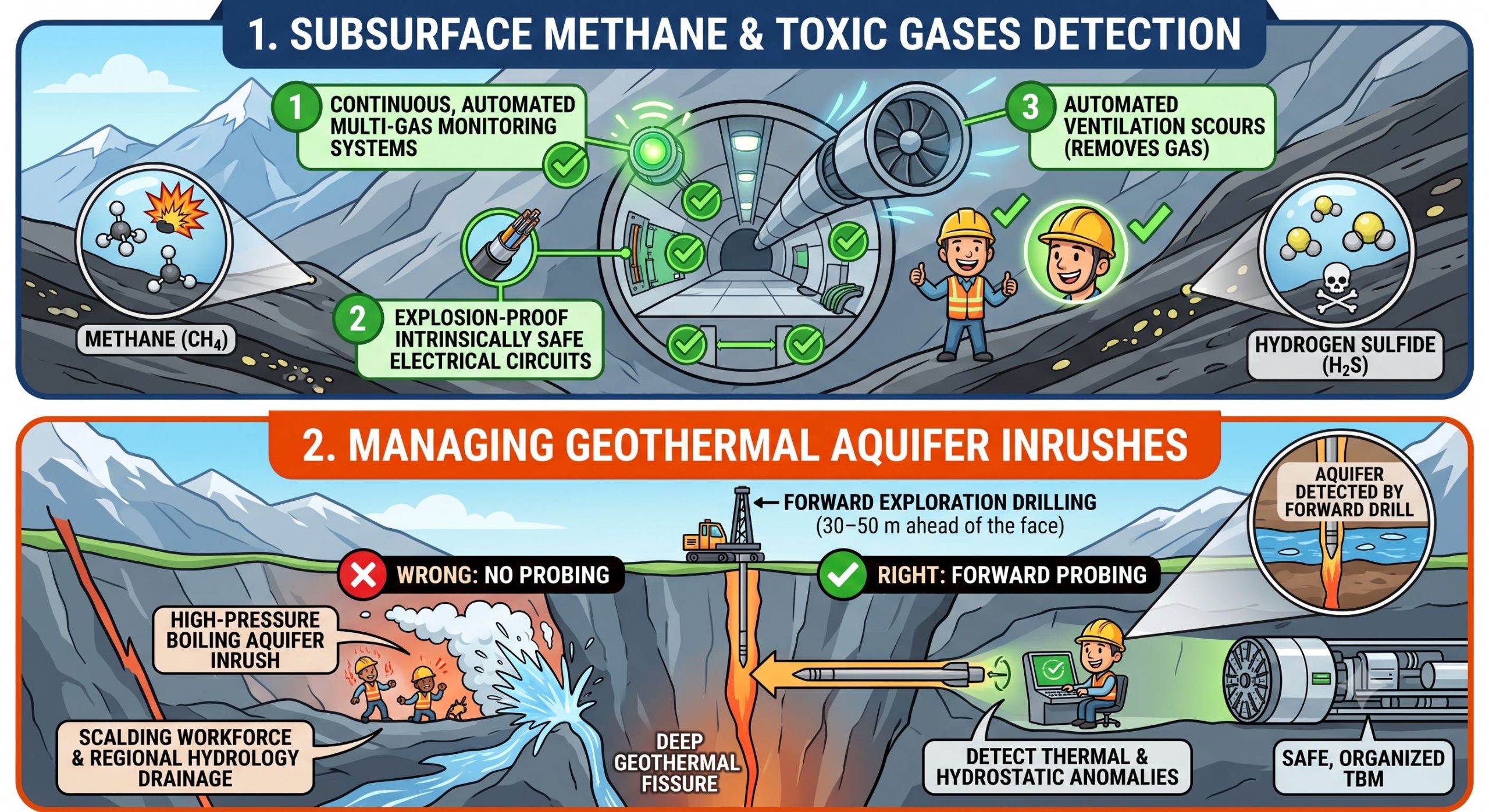
- हिमालय की कार्बन-युक्त चट्टानों और फॉल्ट जोनों में खुदाई करते समय मीथेन जैसी विस्फोटक गैसों और जहरीली गैसों (जैसे CH4, H2S) के अचानक निकलने का भारी खतरा रहता है, जैसा कि सिक्किम की सुरंग दुर्घटना में देखा गया। इसके लिये टनल के अन्दर स्वचालित मल्टी-गैस डिटेक्टर और विस्फोट-रोधी उपकरण अनिवार्य रूप से लगाये जाने चाहिये / Subsurface excavation across organic-rich shales and carbonaceous formations in the Himalayas carries acute risks of explosive methane (CH4) pockets and toxic hydrogen sulfide (H2S). Projects must mandate continuous, automated multi-gas monitoring systems with explosion-proof intrinsically safe electrical circuits and automated ventilation scours.
- अत्यधिक गर्म भूमिगत जल का प्रकोप और शमन / Managing Geothermal Aquifer Inrushes:
- पहाड़ों के भीतर अचानक 40-50 डिग्री सेल्सियस गर्म पानी के भूमिगत जलस्रोतों (geothermal aquifers) के फूटने से टनल में काम कर रहे मजदूरों के झुलसने और डूबने का खतरा रहता है। इस खतरे से बचने के लिये ड्रिलिंग फेस से कम से कम 30-50 मीटर आगे हमेशा ‘अग्रिम अन्वेषण बोरहोल’ (probe drilling) किया जाना चाहिये / Piercing deep fault-controlled geothermal fissures can release high-pressure boiling aquifers (as seen in Tapovan Vishnugad and the Alps‘ Simplon tunnel), scalding workforces and draining regional surface hydrology. Mandatory forward exploration drilling (30–50 meters ahead of the face) is required to detect thermal and hydrostatic anomalies.
संता – बंता की यह जुगलबन्दी आपको कैसी लगी, कृपया हमें जरुर बताये
व
इस जुगलबन्दी को बेहतर बनाने के लिये अपने सुझाव अवश्य दें।
हमें हमेशा की तरह आप के सुझावों, प्रतिक्रियाओं व कटाक्षो का बेसब्री से इंतजार रहता हैं और सच मानिये इसी के आधार पर हम अपने आप में, अपनी सोच व रचनात्मकता में सुधार करने को प्रेरित होते हैं।
सो अच्छा – बुरा जैसा आपको महसूस हुवा हो, कमेंट जरुर करते रहें।
#SubsurfaceHazards #MethaneInTunnels #TapovanLessons #SikkimTunnelAccident#MineSafetyTech #SantaBantaDRR
Leave a Reply