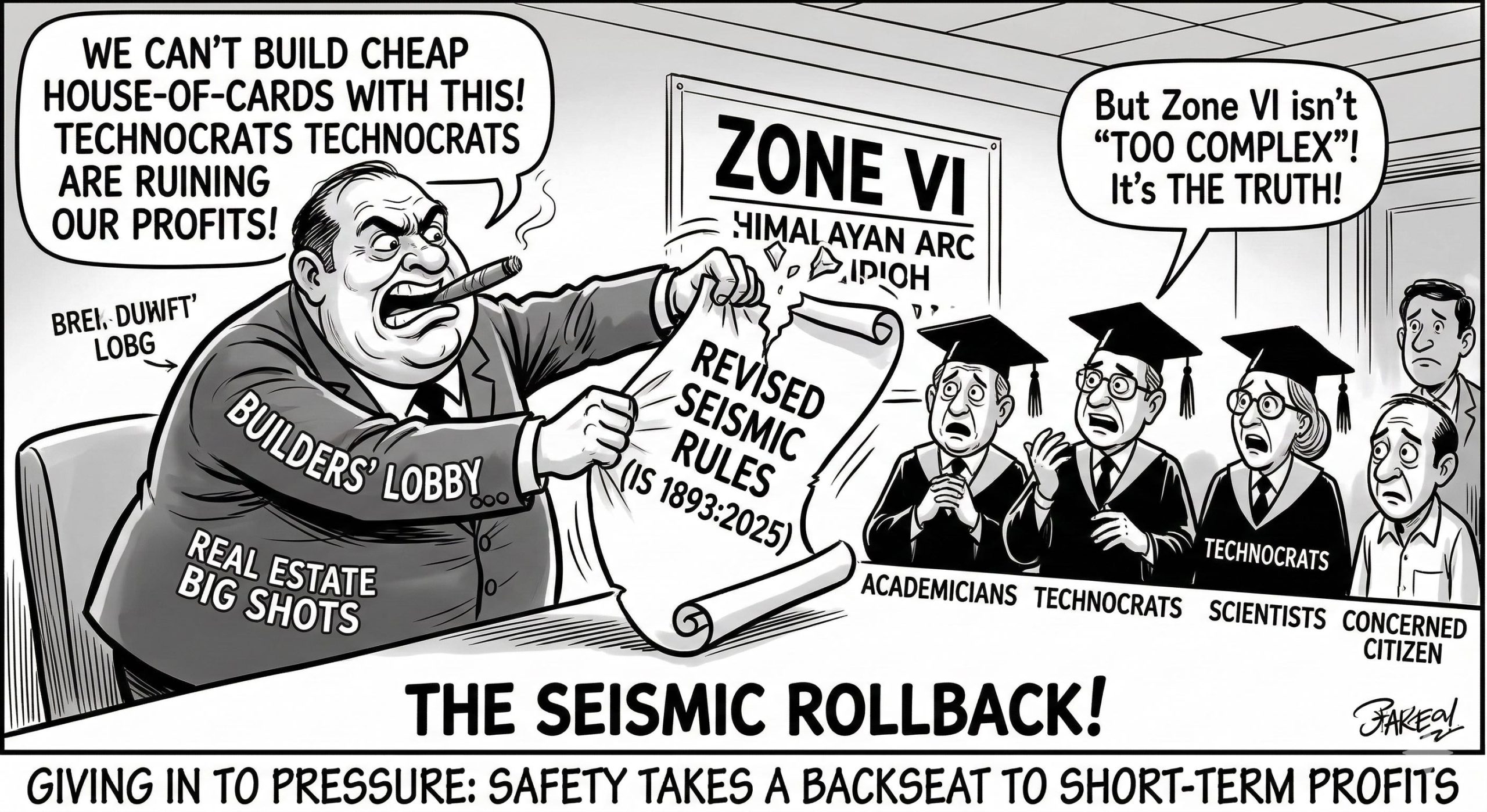
 सच कहें तो लम्बे समय से किसी बड़े भूकम्प का न आना तूफान के पहले का सन्नाटा हैं और यही वह समय हैं जब हमने अपनी तैयारियों को धार दे कर सम्भावित विनाश के परिमाण को कम कर सकते हैं।
भूकम्प सुरक्षा के दृष्टिगत 2025 में IS 1893 में किये गये परिवर्तन इस दिशा में मील का पत्थर साबित हो सकते थे, परन्तु निर्माण कार्यो की लागत में वृद्धि तथा तकनीकी जटिलता जैसी बचकाना दलीलें दे कर इस परिवर्तन को एक सिरे से दरकिनार कर देना जान-बूझ कर करोड़ों जिन्दगियो को जोखिम में डालने के बराबर हैं और आने वाले बड़े भूकम्प के बाद (जिसे देर-सबेर आना ही हैं) इस निर्णय के लिये उत्तरदायी तथा अवसंरचना निर्माण माफिया के समस्त बेशर्मी से नतमस्तक प्राधिकारियों को भविष्य में विधीय कार्यवाही के लिये तैयार रहना चाहिये।
The “New Zone VI”: A Scientific Truth or a Builder’s Nightmare?
For decades, we’ve lived with the comforting, albeit dangerous, fiction that India’s earthquake risk was neatly divided into four zones.
Then came the November 2025 update. It didn’t just add a zone; it added a reality check. By introducing Zone VI—a “Super-Critical” category for the entire Himalayan arc—the Bureau of Indian Standards (BIS) finally admitted what geologists have known for years: the mountains aren’t just “risky,” they are a tectonic powder keg.
With a whopping 61% of our landmass now classified as moderate-to-high risk, the 2025 code was a masterstroke of performance-based engineering. It demanded a 10–30% increase in base shear, tighter structural rules, and rigorous soil checks.
It was the engineering equivalent of upgrading from a seatbelt to a full roll-cage.
The “March 3rd Meltdown“: When Lobbying Outshook the Earth
Then, in a move that would make a magician blush, the government performed a “Grand Disappearing Act.”
On March 3, 2026, the new code was unceremoniously rolled back.
Why? Because the “cost of safety” was deemed too high.
Reports suggest that the Ministry of Housing and Urban Affairs (MoHUA) and influential developer groups raised “technical and financial concerns.” Apparently, a 15–20% spike in construction costs for high-rises and a 30–50% jump for Metro projects was scarier than a Magnitude 8.0 quake.
In the battle between “Profit per Square Foot” and “Probability of Collapse,” the square foot won a landslide victory.
The “Too Complex” Alibi
One of the most humorous—if it weren’t so tragic—reasons for the rollback was that the new code was “too technical.”
This is akin to a surgeon saying, “I’d love to use this new laser for your heart surgery, but the manual has too many big words, so we’re going back to using this rusty butter knife from 2016.”
The claim that practicing engineers would find the code “confusing” is a staggering indictment of our professional training standards.
Instead of investing in nationwide training workshops, we simply deleted the science.
Complacency, it seems, is much easier to “interpret” than Probabilistic Seismic Hazard Assessment (PSHA).
Retrofitting: The “Elephant in the Hallway”
The 2025 code didn’t just look at the new; it cast a stern eye on the old.
Mandating the retrofitting of critical infrastructure like schools and hospitals was the “Great Betrayal” for those holding massive real estate portfolios.
Redesigning an ongoing Metro project isn’t just expensive; it’s an admission that the original design was insufficient.
Rather than face the financial music, the industry decided to change the tune back to the 2016 hits.
The Way Forward: From Petitions to Pillars
We cannot afford to let our seismic safety be decided by “structured consultations” with those who profit from cutting corners. The technical associations and every civil society group must now rally.
- Demand Transparency: Why was a scientific document withdrawn for “financial reasons”?
- Mandate Transition, Not Deletion: If immediate implementation is hard, give us a phased roadmap, not a total rollback.
- Public Audits: Let the masses know which “Pre-Code” buildings are being sold as “Quake Proof” today.
History warns us that the earth doesn’t care about your “stakeholder backlash.” It only cares about physics.
The devastating 2001 Bhuj collapse and the 2015 Nepal tragedy warn us that nature never recognizes ‘financial concerns’ as a valid excuse for structural failure.
These past events tell us that ‘outdated codes’ are essentially death warrants written in ink.
Our ongoing initiatives in ‘Performance-Based Design‘ prove we have the intellect to survive, but history warns us that if we allow ‘short-term profit’ to dictate our seismic standards today, we are effectively financing the mass burials of tomorrow.
Today tells us the fault lines are locked; it warns us that silence is not stability—it’s just the calm before the breach.
#SeismicSafety #IS1893 #TheGreatBetrayal #EarthquakeEngineering #BuildersLobby #HimalayanRisk #ZoneVI #SafeIndia #TectonicTruth
Sir,
Very informative, simple to understand and remember.
Regards