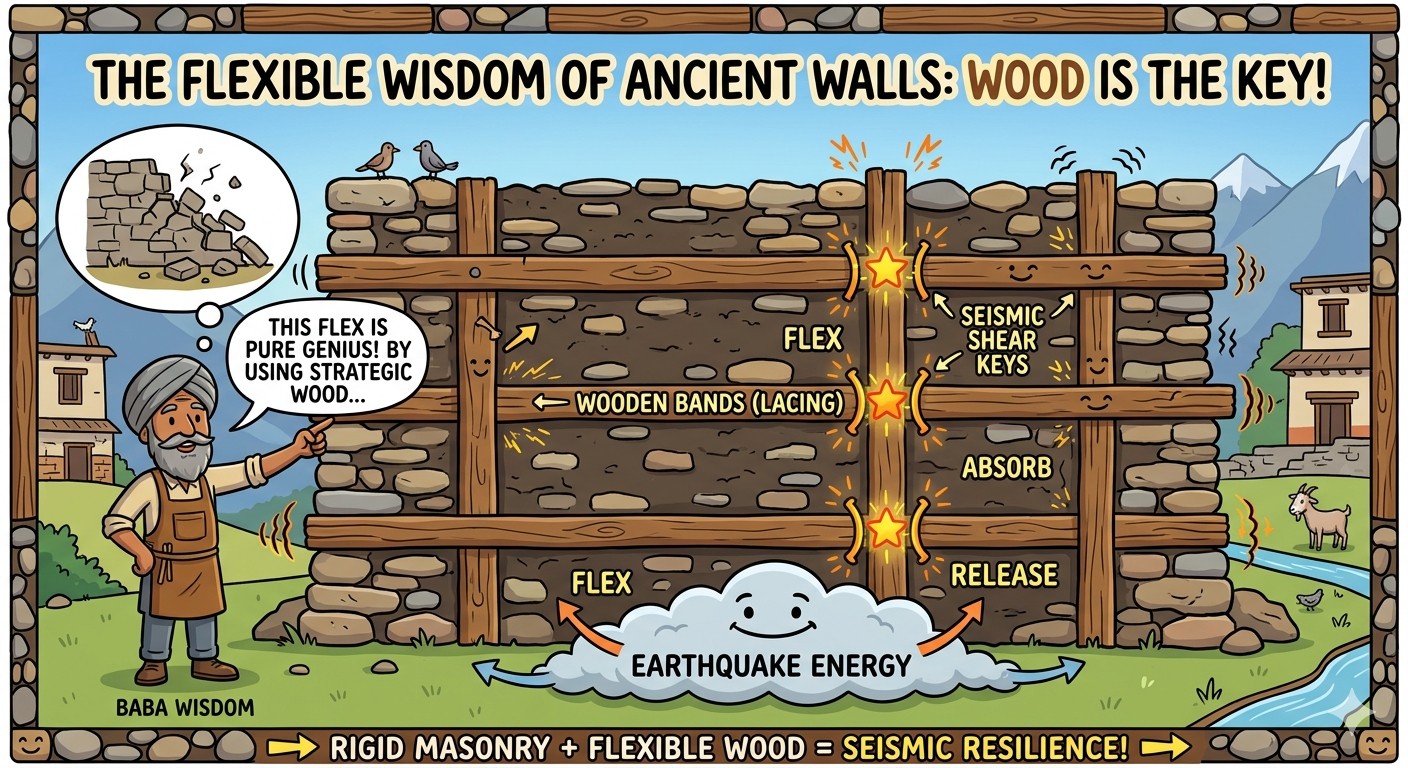
 Santa is looking intently at the outer wall of an old, well-maintained traditional house.
He notices that at certain points, the polished ends of wooden beams are visible, seemingly passing through the stone wall, or perhaps there are distinct wooden elements that seem to ‘pin’ sections of the wall.
“Banta,” Santa asks, “I’ve seen these in many old houses – these wooden pieces that look like they are coming out of the wall, or sometimes like big wooden nails hammered in from the outside.”
“What was their purpose?”
“Were they just for decoration, or to hang things on?”
Banta chuckles.
“Our ancestors were very practical, Santa.”
“While some decorative elements existed, these particular wooden features you’re noticing often had a very serious structural job.”
“Sometimes, these were the exposed ends of the internal timber lacing or cross-beams we just talked about, showing how deeply integrated the wood was.”
“In other cases, especially for strengthening or repairing, wooden beams or ‘keys’ might indeed be inserted from outside, acting like ‘killi’ to further secure the stonework, especially against shearing forces during an earthquake.”
“Wooden keys?” Santa is keen to learn more.
“Imagine an earthquake trying to make one layer of stones slide horizontally over another, or trying to pull a section of the wall outwards,” Banta explains.
“These deeply embedded or inserted wooden elements, acting as ‘seismic shear keys,’ would resist that sliding or pulling motion.”
“They helped to lock the masonry together, ensuring that different parts of the wall moved as one, preventing sections from shearing off.”
He adds, “This entire system – the internal wooden frame, the stone infill, these wooden shear keys – created what you might call a ‘breathable’ structure.”
“Not breathable in terms of air, but in terms of energy.”
“When an earthquake poured its immense energy into the building, this judicious use of wood, which is much lighter than stone yet very strong and flexible, played a crucial role.”
“How so, Banta?”
“Firstly,” Banta details, “by using wood strategically, especially in the upper portions and for the internal framing, the overall weight of the house was reduced compared to an all-stone structure of the same size.”
“Less weight means smaller ‘jhatka‘ are generated when the ground shakes.”
“Less force means less stress on the building.”
“Secondly,” he continues, “the inherent flexibility of the wood, and the way these numerous connections and joints were designed, allowed the entire house to absorb and dissipate a lot of that seismic energy.”
“The wood could flex, the joints could give a tiny bit, the dry-stacked stones could shift minutely and resettle, all without leading to a sudden, brittle collapse.”
“The house could ‘dance‘ with the tremor, release the stress, and often remain standing. It was designed to yield gracefully, not resist rigidly until it broke.”
Santa looks at the old house, no longer seeing just wood and stone, but a complex, dynamic system.
“So, the wood made it lighter on its feet, and the way everything was connected with those wooden keys and frames allowed it to shake off the earthquake‘s anger without falling apart.”
“It’s like they were building a house that knew martial arts – strong, yet flexible and able to absorb blows!”
Banta smiles broadly.
“That’s a wonderful way to describe it, Santa!”
“A house designed with the wisdom of a martial artist, using the strengths of local materials in perfect harmony to achieve both resilience and endurance.”
“That was the genius of our ancestral builders.”
#piyoosh #piyooshrautela #riskavoider #riskavoideracademy
संता – बंता की इस जुगलबन्दी से आज हमने क्या सीखा:-
- हिमालयी क्षेत्र के परम्परागत भवनों की दीवारों में दिखायी देने वाले लकड़ी के अवयव भूकम्पीय बलों का सफलतापूर्वक व सुरक्षित निस्तारण सुनिश्चित करने के साथ ही दीवारों को स्थायित्व प्रदान करते थे / Visible wooden elements in traditional walls, including ends of internal lacing or specially inserted beams, often acted as seismic shear keys, enhancing resistance to shearing forces and improving overall wall stability.
- लकड़ी हलकी होने पर भी लचीली व मजबूत होती है और भवनों में इसके सामरिक उपयोग से भूकम्प की स्थिति में उत्पन्न होने वाले बलों में कमी आती है / The strategic use of wood, a relatively lightweight yet strong and flexible material, helped reduce the inertial forces generated during earthquakes.
- लकड़ी के ढांचे के लचीलेपन के साथ ही परम्परागत भवनों में प्रयुक्त लकड़ी व पत्थरो की सम्मिलित व्यवस्था भूकम्प की स्थिति में ऊर्जा को सोखने व निस्तारण में सहायक होती थी और इसके कारण यह भवन भूकम्प की झटको को झेल पते थे और भरभरा कर ध्वस्त नहीं होते थे / The flexibility of the wood-frame and composite wood-stone system allowed for significant energy absorption and dissipation, enabling the structure to withstand seismic shocks without catastrophic failure.
- इस व्यवस्था से पता चलता है की लोगो को भवन निर्माण सामग्री की गुणों व संरचनात्मक गति – विज्ञान की अच्छी – खासी समझ थी और इसी की आधार पर उन्होंने भूकम्प सुरक्षित संरचनाये बनाने की विधा विकसित की / This approach reflects a sophisticated understanding of material properties and structural dynamics for creating earthquake-resistant buildings.
संता – बंता की यह जुगलबन्दी आपको कैसी लगी, कृपया हमें जरुर बताये
व
इस जुगलबन्दी को बेहतर बनाने के लिये अपने सुझाव अवश्य दें।
हमें हमेशा की तरह आपके सुझावों, प्रतिक्रियाओं व कटाक्षो का बेसब्री से इंतजार रहता हैं और सच मानिये इसी के आधार पर हम अपने आप में, अपनी सोच व रचनात्मकता में सुधार करने को प्रेरित होते हैं।
सो अच्छा – बुरा जैसा आपको महसूस हुवा हो, कमेंट जरुर करते रहें।
Leave a Reply