 “Banta,” Santa says with a deep sigh, holding up the faded green form, “remember these?”
“This was our village’s Annapurna.”
“My father was in the army.”
“Every month, this piece of paper would arrive, and it was like a magic spell that filled our home with rations, new clothes for festivals, and paid the school fees.”
“The whole village economy ran on these little green forms.”
Banta nods, a nostalgic sadness in his eyes.
“You are right, Santa.”
“That was the money-order economy.”
“It was a strong lifeline.”
“Our men were brave soldiers and hard workers outside, but their roots, their hearts, and their earnings all had one permanent address: this village.”
“The money they sent back didn’t just support their own family; it circulated in the village – from the shopkeeper to the carpenter to the farmer.”
“Exactly!” Santa says, getting agitated.
“But now?”
“My own son works in a big company in Noida.”
“He earns much more than my father ever did.”
“But does he send a money-order?”
“No!”
“He says, Papa, what’s the point?”
“I have to pay rent there, school fees there, everything is so expensive there.”
“The lifeline is broken!”
“Ah, Santa,” Banta says gently, “the problem isn’t that your son has become stingy.”
“The problem is that his Ghar is now there, not here.”
“You see, in our time, the men went out to work, but the family – the wife, the children, the elders – they were the anchors holding the fort here.”
“The address for the money to return to was solid.”
“But now, on the pretext of better schools and hospitals, the entire family moves.”
“The anchor itself is lifted.”
He continues, “So the money that is earned from our mountains’ children now circulates in the markets of Delhi and Dehradun.”
“Our village has been left with only the ‘ghost‘ of the money-order – a faint memory of a prosperity that used to arrive by post.”
“And without that economic lifeline, our fields seem less lucrative, our local shops struggle, and more people feel the need to leave.”
“It’s a painful cycle.”
Santa looks at the empty money-order form in his hand.
“So, the real problem is not just that the men are leaving, but that the address of the family itself has moved?”
“We are not just losing our youth; we are losing our very economic foundation.”
“The money no longer knows its way home.”
संता – बंता की इस जुगलबन्दी से आज हमने क्या सीखा:-
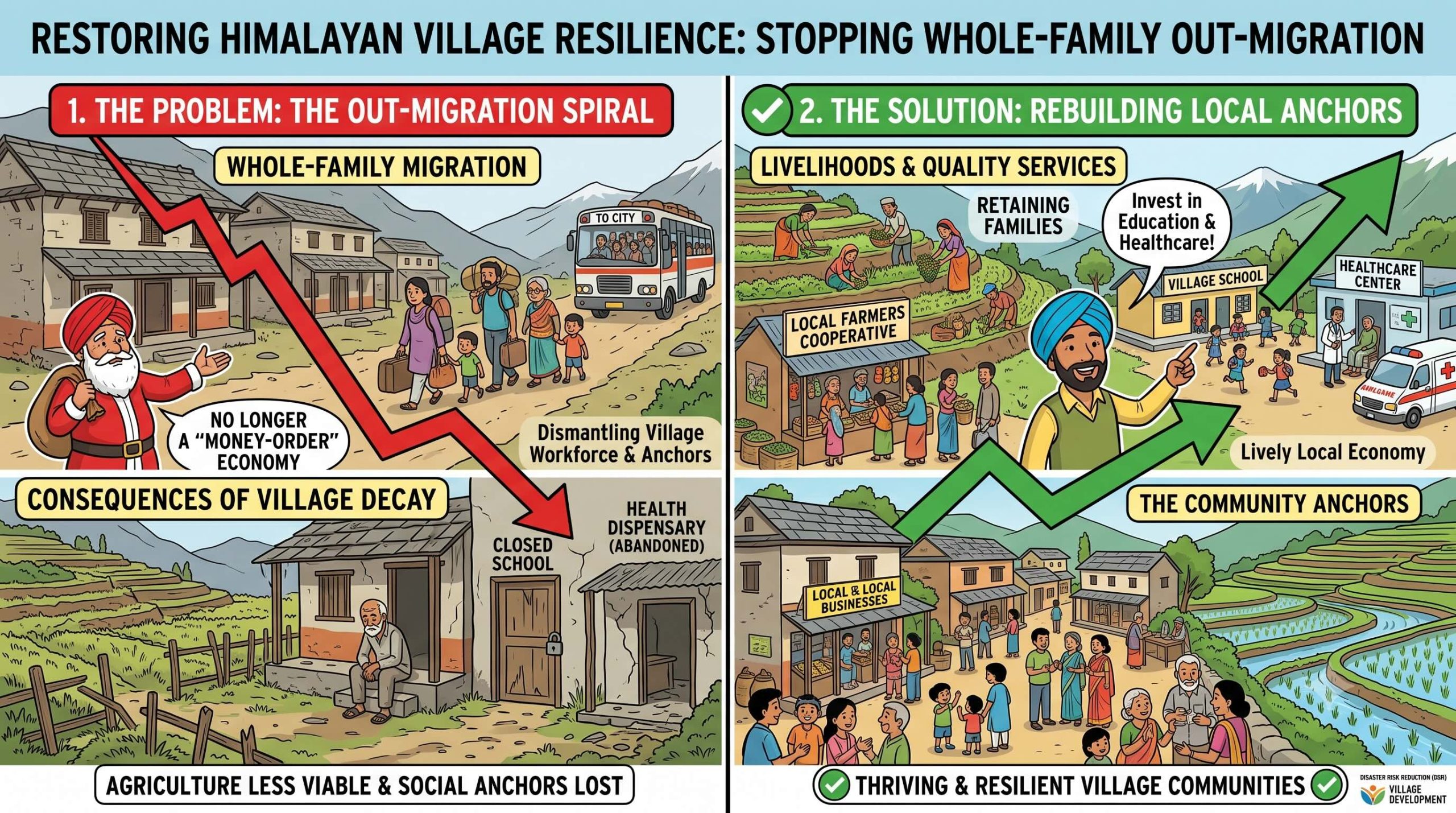
- पूर्व में क्षेत्र से केवल पुरुष ही आजीविका के लिये बाहर जाते थे, परन्तु वर्तमान में पूरा का पूरा परिवार ही साथ जाने लगा है जिसने परम्परागत मनीऑर्डर आधारित अर्थव्यवस्था को पटरी से उतार दिया है और इससे पहाड़ के गांवो की आर्थिक सुरक्षा पर प्रतिकूल प्रभाव पड़ा हैं / The shift from individual male migration to whole-family migration has dismantled the traditional “money-order economy,” severely weakening the financial resilience of villages.
- इसने पहाड़ो में खेती-बाड़ी को अव्यवहारिक बना दिया हैं और इससे पहाड़ो से होने वाले पलायन को गति मिली हैं / This economic decay makes agriculture less viable and creates a vicious cycle, fuelling further out-migration.
- केवल स्थानीय स्तर पर जीवनयापन के अवसर काफी नहीं हैं; परिवारों को पहाड़ो में बनाये रखने के लिये गुणवत्तापरक शिक्षा व स्वास्थ्य सुविधाओं पर निवेश को प्राथमिकता दिया जाना आवश्यक हैं / Creating local livelihood opportunities is not enough; there must be a parallel investment in quality local education and healthcare to retain families, the very anchors of the rural economy.
संता – बंता की यह जुगलबन्दी आपको कैसी लगी, कृपया हमें जरुर बताये
व
इस जुगलबन्दी को बेहतर बनाने के लिये अपने सुझाव अवश्य दें।
हमें हमेशा की तरह आपके सुझावों, प्रतिक्रियाओं व कटाक्षो का बेसब्री से इंतजार रहता हैं औरसच मानिये इसी के आधार पर हम अपने आप में, अपनी सोच व रचनात्मकता में सुधार करने कोप्रेरित होते हैं।
सो अच्छा – बुरा जैसा आपको महसूस हुवा हो, कमेंट जरुर करते रहें।
Leave a Reply