 Edition: 15 Jan 2026 | 2100 hrs IST
I. The Mountain Pulse: Pan-Himalayan Analysis 🏔️
The Himalayan arc is currently experiencing a phenomenon known as “Thermal Desiccation.” After the recent moisture incursion, a sharp drop in humidity combined with intense high-altitude solar radiation is rapidly drying out the top layers of exposed rock and soil, leading to a state of “Surface Brittleness.”
-
The Movement: Across the Central and Western Himalayas, localised acoustic sensors have picked up an increase in “Rock-Popping.” This is the sound of thermal expansion and contraction as the temperature swings 20+ degrees between day and night. This movement is particularly active in the Chenab and Alaknanda basins, where steep gneissic slopes are shedding small debris, a precursor to larger “Spontaneous Rockfalls.”
-
The Status: In the Trans-Himalayan regions (Lahaul, Spiti, and Ladakh), the “Ice-Bonding” of the scree slopes is reaching its peak strength. However, the “Inner-Thaw” on south-facing slopes is creating a risk of “Glide-Avalanches.” For the entire range, this is a “Brittle-Alert” status—the mountains are physically stable but surface-sensitive.
II. Global Echoes 🌏
The planetary gears are shifting, providing critical lessons for the Himalayan context.
-
The Andes (Peru): A significant “Landslide Lake Outburst Flood” (LLOF) occurred today in a remote valley. It serves as a stark reminder that even in “dry” seasons, the breach of a landslide barrier can be catastrophic. The event was triggered by the same “Thermal Wedging” we are seeing in the Himalayas.
-
Iceland (Reykjanes Peninsula): New fissure vents have opened, demonstrating the speed of “Crustal Rifting.”While the Himalayas are a “collisional” zone rather than a “rifting” one, the Icelandic event highlights the necessity of real-time gas and thermal monitoring in seismically active zones.
-
East Africa (The Great Rift): Unseasonal flash floods have scoured the “Arid-Zone” infrastructure. It reinforces our earlier discussion on “Arterial Integrity”—when the one road in a desert or mountain is gone, the disaster is multiplied by isolation.
III. The Laboratory: Cryospheric Physics 🔬
The Topic: “The Albedo Effect and Slope Stability.”
-
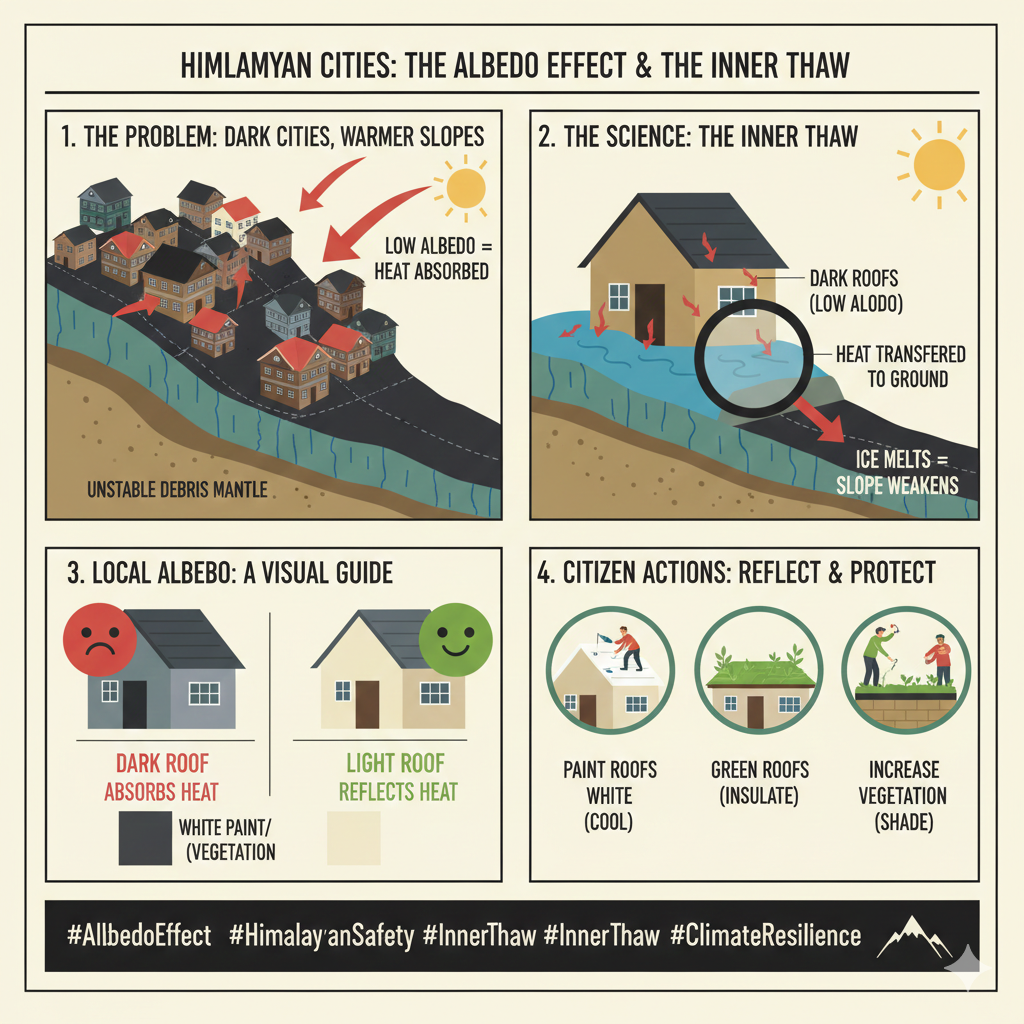
The Science: New research from the Snow and Avalanche Study Establishment (SASE) suggests that “Soot-Loading” on Himalayan glaciers is reducing their Albedo (reflectivity). This causes the ice to absorb more heat, leading to internal melting even when the air temperature is below freezing.
-
The Citizen’s Impact: In a mountain city, your “Local Albedo” matters. Dark-colored roofs and paved courtyards absorb more heat than light-colored or vegetated ones. This heat transfers into the ground, potentially accelerating the “Inner-Thaw” of the slope your house sits on. If you’re painting your roof, choose a light, reflective shade.
IV. The Time Machine ⏳
Historical Evidence: 15 January
-
1934 – The Great Bihar-Nepal Earthquake: This is the primary anniversary of the Magnitude 8.0+ event that reshaped the Himalayan foothills.
-
The Lesson: It highlighted the danger of “Secondary Geohazards.” More people were impacted by the subsequent floods and ground liquefaction than the initial tremors. It remains the ultimate warning that in the Himalayas, the quake is just the beginning.
-
-
2022 – The Hunga Tonga-Hunga Ha’apai Eruption: A massive volcanic event that sent shockwaves around the world.
-
The Lesson: It proved the reality of “Global Interconnectivity.” A disaster in the South Pacific changed atmospheric pressure in the Himalayas within hours. We are never isolated from the planet’s pulse.
-
V. The Daily Ordinance: The “Rock-Sounding” Check 📜
Your 60-second safety hack for mountain living.
-
If you are walking near a steep rock face or a high retaining wall today, listen.
-
The “Ping”: A high-pitched “pinging” sound indicates thermal stress in the rock—stay clear.
-
The “Dust-Fall”: If you see a constant trickle of fine dust or sand coming from a crack in a wall, it means the structure is “settling” or moving. Document it. If the dust-fall is fresh, the movement is active.
#ThermalTension #HimalayanSentinel
The devastation of 1934 and the global shockwaves of the 2022 Tonga eruption warn us that the Himalayas are not an island; they are a resonant chamber for the world’s geological energy. Our ongoing initiatives in ‘Albedo-Monitoring’ prove we can see the invisible thaw, but history tells us that ‘Secondary Geohazards’—the floods and slides that follow the quake—are the true silent killers. Today tells us the peaks are brittle and the ice is absorbing heat; it warns us that if we do not move from reactive relief to ‘Albedo-conscious’ urban planning and ‘Secondary-Hazard’ mapping, we aren’t just building in the mountains—we are building in a hall of mirrors where every tremor is magnified.
Leave a Reply