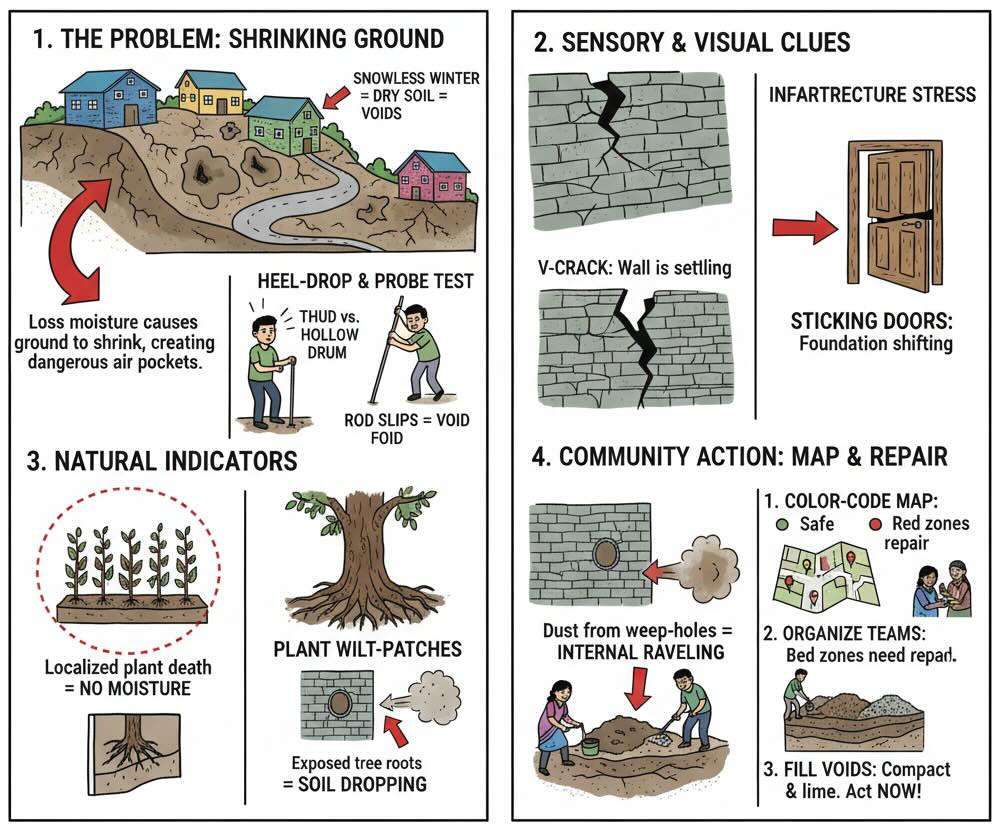
 Strategic Brief: Top-Dressing & Void-Filling for “Red Zones”
In the “Hollow Earth” phase of this snowless winter, mapping the voids is only half the battle.
The next step is “Intervention.
If we leave these “Red Zone” voids open, the first spring rains will transform them into conduits for internal erosion, leading to sudden sinkholes or “piping” landslides.
This guide provides low-cost, community-led techniques to stabilise the ground.
The “Top-Dressing & Void-Filling” Guide
1. The Materials: The “Stabilisation Trio”
You don’t need high-grade concrete. For natural slopes and residential backyards, a flexible, breathable mix is better.
-
Clay–Soil Mix: Acts as the “Sealant.” Clay expands when wet, creating a waterproof plug.
-
Stone Dust / Fine Grit: Acts as the “Bulk.” It provides internal friction to prevent the soil from shifting.
-
Hydrated Lime (Chuna): Acts as the “Binder.” Lime chemically reacts with clay to create a stable, stone-like structure over time (pozzolanic reaction).
2. Method A: The “Rod-and-Slurry” (For Deep Voids)
Use this for “Red Zones” where your rod-probe “slipped” deep into the ground.
-
Enlarge the Entry: Use the rod to slightly widen the hole to create a funnel.
-
Gravity Feed: Pour a dry mix of Stone Dust and Lime (Ratio 4:1) into the hole.
-
Tamp it Down: Use a thinner rod to gently pack the dry mix into the cavity.
-
Seal the Top: Finish with a 6-inch “plug” of compacted clay soil. This prevents surface water from entering the fill.
3. Method B: The “Check-Dressing” (For Surface Fissures)
Use this for long desiccation cracks or “V-cracks” at the base of retaining walls.
-
Clear the Fissure: Remove loose debris and dry pine needles (which act as “wicking agents” for fire and water).
-
The Layered Fill: * Layer 1: Pack the bottom with coarse gravel.
-
Layer 2: Fill the middle with the Stone Dust/Lime mix.
-
Layer 3: Top-dress with a “Soil-Cement” (Soil + 10% Lime) and compact it with a hand-tamper.
-
-
Vegetative Anchor: Plant local grasses or deep-rooted shrubs like Agave or Vetiver on top. Their roots will “stitch” the repair to the surrounding soil.
4. The “Weep-Hole” Maintenance
If you have a retaining wall, do not “plug” the holes. Instead:
-
Filter Back-fill: If soil is crumbling out, push a small amount of Geotextile fabric or coarse coconut husk into the hole.
-
The Goal: This allows water to escape (preventing pressure buildup) but keeps the “fines” (the mountain’s bones) from washing out.
DRR Lesson: “Flexibility Over Rigidity”
हमें समझने की जरूरत है जी हिमालय के ढाल धीरे-धीरे ही सही पर खिसक रहे है, और यह स्थिर नहीं है। ऐसे में लचीलेपन के आभाव में ढाल को स्थिर करने के लिये बिछाये गये कॉन्क्रीट की सतहों में प्रायः दरारे आ जाती है। अतः हमें ढाल पर होने वाली हलचलों को बर्दाश्त कर सकने वाले लचीले विकल्पों पर ध्यान देने की जरूरत है / The history of Himalayan slope failure tells us that pouring rigid concrete into a moving slope often fails because the concrete cracks under the mountain’s weight. Using a Lime–Stone Dust–Soil mix creates a “Living Patch” that can flex and settle with the mountain while maintaining its structural integrity.
The devastating landslides of the 2023 monsoon and the historic void-collapses in limestone terrains warn us that an empty space underground is a promise of a collapse above. These past events tell us that water will always find the path of least resistance; if we don’t fill that path with ‘Stone-Dust and Lime,’ the mountain will fill it with your foundation. Our ongoing initiatives in community ‘Top-Dressing’ prove that small, localized interventions are the most effective way to manage ‘The Vertical Frontier,’ but history warns us that if we do not plug these ‘Red Zones’ while they are dry, we are merely building a drain for our own destruction. Today tells us the cracks are open; it warns us that a mountain patched in time saves a city in the rain.
Leave a Reply