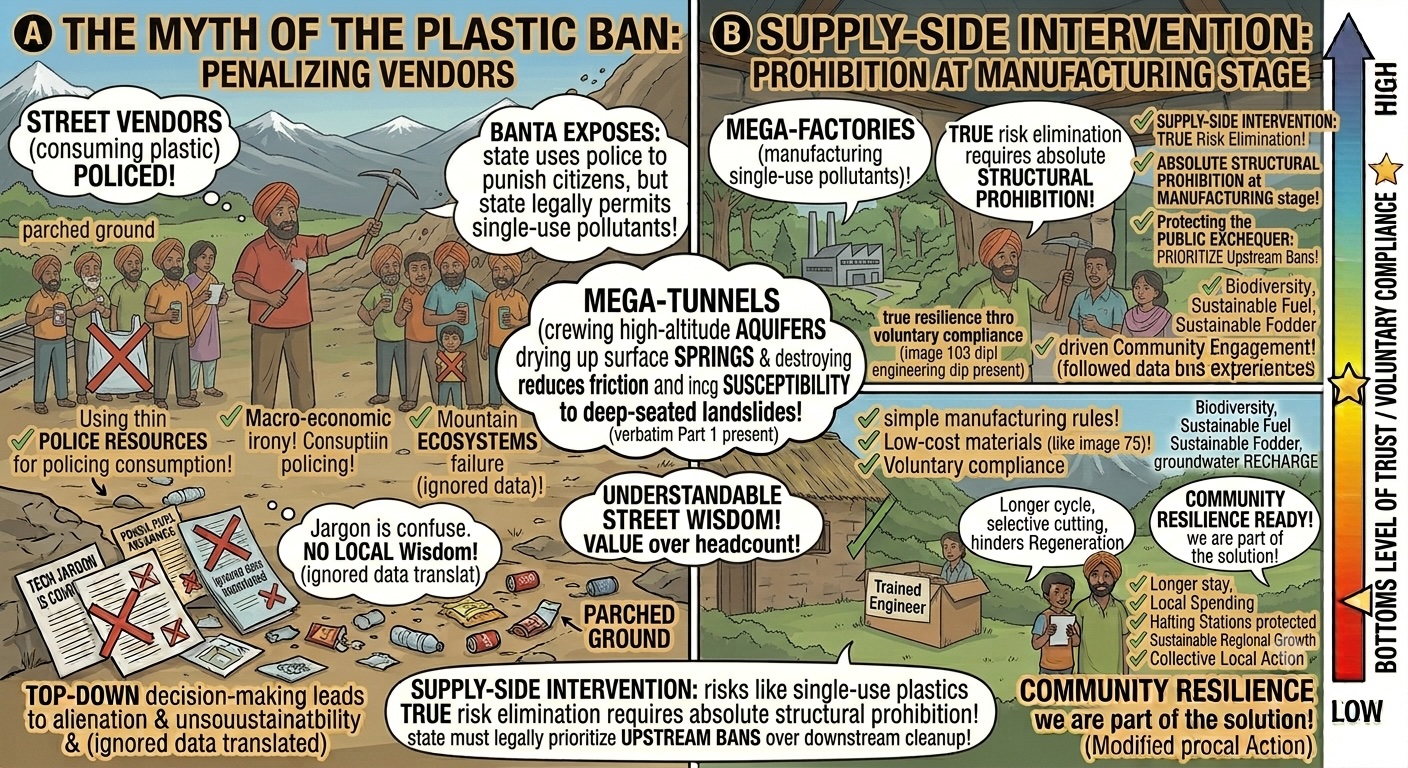
 Santa was standing at the edge of a village pond, wearing a volunteer cap and holding a large wooden stick.
He was leading a local community “Clean-Up Crusade,” scolding a street vendor who was wrapping a samosa in a thin, single-use plastic bag.
“Oye! Stop this eco-crime!” Santa shouted, pointing his stick.
“Single-use plastic is banned by international conventions!”
“It chokes our drains, creates global greenhouse gases, and causes flash floods in the monsoons!”
“The municipality will fine you 500 rupees for using that bag!”
Banta walked up, holding a brand-new, sealed crate of plastic cups directly from a local wholesale supply truck that had just unhitched nearby.
“Santa-ji, your stick is pointed at the wrong man.”
“You are penalizing the person buying the water drop, while ignoring the factory that owns the entire river.”
“What do you mean, Banta?”
“The law says ‘use’ is prohibited!”
“I am enforcing the ban on the street!” Santa said proudly.
“That’s the chicken-and-egg story of environmental governance, Santa,” Banta said, handing him a plastic cup from the factory-sealed crate.
“The state uses its administrative machinery, police clout, and resources to raid small vendors and raise mass awareness against using plastic.”
“But look at this crate!”
“The production facilities are operating with legal electricity, commercial permits, and tax approvals.”
“If the state recognizes single-use plastic as a severe global pollutant, why is it legal to manufacture it by the ton, but illegal for this poor vendor to hold it in his hand?”
Santa dropped his stick, looking at the supply truck.
“Oye… so the factory is allowed to make millions of bags, but the vendor is fined for owning one?”
“Exactly,” Banta said.
“Basic supply and demand laws dictate that if you choke the supply at the factory gate, the demand on the street vanishes automatically.”
“A welfare state is morally bound to protect the public exchequer by shutting down the machinery that creates the pollutant, rather than spending public resources to chase individual plastic bags blowing in the wind.”
संता – बंता की इस जुगलबन्दी से आज हमने क्या सीखा:-
- आपूर्ति-पक्ष पर नियंत्रण / Supply-Side Intervention:
- सिंगल-यूज़ प्लास्टिक जैसे पर्यावरणीय जोखिमों को केवल उपभोग पर रोक लगाकर कम नहीं किया जा सकता। वास्तविक जोखिम उन्मूलन के लिए विनिर्माण (production) के स्तर पर पूर्ण संरचनात्मक प्रतिबंध आवश्यक है / Environmental risks like single-use plastics cannot be effectively mitigated by policing consumption alone. True risk elimination requires absolute structural prohibition at the manufacturing stage.
- सार्वजनिक खजाने की सुरक्षा / Protecting the Public Exchequer:
- : प्लास्टिक कचरे के उत्पादन की अनुमति देकर उसे साफ करने और जुर्माना लगाने में सरकारी संसाधनों को खर्च करना वित्तीय नुकसान का चक्र है। कल्याणकारी राज्य को उत्पादन पर रोक लगाने को प्राथमिकता देनी चाहिए / Spending state resources to clean up and penalize plastic waste while permitting its production creates a fiscal deficit cycle. Welfare states must prioritize upstream bans over downstream cleanup operations.
संता – बंता की यह जुगलबन्दी आपको कैसी लगी, कृपया हमें जरुर बताये
व
इस जुगलबन्दी को बेहतर बनाने के लिये अपने सुझाव अवश्य दें।
हमें हमेशा की तरह आपके सुझावों, प्रतिक्रियाओं व कटाक्षो का बेसब्री से इंतजार रहता हैं औरसच मानिये इसी के आधार पर हम अपने आप में, अपनी सोच व रचनात्मकता में सुधार करने कोप्रेरित होते हैं।
सो अच्छा – बुरा जैसा आपको महसूस हुवा हो, कमेंट जरुर करते रहें।
#PlasticBan #UpstreamSolutions #EnvironmentalPolicy #SupplyAndDemand #EcoResilience #SantaBanta
Leave a Reply